Get Full Government Meeting Transcripts, Videos, & Alerts Forever!
Get email alerts on the Computer Science Education topic
No spam. Unsubscribe anytime.
Board and educators debate how to fold computer science into graduation framework
Summary
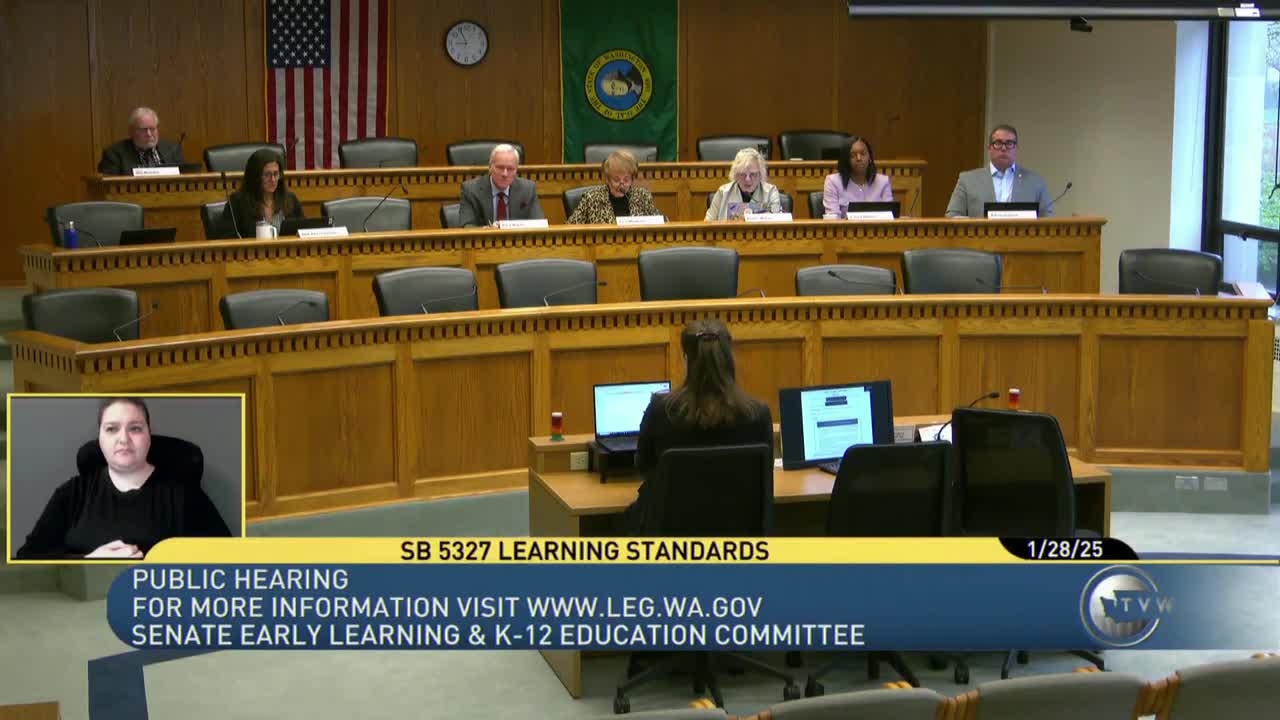
Senate Bill 5327, directing an update of computer science learning standards and asking the State Board of Education to recommend how students might demonstrate competency within the graduation framework, was presented for committee review.
Senate Bill 5327, directing an update of computer science learning standards and asking the State Board of Education to recommend how students might demonstrate competency within the graduation framework, was presented for committee review.
Committee staff Elena Becker summarized the bill: “This bill directs the State Board of Education to develop recommendations to ensure that students have adequate opportunity to demonstrate competency of the computer science learning standards and consider how to incorporate the competencies into the framework of graduation requirements.” OSPI’s current computer science standards list five core concepts: computing systems, networks and the internet, data and analysis, algorithms and programming, and impacts of computing.
Why it matters: Committee members and the State Board said digital fluency is increasingly essential across industries and that clarifying which CS skills are foundational for all students — versus elective or pathway skills — would guide districts and teacher-preparation efforts.
State Board of Education leaders said the bill fits the board’s broader Future Ready initiative, which seeks comprehensive updates to graduation requirements with attention to equity and implementation. Jaylee Schultz, deputy executive director at the State Board, told the panel the board plans a multiyear, stakeholder-driven process to produce recommendations and implementation timelines.
Support and concerns: Computer science teachers and the Computer Science Teachers Association (CSTA) urged steps to reduce barriers to teaching CS — for example, expanding the pool of qualified teachers and ensuring training and endorsements are accessible. Chad Magendance, a computer science teacher, said earlier policy changes allowed computer science to substitute for a third year of math or science, but completing the final policy step — making CS an explicit graduation expectation or ensuring adequate opportunities to demonstrate competency — remains unfinished.
Opponents warned of additional requirements and student stress. Steven Bach, who identified himself as having a computer science degree, said “CS isn't digital literacy” and argued that requiring programming could overburden students and that digital fluency can come from exposure and experience rather than mandated coding instruction. Other witnesses cautioned the committee to differentiate between foundational digital fluency and full computer science programming requirements.
Implementation and next steps: The bill tasks OSPI with reviewing and updating CS standards and the State Board with data collection from districts on current CS offerings and assessment approaches. CSTA Washington offered assistance with data interpretation and standard revisions. The committee heard requests to pair any requirement with funded implementation supports to expand teacher capacity and district offerings. The bill will advance through the customary committee process and the State Board’s recommendations are expected to inform any statutory changes.
The committee closed the public testimony and moved to other agenda items.