Get Full Government Meeting Transcripts, Videos, & Alerts Forever!
Get email alerts on the Workplace Safety topic
No spam. Unsubscribe anytime.
Committee hears expansion of 'isolated worker' protections; bill adds training documentation and penalties
Summary
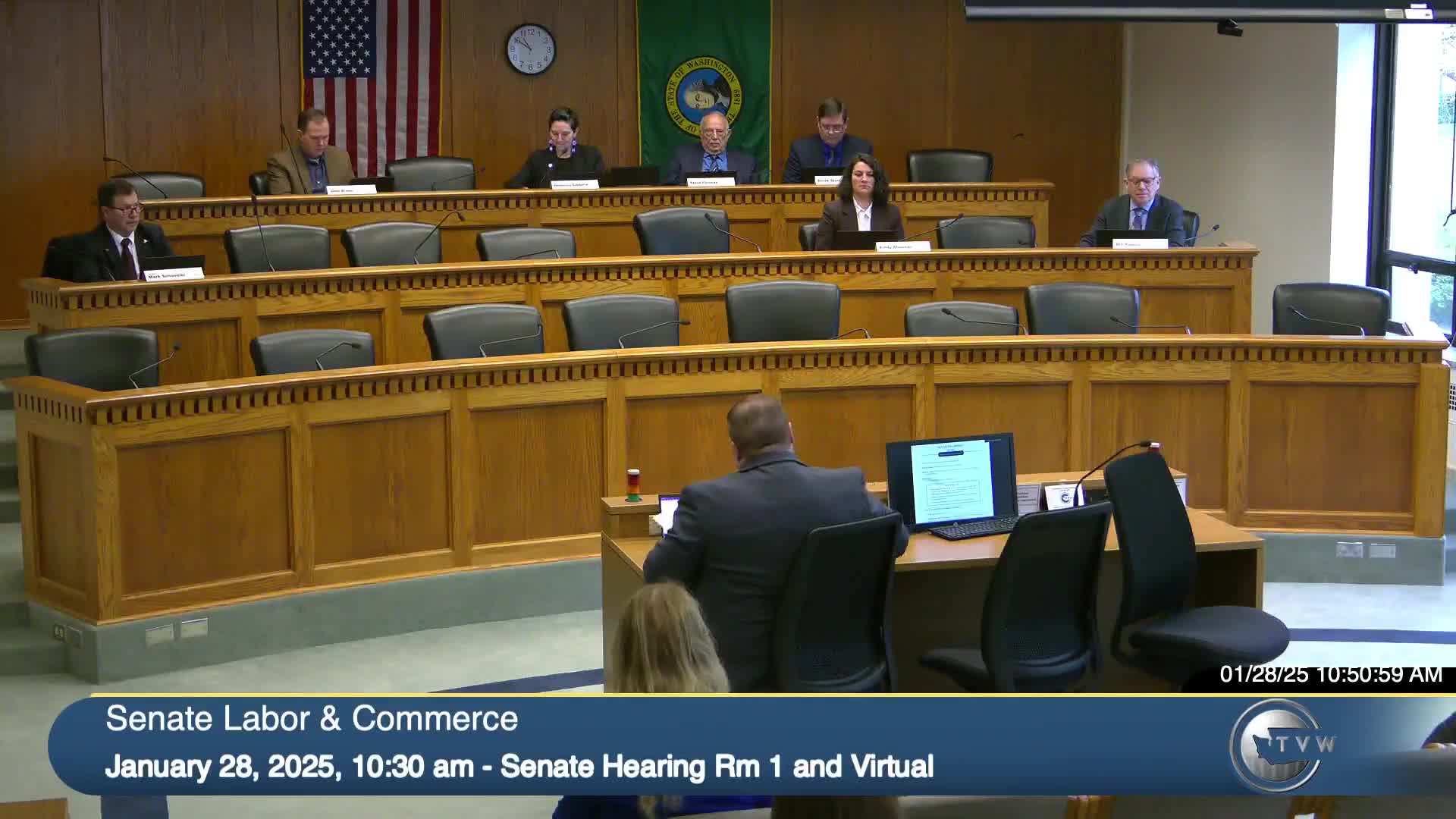
Senate Bill 5336 would consolidate terms into "isolated employee," require training on panic-button use and employer documentation of panic-button purchases and usage, and authorize L&I to investigate violations and assess civil penalties.
Senate Bill 5336 updates Washington's isolated-worker protections by consolidating statutory language, strengthening training and recordkeeping requirements, and authorizing the Department of Labor & Industries (L&I) to investigate violations and assess civil penalties.
Jarrett Sacks, committee staff, told the committee the bill consolidates definitions into a single "isolated employee" term and requires training that includes panic-button use and employer responsibilities to respond. Employers must document completion of mandatory training and maintain records of panic-button purchases and utilization; L&I may investigate and issue citations. The bill would set a first willful-violation penalty of $1,000; repeat willful violations would carry penalties of at least $2,000 and up to $10,000, with L&I able to waive or reduce penalties for corrective actions.
Senator Tina Orwell, prime sponsor, said the bill aims to make panic-button protections meaningful by ensuring installation, maintenance and enforcement. "If they're not installed properly, if they're not available, if they're not working, they're really not posing any security for the worker," Orwell said.
Janitorial and hospitality workers and advocates testified in favor. Melissa Portillo, a janitor, and Sofia Pineda, a night-shift custodian at Seattle Center, described working alone in large buildings and urged guaranteed panic-button access and substantive training. Washington Employment Lawyers Association (WELA) urged the committee to strengthen remedies so workers harmed by employer noncompliance can access relief under the Washington law against discrimination, not only administrative fines. The Washington Hospitality Association said it supports the bill and the enforcement approach but noted the statutory language could be tightened.
Union representatives said compliance remains incomplete five years after the original law. Matt Haney of SEIU Property Services Northwest said LNI training reports show far fewer janitors have completed training than the state estimates of janitorial workers, and urged stronger enforcement.
The committee received both in-person and translated testimony. No committee vote was taken; the sponsor said she is open to amendments and further technical refinement.