Get Full Government Meeting Transcripts, Videos, & Alerts Forever!
Get email alerts on the Hfc Refrigerant Regulation topic
No spam. Unsubscribe anytime.
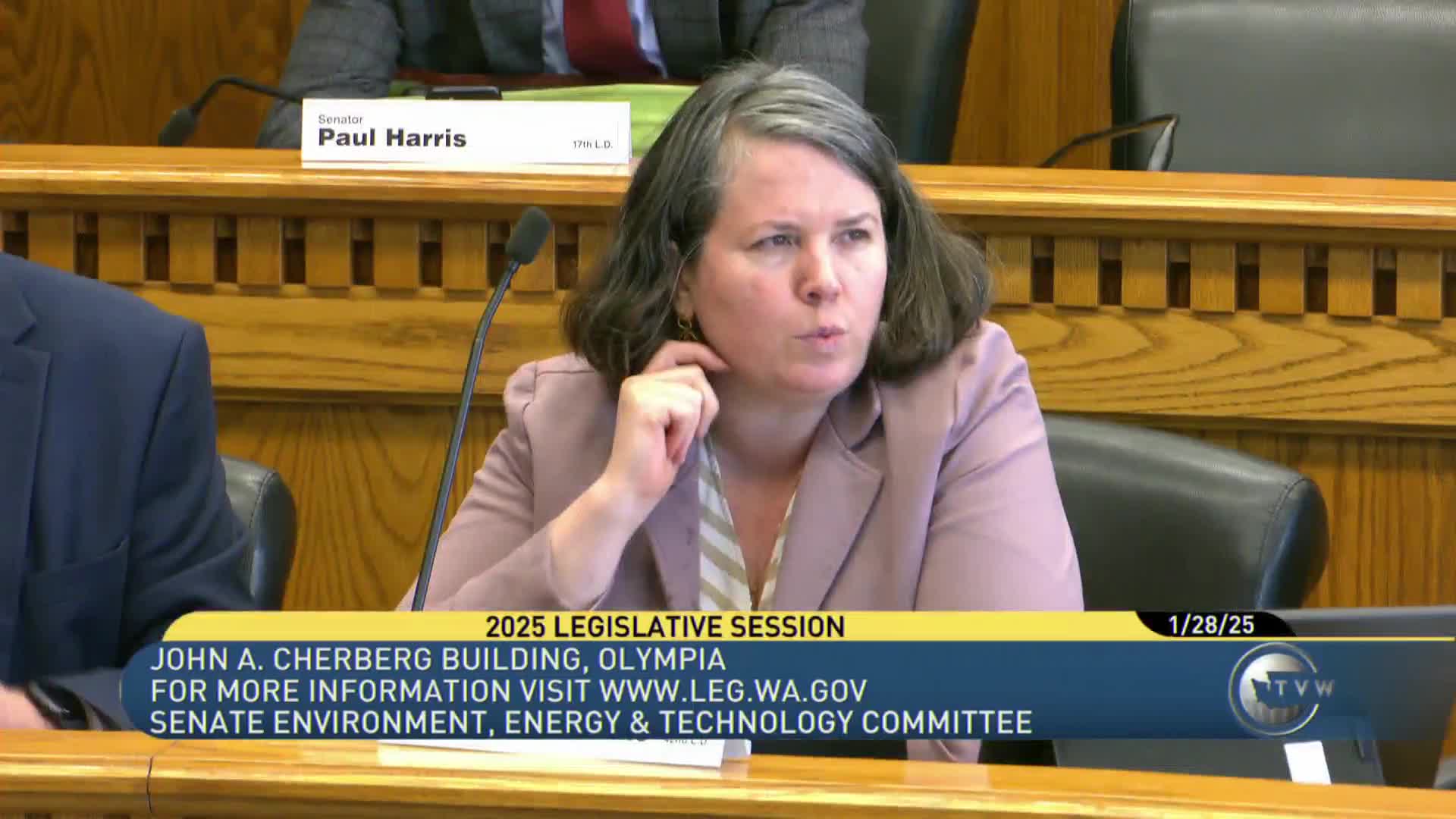
Senate committee hears testimony on bill to phase down high‑GWP refrigerants
Summary
The Senate Environment, Energy & Technology Committee held a public hearing on SB 5438, a bill to phase down sales and use of high‑global‑warming‑potential hydrofluorocarbons (HFCs), create a refrigerant transition task force and direct the state to prioritize reclaimed refrigerants.
The Senate Environment, Energy & Technology Committee held a public hearing on SB 5438, a bill that would phase down sales and use of high global‑warming‑potential hydrofluorocarbons (HFCs) and direct the state to prioritize reclaimed refrigerants while establishing a refrigerant transition task force.
The bill would prohibit the sale or distribution of new (virgin) bulk HFCs above specified global warming potential (GWP) thresholds in a phased schedule, grant the Department of Ecology rule‑making authority to adjust limits if adequate reclaimed supply becomes available, and direct Ecology to form a task force to study the transition and report back to the Legislature by Dec. 31, 2027. The bill also restricts use of non‑reclaimed HFCs for servicing state‑owned stationary equipment beginning July 1, 2026, subject to exemptions where compliance is technically or economically infeasible.
Why it matters: HFCs are potent greenhouse gases used mainly as refrigerants in grocery stores, food processors and commercial equipment. Proponents told the committee the bill aims to reduce emissions while protecting supply and avoiding premature equipment replacements by boosting recovery and reclamation markets.
Committee staff summarized the bill. Matt Sheppard, staff to the committee, told members that the bill “prohibits certain hydrofluorocarbons … through a phased in approach,” listed the phased GWP thresholds, and noted exemptions for reclaimed HFCs, certain federally permitted uses and shipments passing through the state. Sheppard also noted Ecology could grant temporary exemptions when compliance is infeasible.
Sponsor remarks: Senator Liz Lovett (Forty‑first Legislative District) said the bill is intended to “stimulate both our economy and to ensure that we are reducing harmful greenhouse gas pollutants in our environment,” and compared refrigerants’ potency to other greenhouse gases.
Support and industry view: Richie Kor of the Natural Resources Defense Council said Washington should prepare for a national drop in new HFC supply and that the bill, modeled on California law but modified for Washington, provides flexibility to industry while increasing demand for reclaimed refrigerant.
Hudson Technologies, represented by Ruth Ivory Moore, testified in support and described the company as a long‑standing EPA‑certified reclaimer capable of supporting a transition. Moore asked the task force membership to include people “actively engaged in refrigerant reclamation.” Mike Armstrong, president of A‑Gas in the Americas, said federal AIM Act phase‑down will reduce virgin supply and urged the state to prepare its industrial base and boost reclamation to avoid disruptions.
Contractors and customers pressing for changes: Several small‑business and contractor representatives supported the bill’s goals but urged amendments. Carolyn Logue of the Washington Air Conditioning Contractors Association said contractors want more Washington‑centric task force membership, a later effective phase‑out start (she suggested 2028 rather than 2027) to allow rulemaking and implementation, and protections so contractors are not charged when they return contaminated gas that cannot be reclaimed and must be destroyed. Katie Beeson of the Washington Food Industry Association said independent grocery stores will rely on reclaimed HFCs longer than large chains and requested representation on the task force and careful cost‑impact study.
Agriculture and cold storage concerns: Michael Conners of the Washington Potato and Onion Association said reclaimed product is currently limited in supply and more expensive than virgin refrigerant; he warned conversion of large bulk cold‑storage systems to new A2L refrigerants may be infeasible and cost “many millions of dollars” for potato growers. He recommended including an agriculture‑sector professional on the task force.
Reclaimers and recyclers: Total Reclaim (via Kate White Tudor, reading notes for CEO Bobby Farris) and other reclaimers told the committee that illegal venting is the largest barrier today and that growing a reclamation market will reduce venting and premature system replacements.
Environmental groups: Beth Porter of the Environmental Investigation Agency said the phased prohibitions target the most climate‑polluting HFCs, that state action will incentivize recovery and reclamation, and that the bill offers flexibility where compliance is infeasible.
Points of bipartisan concern and suggested fixes: Multiple witnesses asked the committee to (1) ensure the task force completes useful work before phase‑in dates, (2) include representatives from contractors, independent grocers, agriculture and reclaimers on the task force, (3) clarify protection for contractors returning unreclaimable gas, and (4) consider shifting early compliance dates to allow Ecology rulemaking and market adjustments.
Process and next steps: Committee staff closed the public hearing on SB 5438 after extensive testimony and moved to the next agenda item; no committee vote or formal action on SB 5438 was recorded during the hearing.
The committee will carry the record of testimony and any written comments into its follow‑up work on the bill and potential amendments.