Get Full Government Meeting Transcripts, Videos, & Alerts Forever!
Get email alerts on the Financial Education topic
No spam. Unsubscribe anytime.
Committee hears proposal to make financial education a high school graduation requirement
Summary
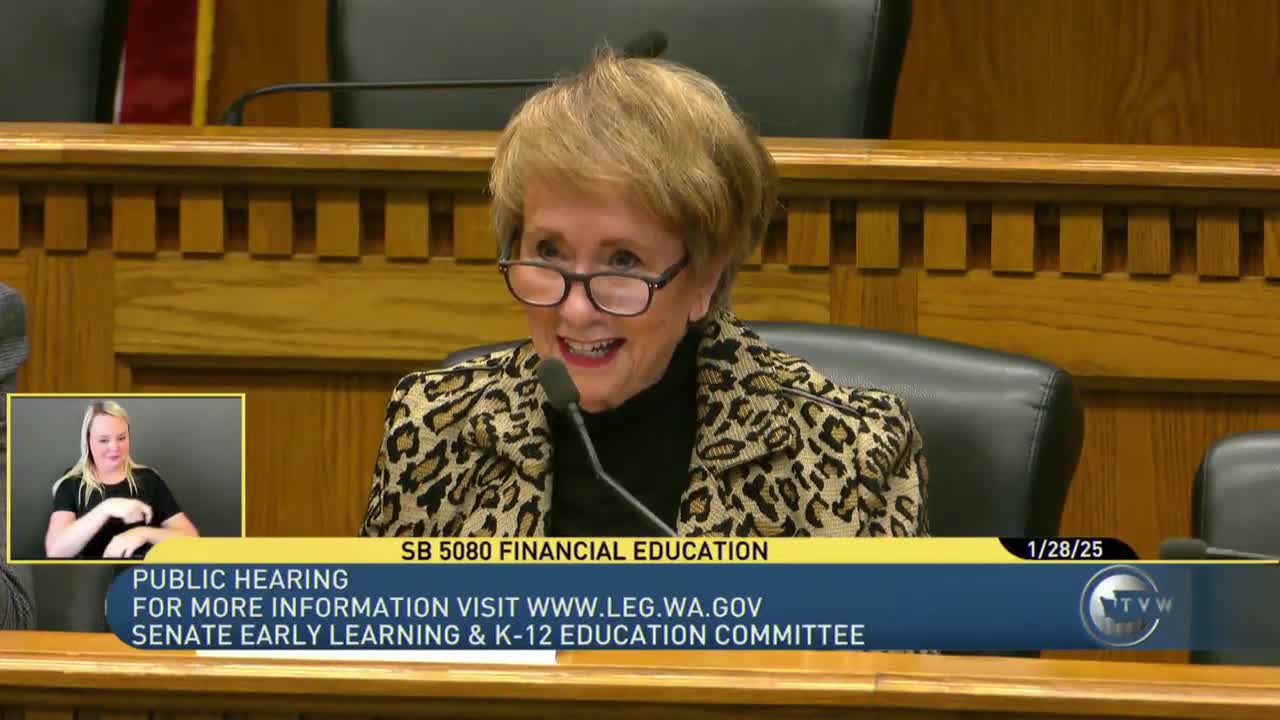
Senate Bill 5080, which would require Washington high school students to meet state financial education learning standards to graduate, was presented Tuesday to the Early Learning & K-12 Education Committee.
Senate Bill 5080, which would require Washington high school students to meet state financial education learning standards to graduate, was presented Tuesday to the Early Learning & K-12 Education Committee.
Elena Becker, committee staff, told the panel the bill “requires school districts to provide all high school students with financial education instruction and requires high school students [to] meet the state financial education learning standards in order to graduate,” with the graduation requirement scheduled to begin with the class of 2033 unless the State Board of Education recommends an earlier start date.
Why it matters: Backers said universal financial education would give students basic skills in budgeting, credit, saving and investing, and would help reduce long-term financial vulnerability. Supporters also said consistent statewide instruction would address unequal access across districts.
State Treasurer Mike Pellicciotti praised student and stakeholder support and urged the panel that “in each of the 39 counties I've been to, it is rare that you have absolute consistent support for a piece of legislation…Everyone comes together and recognizes” financial education’s value. Elena Becker noted OSPI adopted voluntary financial education learning standards in 2016, and the bill directs the Financial Education Public Private Partnership (FEP) to prepare an implementation plan informed by district data.
Fiscal and implementation details: The bill carries a fiscal note showing a cost to the Office of the Superintendent of Public Instruction of $776,000 in the 2025–2027 biennium for initial work. Becker reported local districts estimate a one-time cost of $1,092,000 in fiscal year 2026 related to required data submission; districts also identified indeterminate costs to implement course offerings over time because the State Board has not yet finalized the specific implementation requirements.
Support and opposition: The Financial Education Public Private Partnership (FEP) and business groups including the Washington Bankers Association and Washington credit unions testified in support, saying FEP can supply teacher training and curricular resources and that schools are already embedding financial instruction unevenly. Tracy Godat, executive director of FEP, described the partnership’s work training teachers and producing Spanish-language materials.
Students and youth groups also testified in favor; Bellevue high school students who founded Westbank Financials described classroom and community lessons they have run and urged a statewide, equitable approach. Career and technical education advocates, including Laurie Hairston of Washington DECA, said mandatory instruction would reach students who otherwise have no access.
Opponents included Jeanne Magdua of Conservative Ladies of Washington, who cited state math proficiency concerns and said many citizens signed in opposition. Magdua told the committee that “1193 concerned citizens signed in opposed to this bill,” and urged caution about adding a new graduation requirement while math outcomes remain low.
What the bill would do next: The bill also directs the State Board of Education to work with stakeholders on adjustments to graduation policies, and requires FEP to develop an implementation plan using district data. The committee held public testimony and will consider the bill in subsequent committee action and budget discussions. The committee record shows the required implementation timeline and cost estimates, but the State Board’s decisions and any appropriation choices will determine the exact path and start date for a mandate.
At the hearing, supporters emphasized the bill’s alignment with the State Board’s broader Future Ready initiative; opponents warned about adding requirements before addressing core math proficiency. The committee closed the public hearing and moved on to other bills on its agenda.