Get Full Government Meeting Transcripts, Videos, & Alerts Forever!
Get email alerts on the Presidential Primary Process topic
No spam. Unsubscribe anytime.
Senate takes up bill to move party declaration inside presidential primary return envelope
Summary
Senate Bill 5050 would require voters’ party preference in presidential primaries to be placed inside the ballot return envelope (and include a prominent reminder) to protect privacy and reduce rejected ballots; Office of the Secretary of State testified the office supports improving the process but noted public‑record considerations.
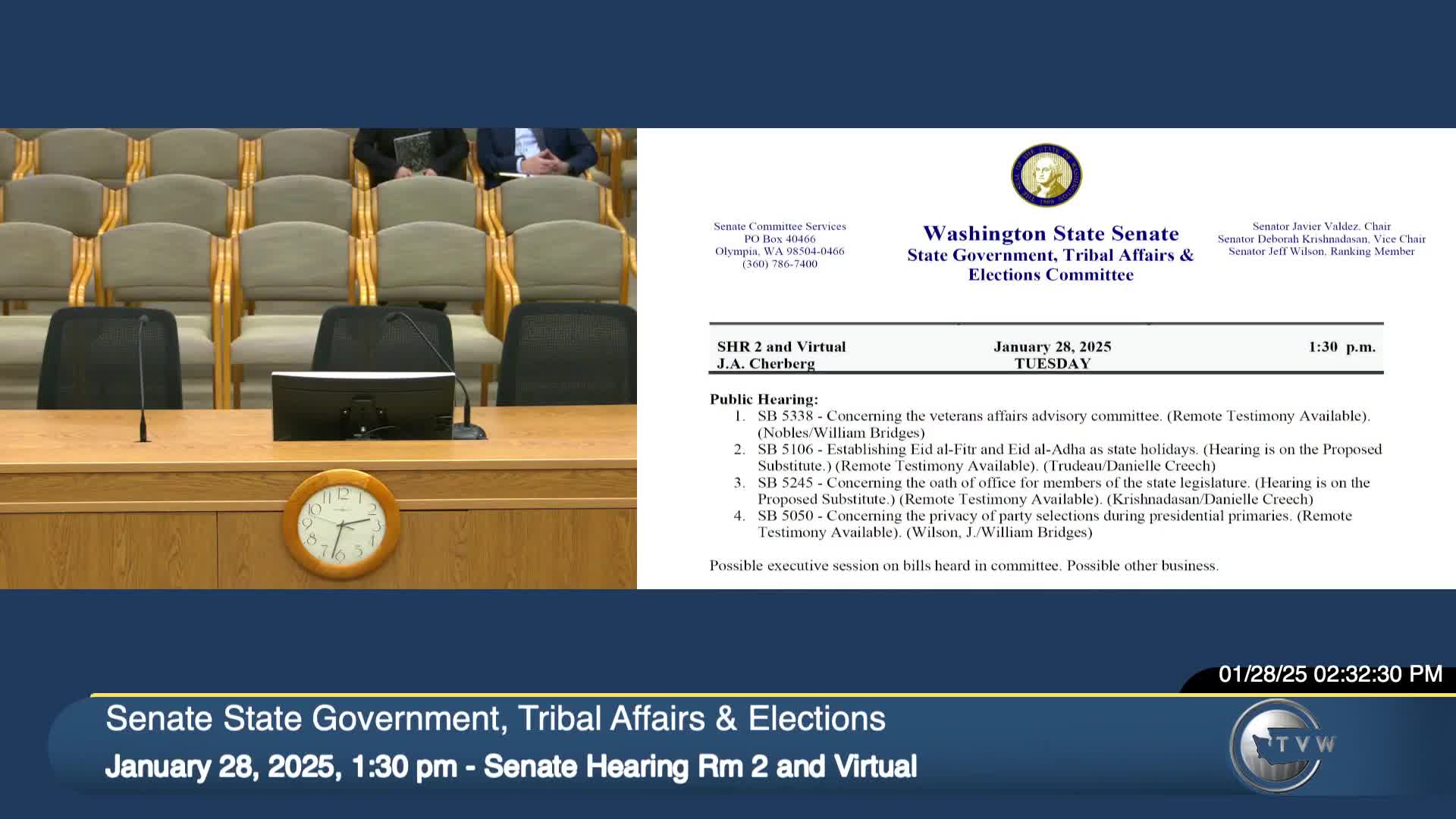
William, committee staff, introduced Senate Bill 5050 at the Jan. 28 hearing, saying the bill would change the presidential primary return‑envelope process so a voter’s party declaration appears inside the envelope rather than on the outside, and that the envelope would include a "prominently placed reminder" informing voters that a party declaration is required for the ballot to be counted.
Senator Jeff Wilson, prime sponsor, framed the bill as a response to ballots rejected in prior presidential preference primaries. "I can give you 47,431 reasons why I brought this bill forward," Wilson said, referring to the number of ballots he said were rejected for issues such as a missing party declaration.
Sean Merchant, policy director for the Office of the Secretary of State, testified "other" in the hearing and said the office is willing to work on changes to improve voter experience, noting historical complaints every four years about the presidential primary process. Merchant also confirmed that while some elements of a voter's party preference are shared with parties as a public record, signatures are not provided for copying. He said the bill's design could place the party preference under a flap or in a separate inner envelope so it remains tied to the ballot for counting while reducing public visibility.
Committee members asked practical and legal questions. Chair and others asked whether the change would conflict with national party rules; staff said their understanding is the bill would not conflict as long as a place to record party preference remains. Senators also discussed whether the system effectively excludes third parties from the nominating process; Merchant said the bill applies to the main presidential primary process and that nomination rules are controlled by the parties.
The clerk reported 182 written respondents on SB 5050 (178 pro, 3 con, 1 other). The committee heard one in‑person witness from the Secretary of State's office and closed the hearing after members discussed logistics and voter‑education features the bill would require.