Get Full Government Meeting Transcripts, Videos, & Alerts Forever!
Get email alerts on the Mandatory Reporting Clergy topic
No spam. Unsubscribe anytime.
Heated testimony at Senate hearing as bill would make clergy mandated reporters for child abuse; survivors press for no exemptions
Summary
Senate Bill 5375 would require members of the clergy to report suspected child abuse or neglect, removing the clergy-penitent exception in state law. Survivors and accountability advocates urged passage without exemptions; Catholic and other religious leaders warned it would violate confessional sacramental law and could deter confession.
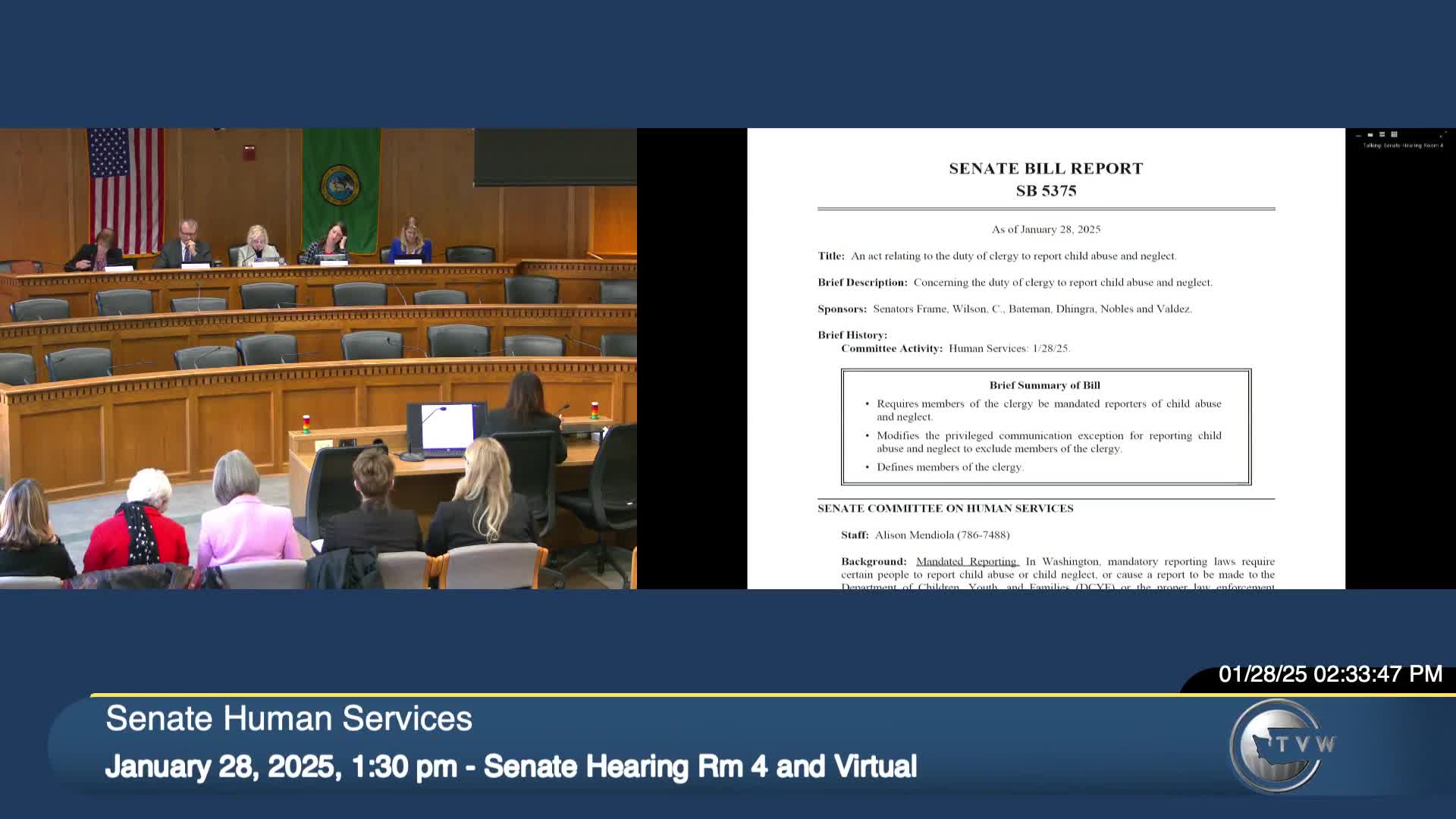
Senate Bill 5375, which would make members of the clergy mandated reporters of child abuse and remove the clergy-penitent reporting exemption, drew emotional testimony and sharply divided witnesses at a Jan. 28 hearing of the Senate Human Services Committee.
Allison Mendiola, committee staff, summarized current law and the bill’s change: Washington requires certain people to report suspected child abuse; a privileged communication exception—the clergy-penitent privilege—currently prevents compelled testimony or reports when information is obtained solely as a privileged communication. Under SB 5375, members of the clergy would be required to report suspected child abuse or neglect even if the information was obtained during privileged communications; the bill’s text defines “member of the clergy” broadly and does not alter privileges for compelled testimony in prosecutions.
Senator Noelle Freme, sponsor of the bill and a survivor of sexual abuse, framed the measure as overdue. “This is personal for me. As a survivor of sexual abuse myself…abuse had only stopped when I told a mandated reporter,” Freme said. She described past investigative reporting into religious communities—including Jehovah’s Witnesses and allegations within Catholic institutions—and said Washington is one of only five states that do not make clergy mandated reporters. “I stand by the bill with no exemption,” she said.
Survivors and representatives of accountability groups urged passage without an exemption. Sharon Huling of the Clergy Accountability Coalition said mandatory reporting without exemptions prevents child abuse from remaining hidden and that “the only people who have to worry about the privacy of their confession are child rapists and abusers.” Mary Dispenza, a survivor with Survivors Network of those Abused by Priests and Nuns (SNAP), said the privilege left perpetrators free to offend for decades and urged a yes vote.
Witnesses and advocates stressed that internal religious processes can shield abusers. Kirsten Larson, raised as a Jehovah’s Witness, described elders’ internal investigations and policies that require reporting up an organization’s hierarchy rather than to civil authorities.
Religious leaders and representatives of the Washington State Catholic Conference opposed the bill as written. Gene Hill of the Catholic Conference said privileges exist to encourage communication that otherwise would not occur and warned the bill could “shut that avenue for many perpetrators” who would otherwise seek counseling. Bishop Frank Shuster, speaking as a pastor and not for the wider church, described the sacrament of penance (confession) as an act of worship and said canon law imposes excommunication for priests who break the seal; he urged a reworded approach to avoid constitutional questions and protect religious practice while promoting safety.
Other clergy and faith advocates echoed constitutional and pastoral concerns; testimony noted differences across denominations and contexts and included suggestions that clergy can encourage reporting in many pastoral counseling situations without compromising sacramental confidentiality.
Survivors raised specific organizational examples and international investigations, and several former Jehovah’s Witnesses testified that internal policies and community isolation had prevented reporting and left children unprotected for years. Testimony included references to investigative reports and governmental inquiries in other countries that found institutional failures to report.
No vote was taken. Sponsors and opponents said they would continue discussions; survivors urged the committee to pass the bill without an exception to clergy-penitent communications.