Get Full Government Meeting Transcripts, Videos, & Alerts Forever!
Get email alerts on the Legislative Oversight Corrections topic
No spam. Unsubscribe anytime.
Senate committee hears bill to require legislative access to state correctional, juvenile and psychiatric facilities; DOC cites safety and staffing concerns
Summary
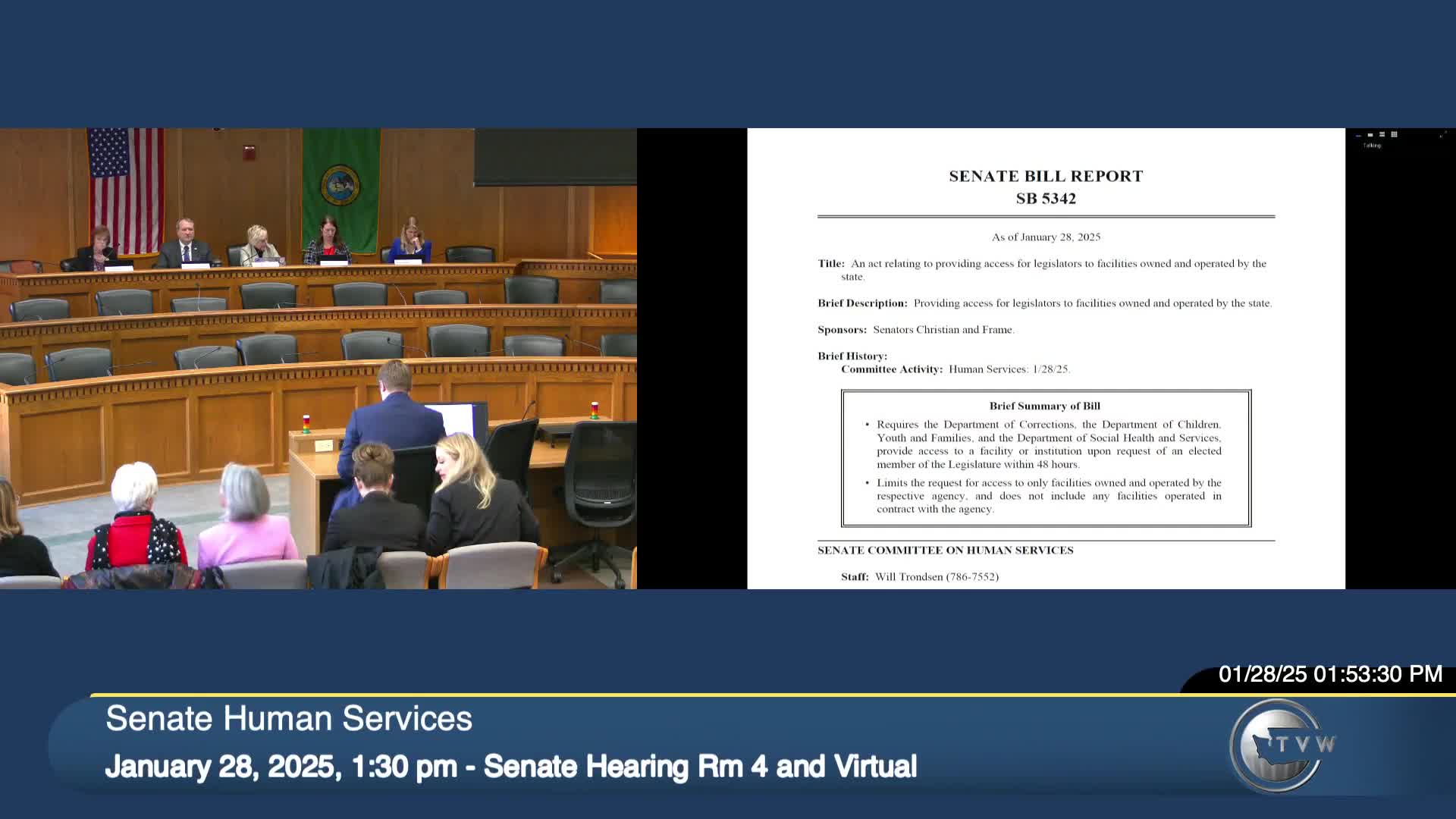
The Senate Human Services Committee on Jan. 28 took testimony on Senate Bill 5342, which would require DOC, DCYF and DSHS to provide legislators access to state-run facilities within 48 hours of written request.
The Senate Human Services Committee held a public hearing Jan. 28 on Senate Bill 5342, which would require the Department of Corrections (DOC), Department of Children, Youth, and Families (DCYF) and Department of Social and Health Services (DSHS) to provide access to facilities they operate when requested in writing by an elected legislator.
Will Tronson, committee staff, summarized the bill and its scope. “Senate Bill 5342 requires the Department of Corrections, Department of Children, Youth, and Families, or the Department of Social and Health Services to provide access to a facility or institution when any currently elected member of the legislature requests,” Tronson said, and added the bill would require responses within 48 hours of receipt of such requests and set submission to each department’s legislative affairs office.
Jason Bennett, senior director of correctional operations for DOC and former superintendent at Stafford Creek Corrections Center, testified that DOC supports legislative visits but expressed concerns about the bill’s timing requirement. Bennett said DOC policy currently provides for visits with two weeks’ notice to allow staff to prepare “meaningful and productive visits while minimizing disruptions to the population and ensuring a safe experience for all.”
“The bill, as written, would require the department to provide facility access to legislators 24 hours a day, 7 days a week, with only 48 hours notice of the request,” Bennett said. “We have significant concerns with our ability to safely manage visits in the short turnaround…Funding for additional staff would be required to effectively implement this legislation.”
Committee members asked DOC and witnesses about alternatives and past practice. Bennett said DOC policy’s two-week notice generally worked well and that the agency had not denied visits when adequate planning was provided. Jacob Schmidt, director of Just Us Solutions, disputed the department’s characterization of access, recounting that an attempt to enter Stafford Creek took five months to arrange and attendees were given only one hour with the people they sought to meet.
“Having spent an extended period of time in the Department of Corrections…we could appreciate maybe some variables in the way that this happens,” Schmidt said. Raymond Williams, who previously spent time inside DOC facilities, told the committee that legislative access historically was more straightforward and urged lawmakers not to accept “attitudinal disposition” that restricted access.
Tronson told the committee that DOC submitted an anticipated fiscal estimate of about $2,500,000 associated with the bill and that DCYF had reported no fiscal impact; DSHS had not responded to the partial fiscal note provided by noon the day of the hearing.
Senator Christian, sponsor of the bill noted he recently visited Green Hill to see conditions firsthand and said the bill aims to give legislators the ability to respond to constituent concerns and budget oversight questions without “blindfolds on.” “Going to cost us $2,500,000 just for access to do our job? Seems a little ridiculous to me,” Christian said.
No amendments or votes on SB 5342 were taken at the hearing. The committee received testimony both urging easier access for oversight and cautioning that short notice could pose safety and staffing challenges for agencies that operate secure institutions. Committee staff said follow-up questions, including clarifying the fiscal note, would be pursued.