Get Full Government Meeting Transcripts, Videos, & Alerts Forever!
Get email alerts on the Youth Mental Health topic
No spam. Unsubscribe anytime.
Spokane students present youth-designed mental-health, food-security projects to Senate Human Services Committee
Summary
Students from On Track Academy told the Senate Human Services Committee about projects from Spokane’s Youth Wellness Zone—ranging from motivational sweatshirts and zines to forest-bathing data and a school food partnership—urging support and broader community partnerships.
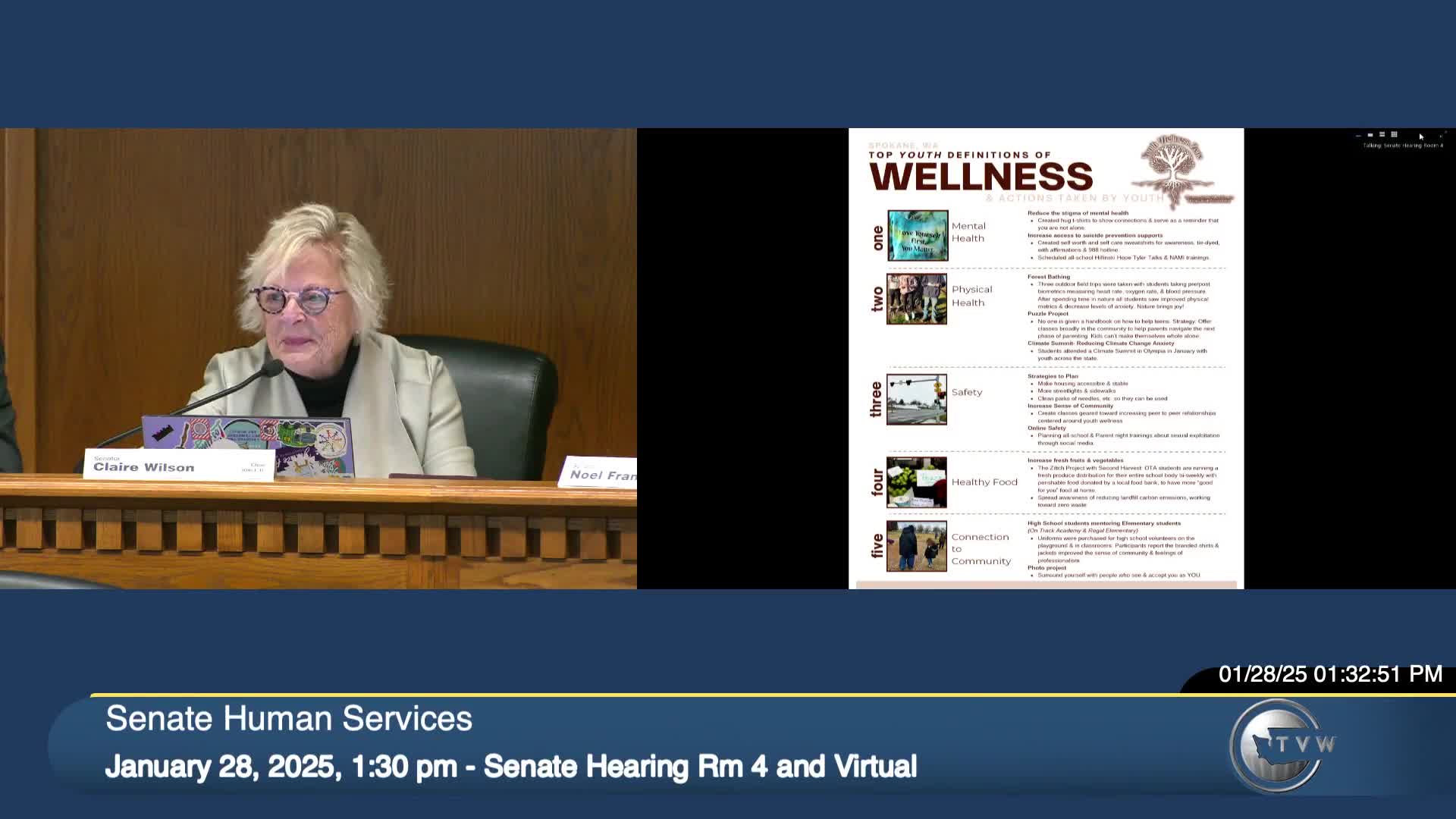
Students from Spokane’s Youth Wellness Zone described projects aimed at supporting youth mental health and wellness during a work session of the Washington Senate Human Services Committee on Jan. 28.
The students, who attend On Track Academy and took a wellness elective funded through a 2024 legislative proviso, outlined place-based strategies including a fresh-food partnership with Second Harvest, motivational sweatshirts that list the suicide hotline, “zines” with local-resource QR codes, a tapestry and journal about living with ADHD, and a short study showing lower heart rate and blood pressure after supervised time in a local forest.
The students and Jenna Ray, director of Zone Spokane, told the committee the initiative is part of four youth wellness zones funded around the state (Yakima, Spokane, Parkland and Renton) and overseen for data collection by the University of Washington CoLab. Ray said the zones are “place based initiatives” that lean on youth voice to define wellness and surface community solutions.
“By leaning into youth voice, we understand what wellness means to them, what it looks like in their neighborhoods, and community solutions,” Ray said.
Student presenters described concrete projects. Myles Day said his group produced sweatshirts with the phrase “love yourself first, you matter” on the back and the suicide hotline on the sleeve to “spread a positive message.” Achilles Ferguson described two small booklets—zines—documenting local disparities and joys with QR codes linking to resources, and said students measured blood pressure and oxygen levels before and after a forest visit, finding improvements across measures.
“We did blood pressure and our heart rate…when we came out of the forest and redid our blood pressure and oxygen levels, they were significantly lower for most students,” Achilles said.
Wednesday Adams described a project that uses a puzzle metaphor to call for parent support groups and regular staff-parent meetings to help families navigate adolescent milestones. Riley Bennett said a handmade tapestry and journal aim to surface what high school students with ADHD experience and called for training for educators and parents.
Committee members praised the student work. Senator Orwell singled out the ADHD training suggestion and complimented the sweatshirts; Senator Warnec endorsed outreach to agricultural communities after Achilles’ presentation; and Chair Wilson said she hoped to visit Spokane to see the students’ showcase.
Ray noted the students will also present at a Chase Youth Commission showcase at Spokane City Hall and at the End the Violence Conference 2025 in Spokane, and said On Track Academy plans to continue offering the wellness elective.
The session emphasized the projects’ community connections: students are distributing perishable food in partnership with Second Harvest and plan broader public presentations. Ray said the CoLab will manage statewide data collection and the zone organizers hope to return next year with results and community follow-ups.
Committee members encouraged continuing the collaboration among youth groups, schools and local partners and asked staff and senators to visit Spokane during interim work.
Closing: The committee shifted from the youth work session to its bill hearings after members thanked the students for their presentations and invited continued engagement and invitations to legislative visits.