Get Full Government Meeting Transcripts, Videos, & Alerts Forever!
Get email alerts on the Salmon Recovery topic
No spam. Unsubscribe anytime.
State officials brief committee on salmon recovery: modest gains, persistent threats
Summary
Agency leaders and the Puget Sound Partnership reviewed Washington's salmon recovery framework, reported modest improvements for Chinook abundance and estuary/floodplain restoration, and flagged continued challenges from climate, toxics, predation and funding shortfalls.
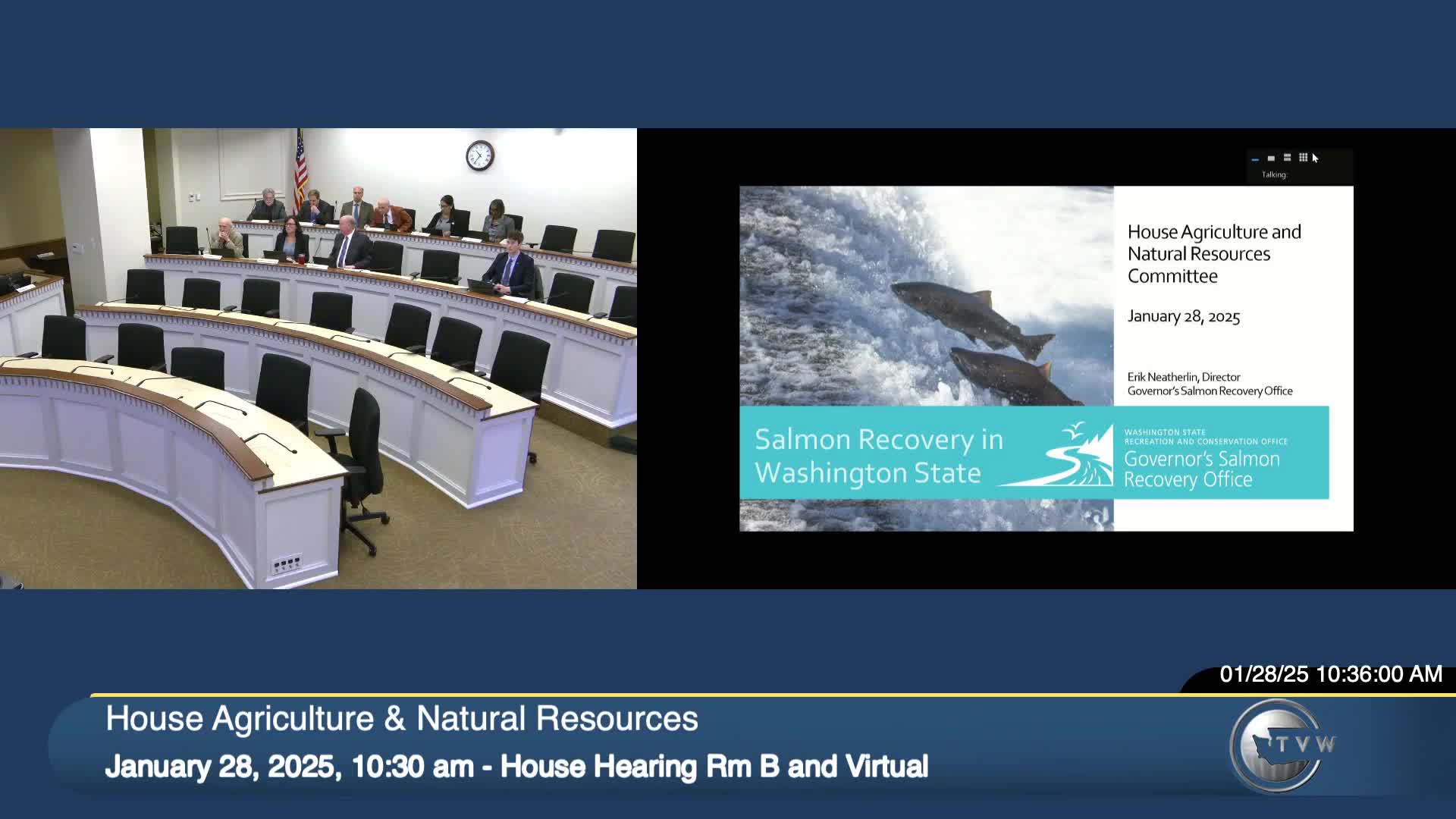
Agency directors and recovery partners provided a work-session briefing to the Agriculture and Natural Resources Committee on Jan. 28, outlining how Washington coordinates salmon recovery and reporting modest progress on Chinook abundance alongside major outstanding challenges.
Eric Netherland, director of the Governor's Salmon Recovery Office within the Recreation and Conservation Office, described Washington's locally based framework: regional recovery organizations aligned to federal ESA listings, watershed-scale lead entities, a Salmon Recovery Funding Board that prioritizes voluntary habitat projects, and a governor's statewide salmon strategy first issued in 1999 and updated in 2021. Netherland said Washington was “looked at as a model” for locally driven recovery and emphasized tribes’ sovereign roles as partners and government-to-government participants.
Netherland said 14 salmon populations in Washington are currently listed under the federal Endangered Species Act. He told the committee the state is “making modest progress” and that some species have moved from “not keeping pace” toward recovery goals. He also said funding for restoration has increased but still covers only roughly 25–30% of estimated need for full recovery work.
Melissa Speeg, Salmon Recovery Manager at the Puget Sound Partnership, focused on regional indicators for Puget Sound. She said the region tracks 22 independent Chinook populations across 16 watersheds and uses indicators for abundance, floodplain connectivity and estuary function. Speeg reported that Chinook abundance is improving in some watersheds and that recent indicators show 2–4% abundance increases for Chinook in the last two years; however, most populations remain well below recovery targets. She cited Port Susan Bay as an example where protection and staged restoration (3,900 acres protected in 2006; 150 acres restored in 2015; a later 115-acre restoration) and continued monitoring led practitioners to adjust designs and expand habitat reconnection.
Jeremy Cram of the Department of Fish and Wildlife reviewed monitoring, hatcheries, fish passage, toxics and predation. Cram called hatcheries “probably the most complex component of the salmon recovery landscape,” noting they both support fisheries and pose ecological or genetic risks to wild fish. He highlighted fish-passage work (including the Brian Abbott Fish Barrier Removal Board funding), emerging reintroduction efforts above Chief Joseph and Grand Coulee dams led by Upper Columbia United Tribes, and growing concern about toxics and predation. Speakers stressed that improvements on the ground — restoring floodplain connectivity, estuaries and providing cold-water refugia — increase the likelihood salmon will fare better in variable ocean conditions.
Committee members asked about measurement of success, regional breakdowns (Columbia River Basin/Snake River), predation, engagement of children in recovery programs, forestry partners’ roles, and how ocean conditions interact with freshwater restoration. Panelists answered that success is measured both by habitat metrics (stream miles and acres restored) and biological indicators (fish abundance and survival), and that local partnerships and targeted monitoring are critical to tracking progress. There were no formal committee actions or votes taken on policy in the work session.