Get Full Government Meeting Transcripts, Videos, & Alerts Forever!
Get email alerts on the Capital Gains Tax topic
No spam. Unsubscribe anytime.
Committee reviews technical changes to Washington capital gains tax; DOR seeks clarity and penalty relief authority
Summary
Staff and Department of Revenue representatives described technical amendments to the state capital gains tax, including treatment of section 1256 contracts, narrowing required federal attachments, clarifying family‑owned business holding periods, and creating limited penalty waiver authority for late payments.
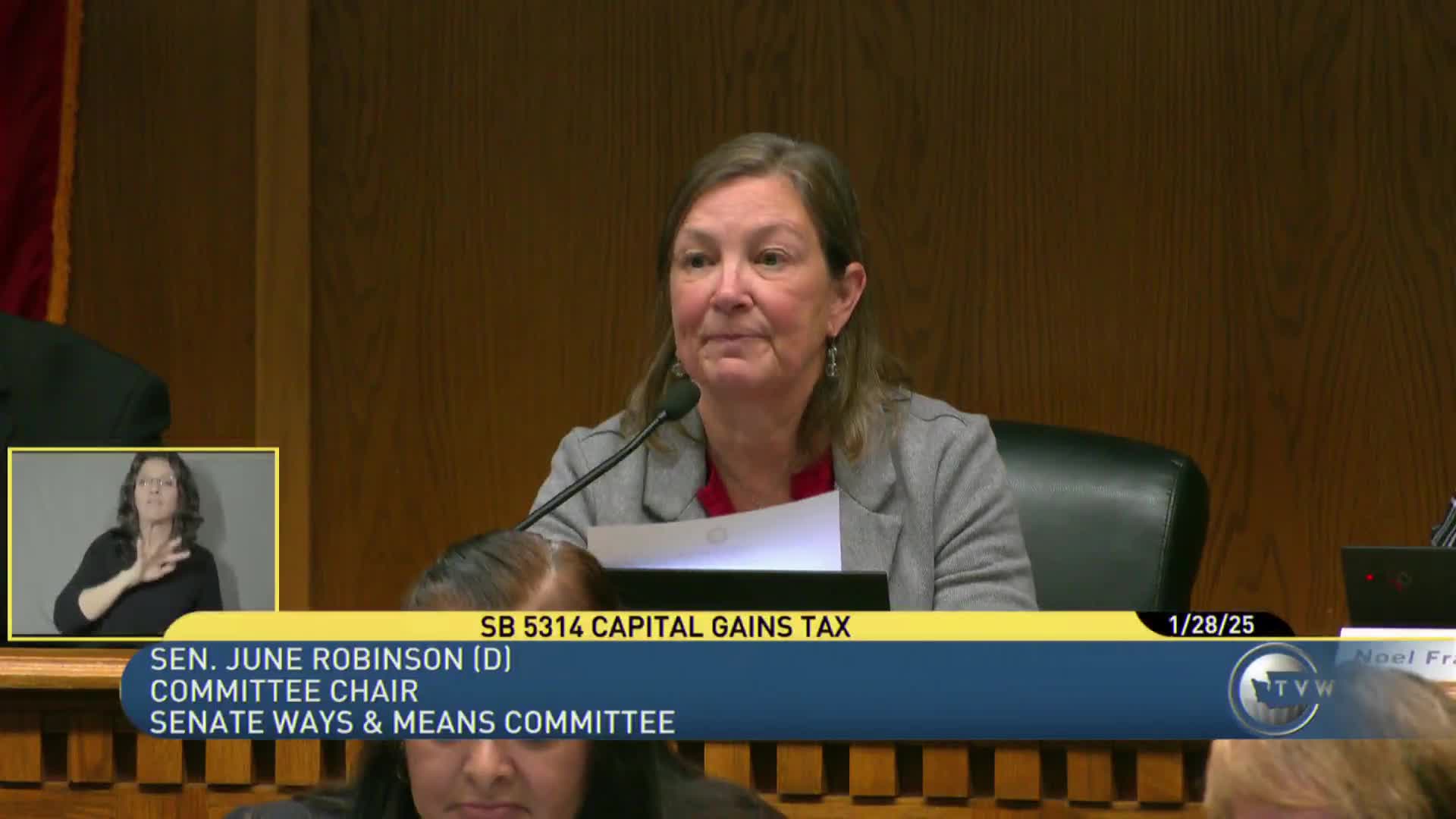
Jeff Mitchell, staff to the Senate Ways & Means Committee, briefed members Jan. 28 on Senate Bill 5314, a Department of Revenue request bill containing technical corrections and clarifications to the Washington capital gains tax enacted earlier.
Mitchell described several significant changes in the draft: when a federal Section 1256 contract (for example, certain futures or foreign currency contracts) is actually sold after being held more than one year, the bill would allow treatment of the entire gain or loss as long‑term rather than the current 60/40 split under federal treatment. The bill also narrows the requirement to include federal tax filings with the state capital gains return to only those federal documents used directly in the taxpayer’s calculation of net long‑term capital gain, rather than attaching entire federal returns in many cases.
Other changes would prevent a taxpayer’s five‑year holding period for the qualified family‑owned small business deduction from resetting when the business merely changes entity type or makes non‑material changes, and would permit limited Department of Revenue authority to waive or cancel penalties for delinquent payments under specified conditions. Mitchell said a taxpayer must amend a Washington capital gains return within 90 days if a final federal change alters Washington tax liability; failing to amend triggers staged penalties up to 25%.
Steve Ewing of the Department of Revenue said the agency supports clarifying and administrable rules and highlighted the new limited penalty waiver as a compliance tool for a recently implemented tax. A fiscal note accompanying the bill estimates four‑year expenditures of about $1.4 million; projected revenue impacts for specific provisions were small and indeterminate, Mitchell said.
The committee received no public testimony in opposition during the hearing; the bill was presented as administrative fixes designed to reduce taxpayer burden and improve the department’s capacity to administer the capital gains tax.