Get Full Government Meeting Transcripts, Videos, & Alerts Forever!
Get email alerts on the Hope Card Protection Orders topic
No spam. Unsubscribe anytime.
Legislation would centralize HOPE card issuance to ease carrying protection orders
Summary
House Bill 1460 would shift issuance of small, portable protection‑order "HOPE" cards from local courts to the Administrative Office of the Courts and narrow the data printed on the card to core identifying items and case identifiers.
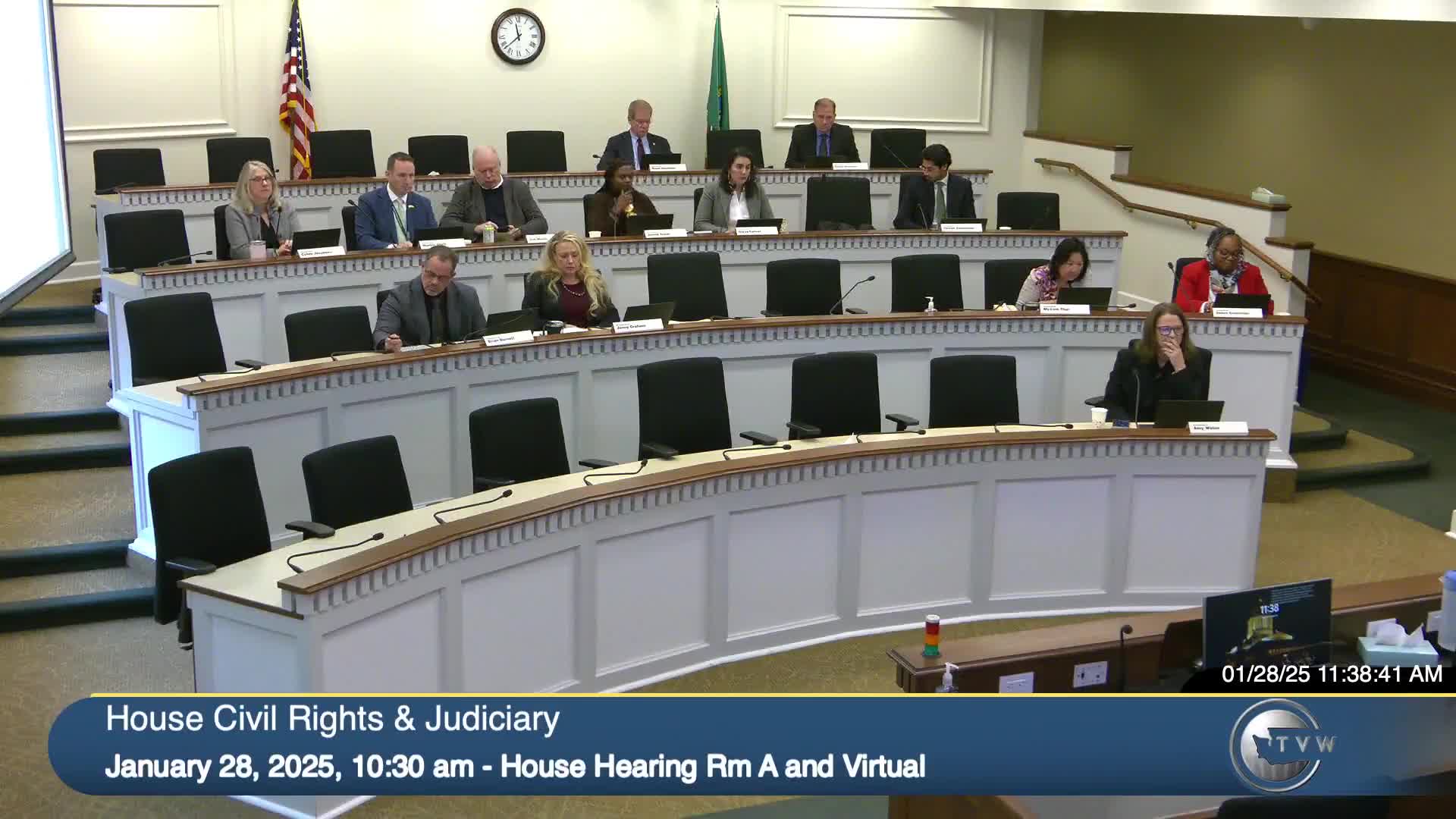
House Bill 1460, intended to make civil protection orders more portable for people seeking safety, was presented to the Civil Rights & Judiciary Committee on Jan. 28.
The bill would move responsibility for issuing HOPE cards — wallet‑sized summaries that accompany a protection order — from the issuing courts to the Administrative Office of the Courts and eliminate the statutory requirement that the card be issued in a scannable electronic format. Under the bill the card would contain a concise set of data: the restrained person's name and date of birth, the protected person's name and date of birth (including covered minor children), the issuing court case number, the issuing date and the expiration date.
Representative Griffey, the bill sponsor, said the change is designed to ease portability for survivors who must carry long, multi‑page protection orders. "We wanna put it all on a card the size of a driver's license," Griffey said, and noted the program has already issued cards in early rollout.
Scott Alff, court services director and chief legal counsel at the Administrative Office of the Courts, testified the office had issued 92 HOPE cards to date and that the bill would "clean up" statutory language to better reflect what the office can reliably supply. He said details such as eye color or weight may not typically be available and that the office would update the card format over time.
Members asked whether the statute allows the Administrative Office to update format or content without new legislation; Alff said the bill gives some flexibility for incremental changes and that the HOPE card process is expected to evolve.
No formal amendment or vote was taken Jan. 28; committee members asked clarifying questions about law enforcement use and whether expiration dates would appear on the card. Stakeholders said the expiration date will be included to help officers confirm whether an order remains in effect.