Get Full Government Meeting Transcripts, Videos, & Alerts Forever!
Get email alerts on the Tourism Funding Assessment topic
No spam. Unsubscribe anytime.
Bill to create advisory group for tourism self-assessment wins committee hearing; sponsors outline public–private funding framework
Summary
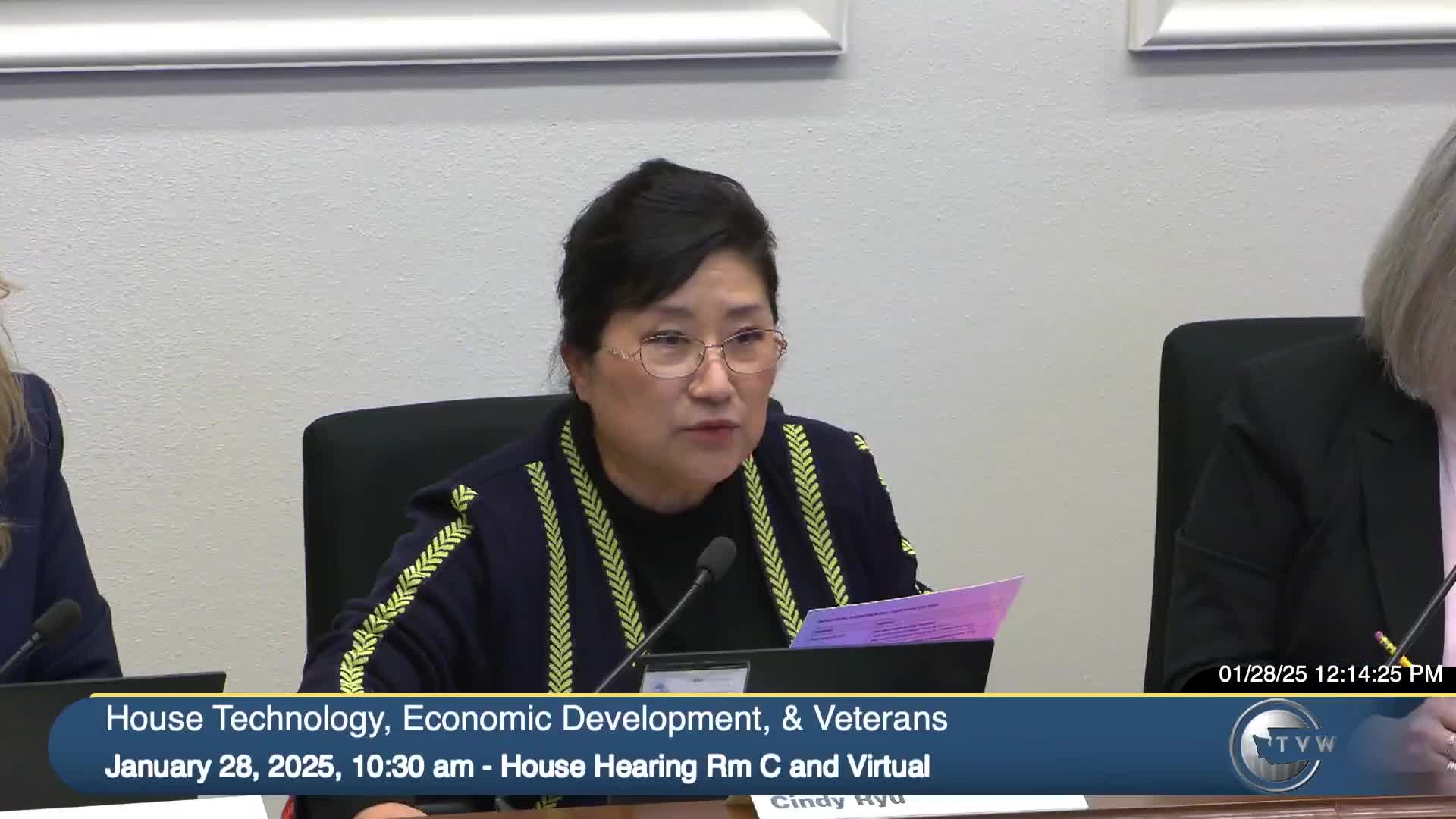
Representative Amy Wallen opened a public hearing on House Bill 14 37 on Jan. 28, 2025, which would create an advisory group to evaluate an industry self-supported assessment to fund statewide tourism promotion.
Representative Amy Wallen introduced House Bill 14 37 and the Technology, Economic Development, and Veterans Committee opened a public hearing on Jan. 28, 2025, to take testimony from tourism industry representatives and community partners about a proposed advisory group to evaluate an industry self-supported assessment for statewide tourism promotion.
Martha Whaling, staff to the committee, summarized the bill’s core feature: the Washington Tourism Marketing Authority Board would appoint at least eight members representing tourism-sector interests to an advisory group charged with evaluating the viability of an industry self-supported assessment and recommending procedures to establish it. The advisory group’s recommendations would be due to the Legislature by November 2025.
Representative Wallen, the bill’s prime sponsor, said the goal is a sustainable public–private partnership that increases tourism funding without relying solely on additional state general-fund appropriations. Wallen told the committee the bill’s framework aims to help rural and underserved communities attract visitors and generate additional visitor spending and tax revenue.
Industry witnesses uniformly voiced support in the hearing. Annie McGrath of State of Washington Tourism said the bill lays the “foundation for long term tourism promotion” and noted an intention to offer a friendly amendment to streamline advisory appointments and broaden sector representation. David Blandford, executive director for State of Washington Tourism, described multi-year work with industry stakeholders to design a sustainable funding mechanism and framed the bill as a first step toward a public–private partnership rather than a final funding decision.
Anthony Antone, president and CEO of the Washington Hospitality Association and chair of the Washington Tourism Marketing Authority, said the bill reflects substantial outreach to operators statewide; he noted a summer tour of 20 cities and said the approach would benefit communities across the state. Representatives from destination marketing organizations, the Washington Wine Institute, the Washington Brewers Guild, Visit Vancouver, and small-business tourism operators including the Organic Farm School also testified in support.
Testimony included practical examples of benefits from existing tourism-marketing work: the Organic Farm School said a Department of Commerce grant administered through the statewide tourism office had expanded its outreach and data capacity; Visit Vancouver said a stronger state-level marketing partner would increase grants, data and co-op marketing opportunities for local destinations.
Sponsor statements referenced maintaining the current state general‑fund appropriation to support the industry’s ability to pursue a self-assessment model; the committee record contains a number given in testimony that appears garbled in the transcript and therefore is listed as not specified in this report. Witnesses said the advisory group would ensure representation across sectors and geographies and produce options that reflect the state’s diverse destinations.
No final committee action on HB 14 37 was taken on Jan. 28; the hearing record closed with the sponsor indicating intent to move the bill in the next committee cycle and inviting amendment requests.
Speakers quoted or referenced in this report are those who testified during the public hearing and the committee staff who briefed members.