Get Full Government Meeting Transcripts, Videos, & Alerts Forever!
Get email alerts on the Legal Financial Obligations topic
No spam. Unsubscribe anytime.
Committee weighs repeal of many criminal legal financial obligations to relieve debt on people leaving the system
Summary
House Bill 1499 would eliminate a range of court‑imposed "poverty fees" and make many outstanding amounts unenforceable; sponsors argued fees are ineffective and harmful, while some judges and court officials warned of local fiscal impacts.
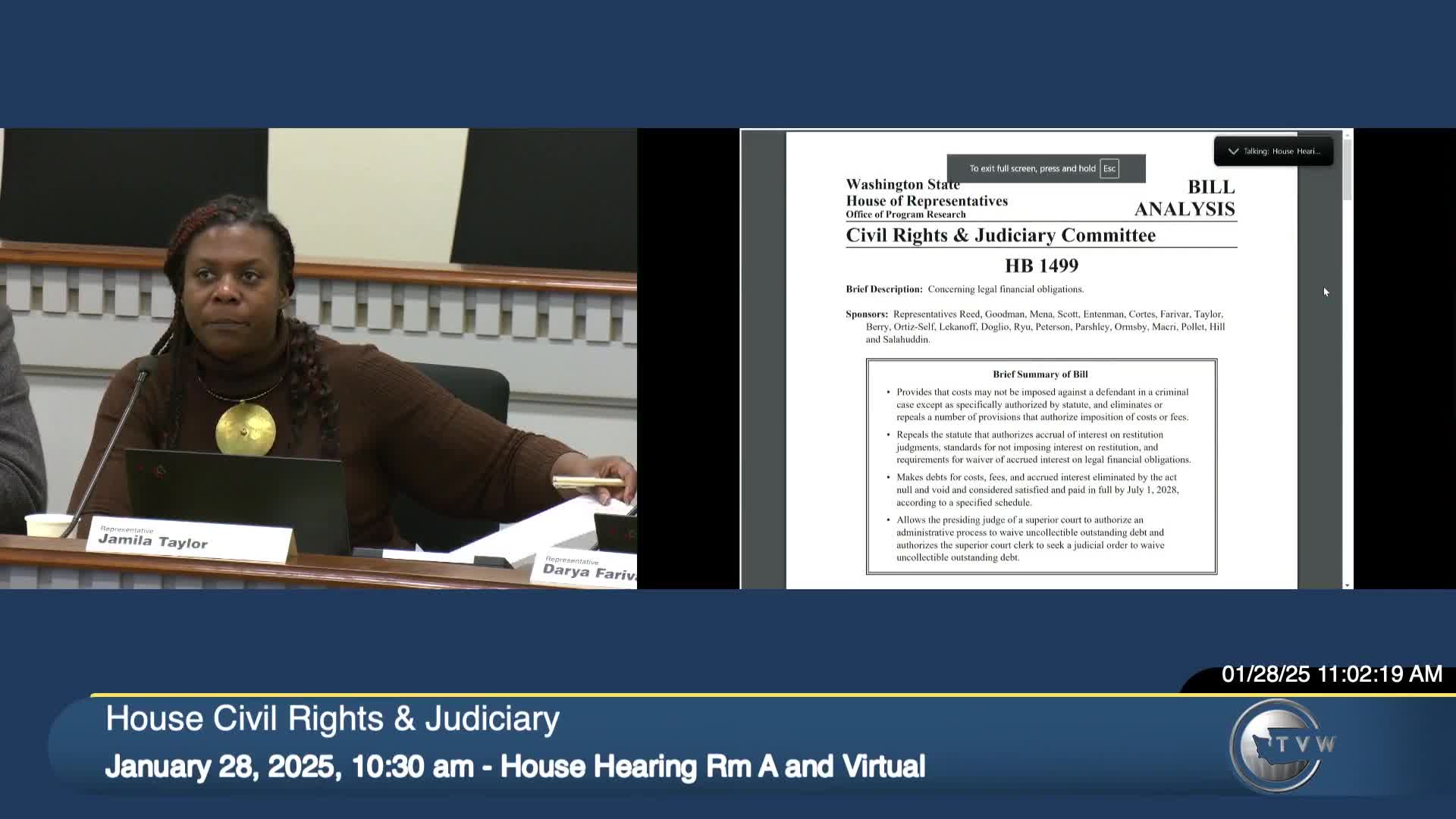
House Bill 1499, a broad rewrite that would bar courts from imposing many categories of legal financial obligations (LFOs) unless specifically authorized by statute and make certain outstanding LFOs unenforceable over a statutory schedule, drew lengthy testimony on Jan. 28.
Sponsor Representative Julia Reed told the Civil Rights & Judiciary Committee the bill targets poverty fees — court‑imposed costs that fall most heavily on indigent defendants and often go uncollected. "Poverty fees are ineffective, fiscally irresponsible, and socially harmful," Reed said, noting that last year "96% of public defender fees and 93% of incarceration fees went uncollected" and that the state spends roughly $1,000,000 a year trying to collect these debts.
Testimony from people with lived experience and legal aid attorneys described how outstanding LFOs create barriers to housing, employment and record‑vacatur. "LFOs don't just hurt people like me. They hurt our families, our communities," Aaron Delaney, a formerly incarcerated father, told the committee. Reentry attorneys and advocates said Indigenous, Black and Native defendants are disproportionately affected.
Judges and court administrators raised fiscal and operational concerns. Judge Megan Ballantyne of Grays Harbor County, speaking for the District and Municipal Court Judges Association, said many local programs — deferred prosecution, pretrial supervision and misdemeanor probation — rely on locally collected fees for partial funding and warned of a fiscal impact on smaller, rural jurisdictions. "Allowing these costs demonstrates to local officials that the legislature believes funding these programs is worthwhile," she said.
Other judges disagreed. King County Superior Court Judge Maureen McKee testified in favor of the bill and argued that eliminating fees for which indigency determinations are impractical would remove an unjust revenue stream that falls on the poor. "Fees should not be a sentencing tool and should not be used to try to change behavior," McKee said.
The bill would also repeal the statute authorizing accrual of interest on restitution judgments and declare specified eliminated debts unenforceable after the bill's effective date, with a statutory schedule deeming those debts satisfied by July 1, 2028. The presiding judge of a superior court could authorize an administrative waiver process; superior court clerks may seek judicial orders for waiver. Committee members asked judges and administrators for cost and collection data to better estimate fiscal impacts.
No committee vote was taken; sponsors and stakeholders pledged to supply additional data on collections, program budgets and the fiscal consequences for local courts.