Get Full Government Meeting Transcripts, Videos, & Alerts Forever!
Get email alerts on the Drivers License Employment topic
No spam. Unsubscribe anytime.
Bill would bar employers from requiring a driver’s license on job applications unless driving is essential
Summary
House Bill 1402 would make it an unfair practice to require a driver’s license on job postings or applications unless driving is an essential job function or alternate transportation is not comparable; disability advocates said it would open opportunities while business groups sought clearer definitions.
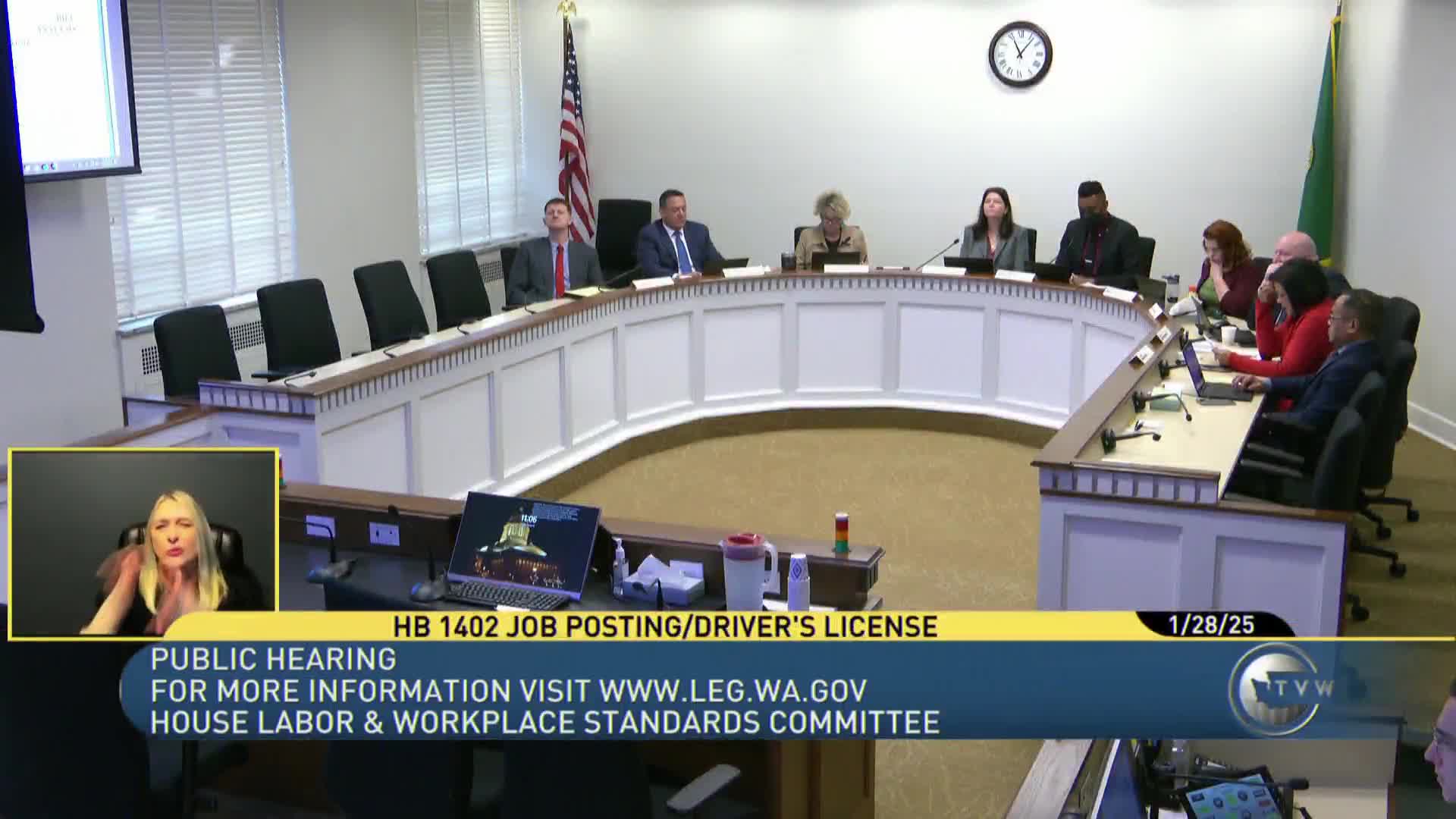
House Bill 1402 would make it an unfair practice under the Washington Law Against Discrimination for an employer to require a driver’s license on a job advertisement, posting or application unless driving is an essential job function or the employer reasonably believes alternate transportation would not be comparable in time or cost, staff told the committee on Jan. 28.
Disability Rights Washington, the National Federation of the Blind of Washington and individual witnesses testified in strong support, saying the license requirement functions as a screening tool that prevents qualified candidates — including people who are blind or use wheelchairs — from even reaching interviews for jobs that do not require driving. Marcy Carpenter, president of the National Federation of the Blind of Washington, said blind people “are excluded from even getting to the point of an interview because often the driver’s license question is a screener.”
Testimony included personal examples. Crystal Monteros said she was denied a child-care position despite passing interview steps because she does not hold a driver’s license and relies on public transit and caregiving supports. Haley Edick, assistant chair of the state Commission on Disabilities, said some application systems reject an applicant who indicates they cannot or do not drive and that applicants sometimes feel compelled to falsify answers to proceed.
Business groups supported the bill’s intent but asked for clearer drafting on key terms. Mike Ennis of the Building Industry Association of Washington and Rose Gunderson of the Washington Retail Association said terms such as “reasonable” and “essential” should be defined to reduce uncertainty. Gunderson also said the bill’s assessment requirement could trigger rulemaking and small-business economic impact analyses; she suggested borrowing language from a separate bill (SB 5501) that the committee is considering.
Witnesses said the Americans with Disabilities Act’s definition of “essential function” is a relevant legal reference for determining when driving is required. Committee members asked whether the bill would allow employers in rural areas to ensure applicants have a reliable way to get to work; several disability witnesses replied that employers may require reliable attendance but that how an employee gets to work is not the employer’s business when driving is not essential.
No vote was taken during the Jan. 28 hearing.