Get Full Government Meeting Transcripts, Videos, & Alerts Forever!
Get email alerts on the Artificial Intelligence Transparency topic
No spam. Unsubscribe anytime.
Committee advances bill requiring generative-AI developers to post training documentation
Summary
A proposed substitute for House Bill 11 68 that would require developers of generative artificial intelligence systems to publish documentation about training data and provenance was reported out of the Technology, Economic Development, and Veterans Committee on Jan. 28, 2025, with a due-pass recommendation.
A proposed substitute for House Bill 11 68 that would require developers of generative artificial intelligence systems to publish documentation about training data and provenance was reported out of the Technology, Economic Development, and Veterans Committee on Jan. 28, 2025, with a due-pass recommendation.
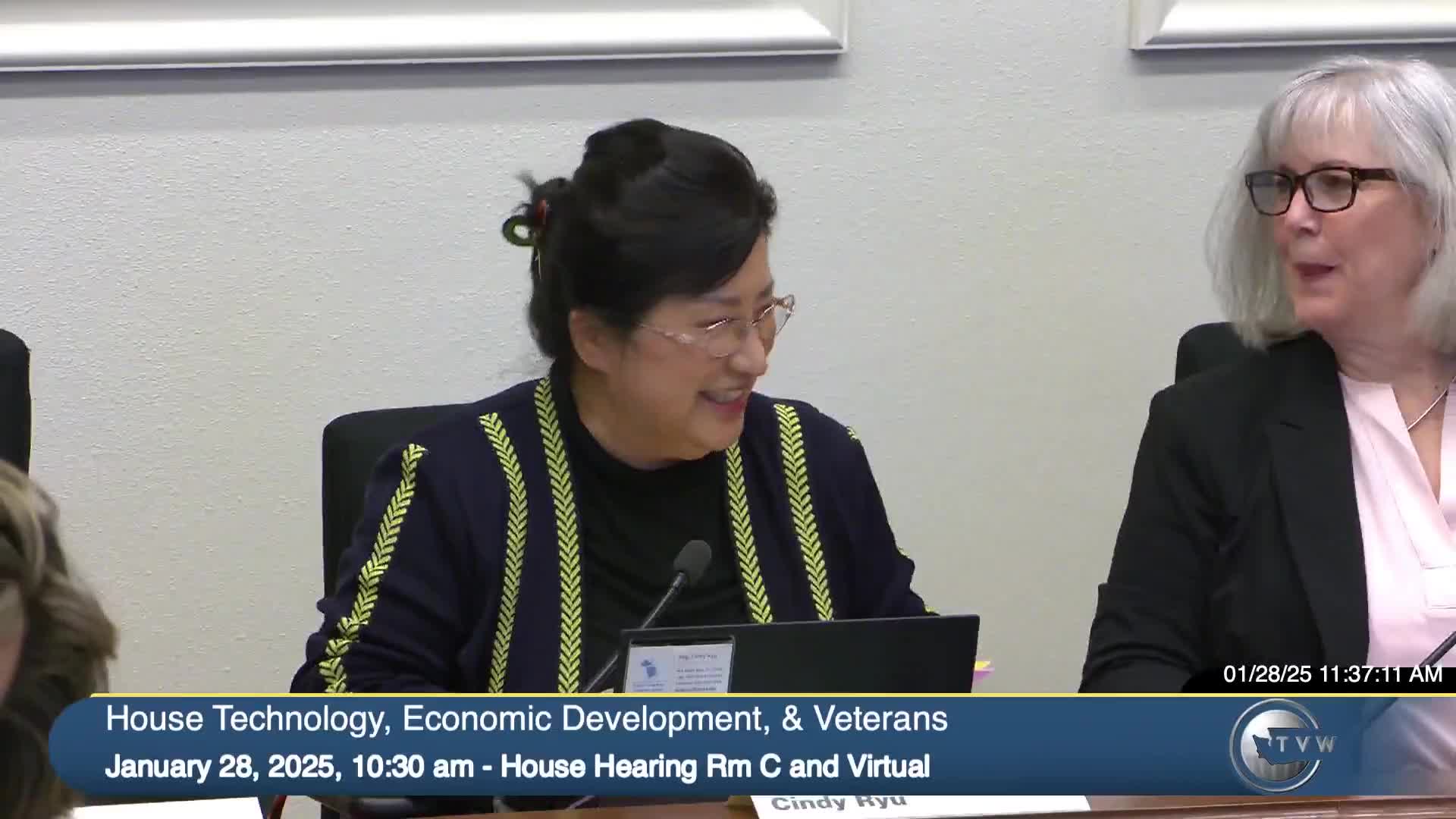
The committee moved the proposed substitute (H-913.1) and, after debate and amendment votes, approved the substitute as amended by an adopted amendment commonly referred to in the record as Wale 205. Representative Ryu, chair of the Technology, Economic Development, and Veterans Committee, announced the final vote as 8 ayes and 5 nays; the committee subsequently recorded individual votes (see “Votes at a glance”).
The bill, as explained to the committee by Emily Poole, staff to the committee, would require developers of generative AI systems to post documentation describing certain aspects of datasets and system provenance and would provide for Attorney General enforcement with civil penalties. The proposed substitute makes several definitional changes (for example, adjusting references throughout the bill to “generative artificial intelligence systems or services”) and changes some required disclosure items compared with the bill’s original text.
Key provisions described in committee debate include: developers must indicate whether datasets include personal information and provide dates when datasets were first trained or last significantly updated rather than the dates datasets were first collected; civil penalties are specified in the substitute as $5,000 per day for violations; and the Attorney General must provide an opportunity to cure violations before bringing civil action. During debate, staff clarified that the bill’s original personal-information reference used the state data-breach statute definition (RCW 19.255.005) and that an alternative definition discussed in the hearing (from the My Health My Data Act) is broader and does not equate to consumer health data.
Committee debate focused heavily on definitions and the tension between transparency and protection of trade secrets. Representative Penner argued for narrowing the definition of “developer” and excluding internal, research, or third-party systems not substantially modified, saying this would protect small startups from unintended regulatory burdens. An amendment adopting that narrower drafting (Wale 205) was adopted. Another amendment that would have explicitly carved out trade-secret disclosure requirements (Pool 094) failed in committee; Representative Clovis and others warned a broad trade-secret carve-out could create a large loophole.
Several members expressed continuing reservations. Representative Barnard and others urged greater reliance on the state AI task force’s forthcoming recommendations and cautioned against moving ahead before that body’s work was complete. Representative Quova voted yes but warned that de-identified data can be re-identified and expressed concern about removing requirements that training-data summaries indicate whether copyrighted or trademarked material was included.
Formal action: the committee reported the proposed substitute House Bill 11 68 (H-913.1), as amended by amendment Wale 205, out of committee with a due-pass recommendation.
Votes at a glance: the clerk recorded Representative Ryu (aye); Representative Kloba (aye); Representative Barnard (no/do not pass); Representative Cortez (aye); Representative Donaghy (aye); Representative Keaton (nay/do not pass); Representative Paul (aye); Representative Penner (no/do not pass); Representative Shavers (aye); Representative Simmons (aye); Representative Thomas (aye); Representative Volz (nay/do not pass); Representative Waters (nay/do not pass). The chair announced the tally as eight ayes and five nays.
What happens next: As reported, the bill will proceed to the legislative floor; committee members repeatedly said they expect floor amendments and continued stakeholder engagement. The committee record shows several outstanding concerns — definitions, trade-secret scope, the adequacy of AI-detection tools, and alignment with the state task force — that sponsors said they expect to address in later amendments.
Speakers quoted or referenced in this report are those who appeared in committee or staff briefings during the discussion and vote on HB 11 68. The committee’s staff briefed members on the substitute and described the amendments and their effects.