Get Full Government Meeting Transcripts, Videos, & Alerts Forever!
Get email alerts on the Advance Directives Pregnancy topic
No spam. Unsubscribe anytime.
Committee considers removing pregnancy exclusion from state advance directive template
Summary
House Bill 1215 would delete a pregnancy exclusion clause from Washington's model advance health care directive; proponents said the model's wording has caused providers to refuse directives, while opponents said removing the clause could endanger fetuses.
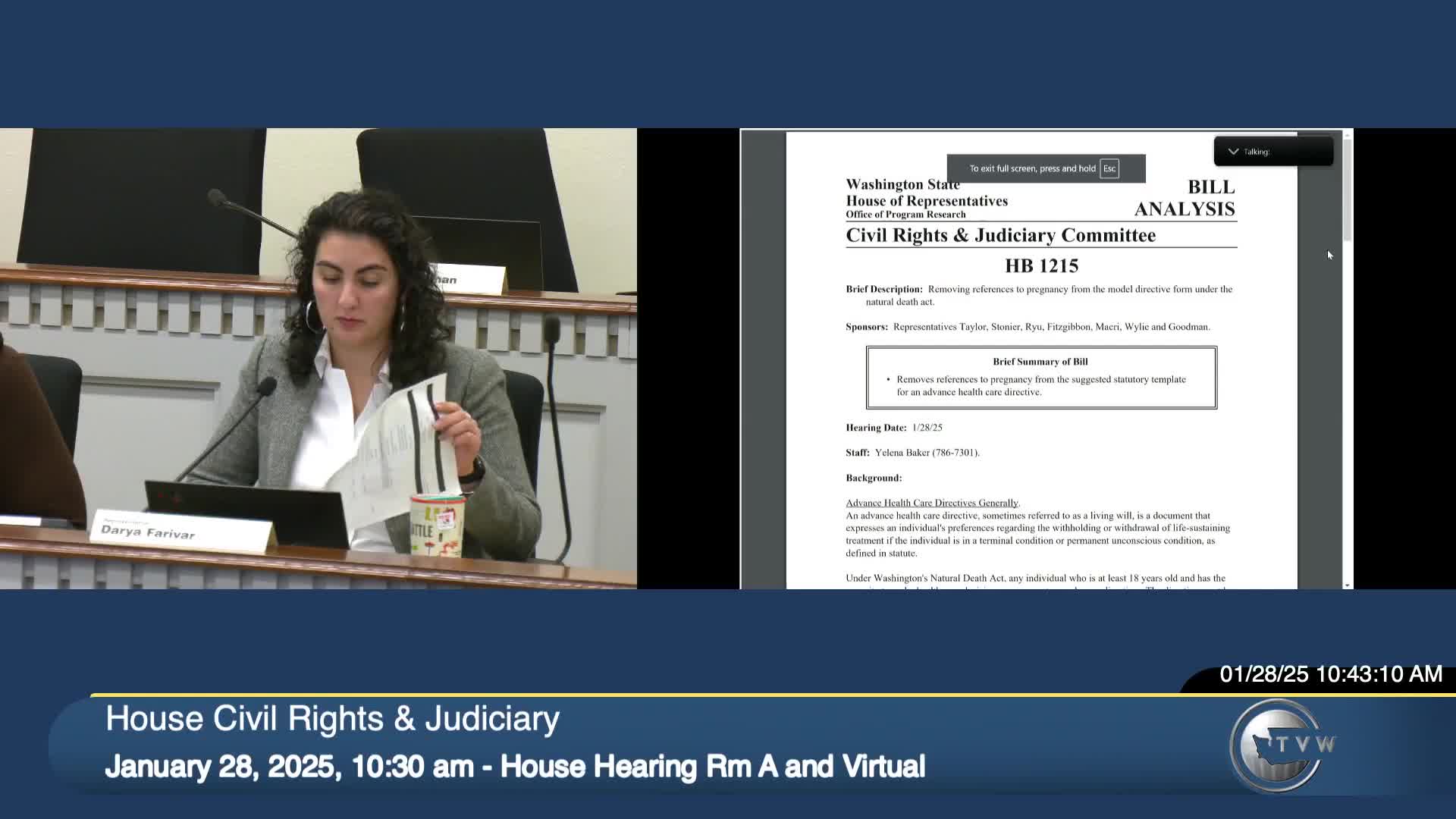
House Bill 1215, which would remove language in the state's suggested advance health care directive that automatically voids a directive if the signer is pregnant and the physician knows of the pregnancy, drew supporters and opponents to the Civil Rights & Judiciary Committee on Jan. 28.
Sponsor Representative Jamila Taylor said the measure is intended to ensure parity in end‑of‑life decision‑making: "I bring this bill in order to help bring parity for a person who is pregnant, in terms of their end of life care and their directives," she told the committee. The bill removes a sentence in the model form that reads, in the statutory template, that a directive "shall have no force or effect during the course of my pregnancy" if the physician knows of the pregnancy.
Advocates argued that, because the statutory model is widely used, the clause has led some providers and legal advisers to treat directives completed by pregnant people as void, even where the law does not require that outcome. "Because the model form does have that provision, people ... continue to believe and to advise people that they cannot have a valid advance directive that doesn't include that language," Sarah Ainsworth, chief legal and policy director at If/When/How, told the committee, citing litigation in Idaho where similar language had been struck down.
Nancy Sapero, representing Cedar River Clinics, the American College of Obstetricians and Gynecologists and End of Life Washington, said the model form is in the statute and therefore used by most lawyers and the public. "People's rights are not diminished because they have the capacity to become or are pregnant," Sapero said, urging passage.
Opponents said the model clause protects fetal life. Theresa Shrimp, a retired estate‑planning attorney who testified in opposition, said eliminating the clause would "effectively provid[e] that the unborn child must die along with the mother without specifically saying so," and urged the committee to retain an express option for signers to address pregnancy in the form.
Committee members questioned whether the model should instead present an explicit choice (for example, a checkbox allowing a signer to indicate whether the directive applies during pregnancy) rather than simply striking the sentence. Testimony noted the Idaho litigation that resulted in a federal court ruling that a mandatory pregnancy exclusion could be unconstitutional when it compelled speech or invalidated a pregnant person's declared wishes.
No formal action was taken at the Jan. 28 hearing. Advocates said they will provide illustrative scenarios and legal analyses to the committee to address questions about how hospitals and providers should apply advance directives for pregnant patients.