Get Full Government Meeting Transcripts, Videos, & Alerts Forever!
Get email alerts on the Adult Family Homes Arbitration topic
No spam. Unsubscribe anytime.
Bill would add factors for arbitrators in adult family home bargaining, providers say it would improve pay
Summary
House Bill 1398 would add required and permissive factors for interest arbitration between adult family home providers and the state; providers and advocates said the change would help align reimbursements with comparable long-term care settings and support workforce stability.
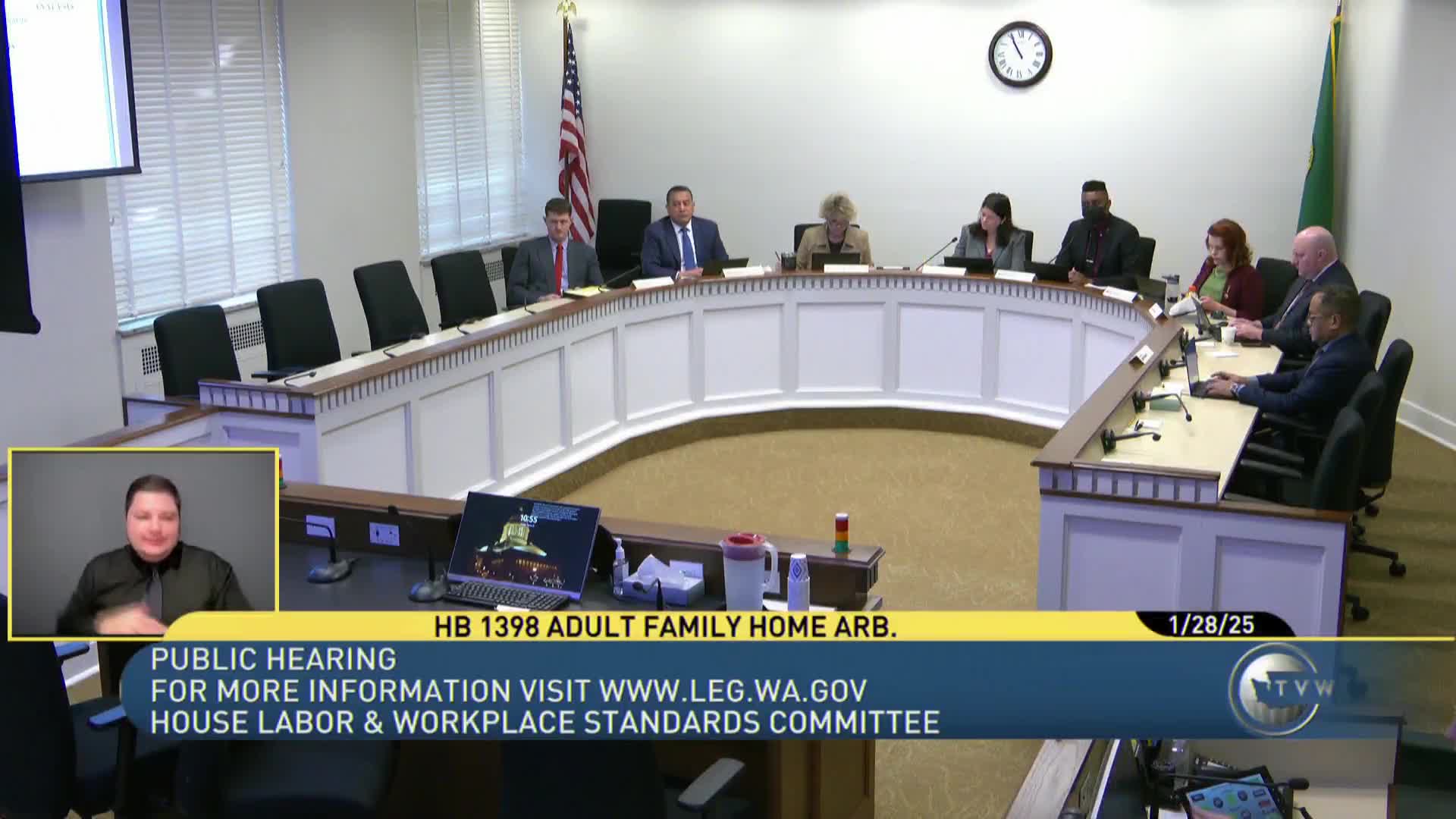
House Bill 1398 would add new factors an interest arbitration panel must or may consider in collective bargaining impasses between adult family home providers and their public employer, staff told the House Labor & Workplace Standards Committee at a Jan. 28 hearing.
Adult family homes provide licensed residential care for elderly people and individuals with developmental or physical disabilities. Under current law, providers are considered public employees for bargaining purposes and disputes that reach impasse go to mediation and binding arbitration. HB 1398 would add two required factors: a comparison of wages, hours and conditions of publicly reimbursed personnel providing similar services across the United States, and a consideration of the state’s financial ability to pay for the collective bargaining agreement. The bill would also add four discretionary factors, including comparisons with publicly employed personnel nationally and the state’s interest in promoting a stable long-term care workforce.
Proponents from the Adult Family Home Council and individual operators said the sector has grown rapidly and that Medicaid reimbursement rates lag other long-term care programs. Courtney Williams, advocacy coordinator for the Adult Family Home Council, said Washington has roughly 5,200 adult family homes serving about 30,000 residents and that the sector has grown about 58% since 2021. “It is time to extend equitable considerations to adult family homes,” Williams said.
Owner-operators and consultants described complex resident needs, staffing ratios and the prevalence of Medicaid funding. Alyssa Arley, who consults on adult family home development, told the committee many providers care for residents with complex medical and behavioral needs and that more than 65% of adult family homes are funded by Medicaid while reimbursement rates “fall far below what’s needed to cover the actual cost of care.” Dan Privette, an owner and council board member, said Medicaid patients represent a majority of beds and that higher reimbursement would allow more providers to accept Medicaid residents without long private-pay waiting periods.
Committee staff answered factual questions about the bill’s effect on arbitration factors; staff said the change alters the factors a panel must consider but does not itself set reimbursement rates. A committee member asked whether the law would enable arbitration panels to raise Medicaid reimbursement levels; staff said they would follow up with details about how reimbursement rate-setting functions in practice.
No committee vote was taken during the hearing.