Get Full Government Meeting Transcripts, Videos, & Alerts Forever!
Get email alerts on the Research Agency Overview topic
No spam. Unsubscribe anytime.
WSIPP director outlines institute's nonpartisan research role and timelines to Senate Ways & Means Committee
Summary
Stephanie Lee, director of the Washington State Institute for Public Policy, briefed the Senate Ways & Means Committee on WSIPP’s mission, governance and typical timelines for evidence reviews, outcome evaluations and economic analyses as the legislature considers research assignments for the next biennium.
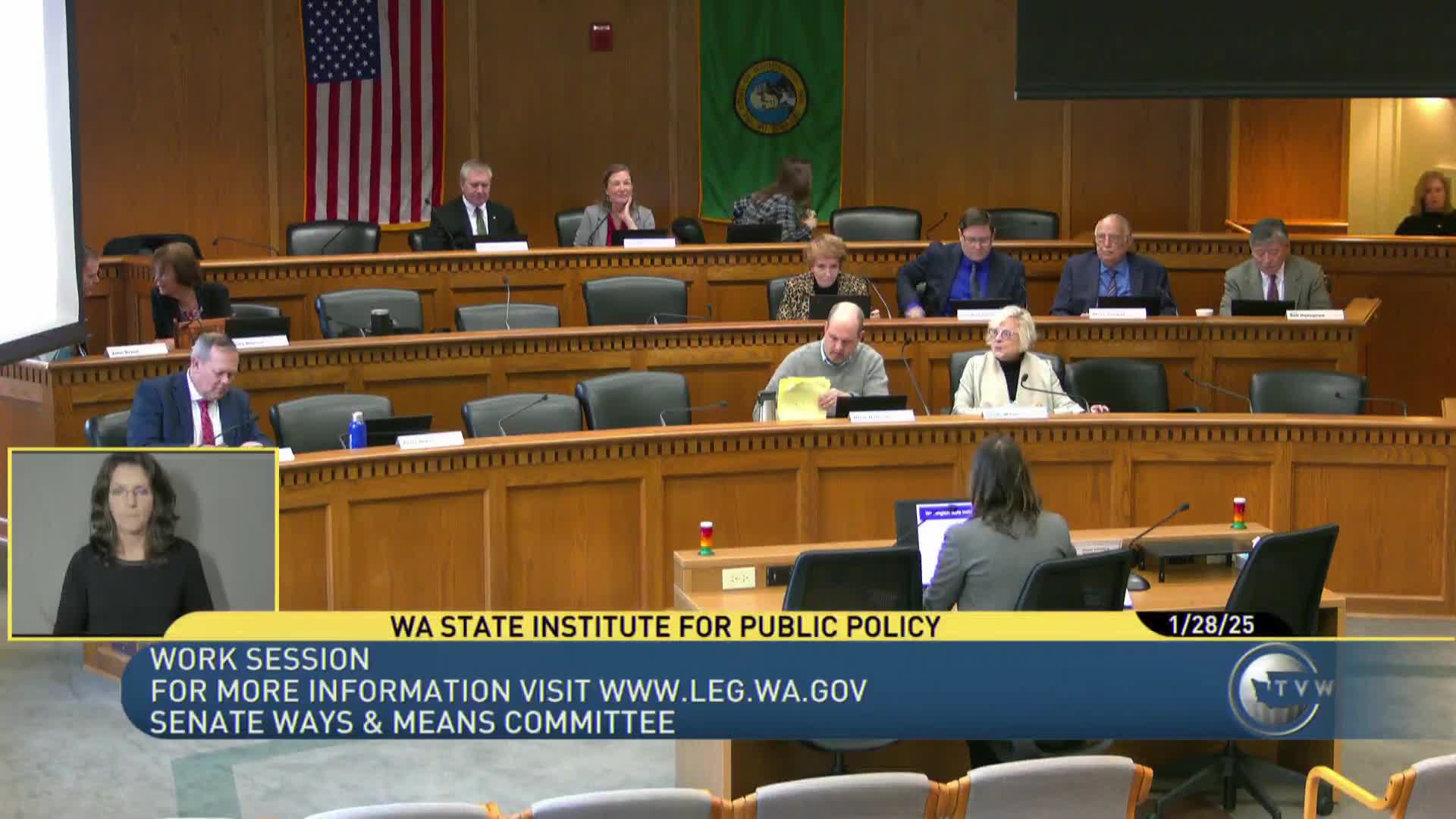
Stephanie Lee, director of the Washington State Institute for Public Policy, told the Senate Ways & Means Committee on Jan. 28 that WSIPP is an explicitly nonpartisan research agency that serves the legislature with quantitative, evidence-based studies.
"We are an explicitly nonpartisan research agency designed to serve the legislature with rigorous research," Lee said in opening remarks. She told the committee WSIPP was created in 1982, is administered as a public service center through The Evergreen State College and that most projects are initiated or funded by legislative assignments.
Lee described the institute’s typical study types and timelines: tightly scoped evidence or policy reviews generally take at least six months and can extend to 18 months; outcome evaluations and economic analyses that require state agency data typically take a year to two years; descriptive studies run six to 24 months. She said WSIPP has active assignments and a packet of one‑page summaries of the last year’s work available to legislators.
Lee also outlined WSIPP’s board composition and staffing capacity. She said the 16-member board includes legislative members from both chambers and both parties and representatives from the governor’s office and higher education institutions; that board structure influences what WSIPP takes on. Lee closed by urging lawmakers with potential study ideas to contact WSIPP’s Associate Director for Research, Eva Wesley.
The committee did not take action during the briefing. The presentation served to remind members of WSIPP’s workload, expected completion dates for near-term studies and to invite assignments that could be scoped to inform the upcoming legislative session.
Looking ahead, Lee said WSIPP could begin new legislative assignments as early as July 1 if projects are scoped and funded, and the institute has more than 600 archived reports available online for reference.