Get Full Government Meeting Transcripts, Videos, & Alerts Forever!
Get email alerts on the Child Fatality Reviews topic
No spam. Unsubscribe anytime.
Bill modernizes local child fatality reviews, expands scope to age 19 and revises data-access rules
Summary
House Bill 1459 would rename and expand child mortality reviews to child fatality reviews, extend the review age to 19, clarify permitted data access for reviews, and refine confidentiality and evidentiary rules so review materials remain confidential but may be used in criminal proceedings in certain ways; prosecutors and public health officials
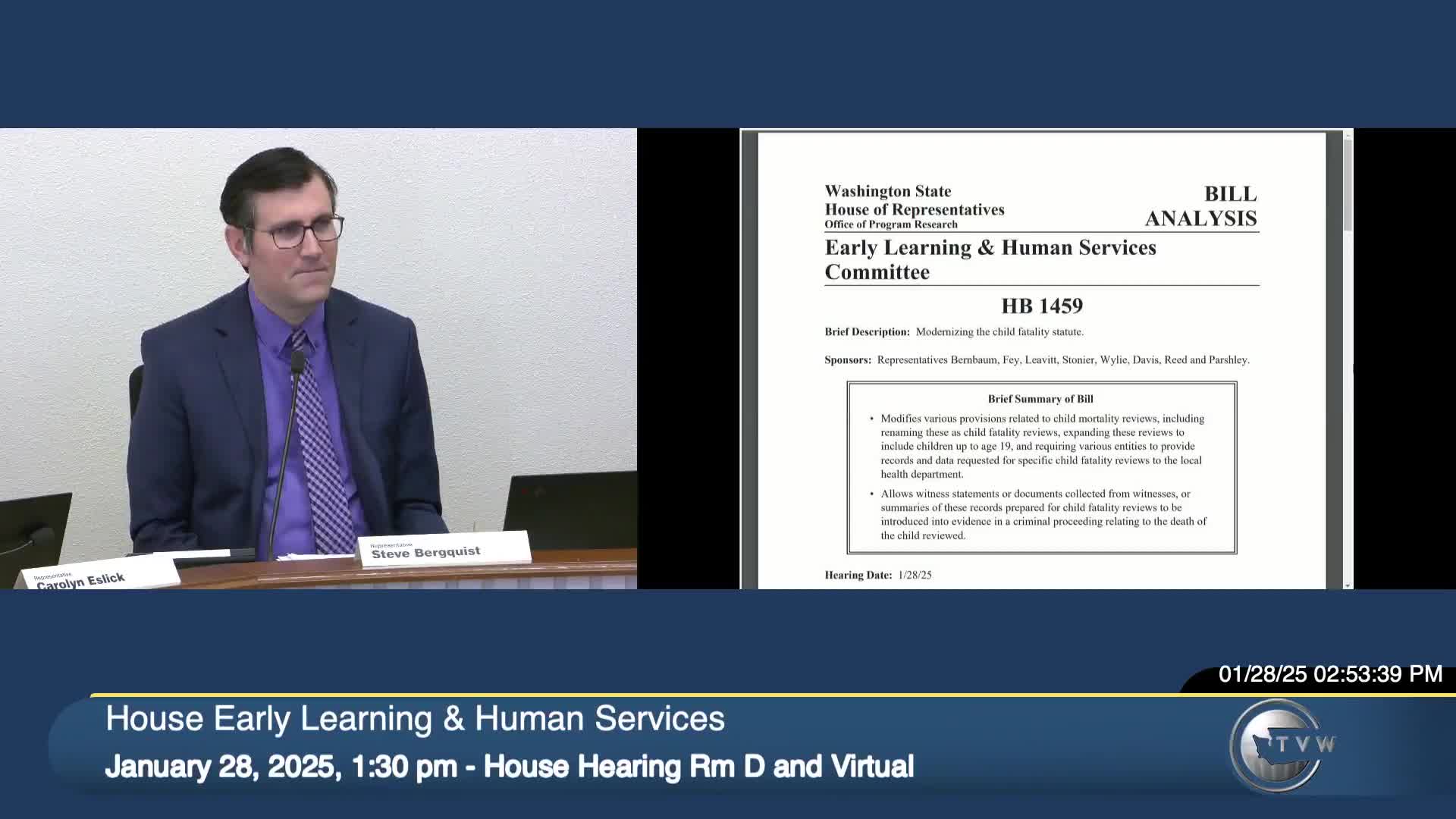
House Bill 1459 would update Washington’s local child mortality review statutes by renaming the process “child fatality reviews,” expanding the review age to include deaths of individuals up to 19 years old, clarifying permitted data access for local health departments, and refining confidentiality and evidentiary rules for materials collected during reviews.
Committee counsel Luke Wickham told members that local child fatality review teams examine medical, social, environmental and administrative factors that contribute to nonnatural child deaths to identify opportunities for prevention. Under the bill, local health departments would be able to request and receive medical records, autopsy and medical examiner reports and other data necessary to conduct a review; information submitted to the Department of Health and local health departments for the reviews would remain confidential and not subject to public disclosure, discovery, subpoena or introduction into evidence in civil or administrative proceedings.
The bill carves out a limited exception for criminal proceedings: witness statements or documents collected from witnesses (or summaries prepared for the review) may be introduced into evidence in a criminal prosecution, and local health department staff may be examined in a criminal proceeding. The bill also clarifies that if the review team uncovers a current, reportable and unresolved concern about child abuse or neglect, the team may designate a member to make a child abuse or neglect report; that person is not converted into a mandated reporter by the statute because the report is voluntary.
Jamie Bodden (representing the State Association of Local Public Health Officials), Katie Eilers (Department of Health) and Russell Brown (Washington Association of Prosecuting Attorneys) described negotiations during the interim to balance confidentiality for prevention work with prosecutors’ needs for access in criminal investigations. Bodden told the committee reviews can take time — often months to years — because teams may wait for parallel criminal or administrative proceedings to conclude before finalizing a review.
Representative Adam Birnbaum, who brought the bill to the committee, said the statutory updates preserve confidentiality while addressing prosecutors’ and local public health officials’ implementation concerns. The committee heard no opposition testimony and closed the hearing without taking immediate action.