Get Full Government Meeting Transcripts, Videos, & Alerts Forever!
Get email alerts on the Apcd Transparency topic
No spam. Unsubscribe anytime.
Panel debates removing ‘proprietary financial information’ restriction from Washington’s all-payer claims database
Summary
House Bill 1382 would remove statutory references to “proprietary financial information” in Washington’s all-payer claims database law and align state rules with federal price-transparency requirements to expand permissible reporting of negotiated rates and paid amounts.
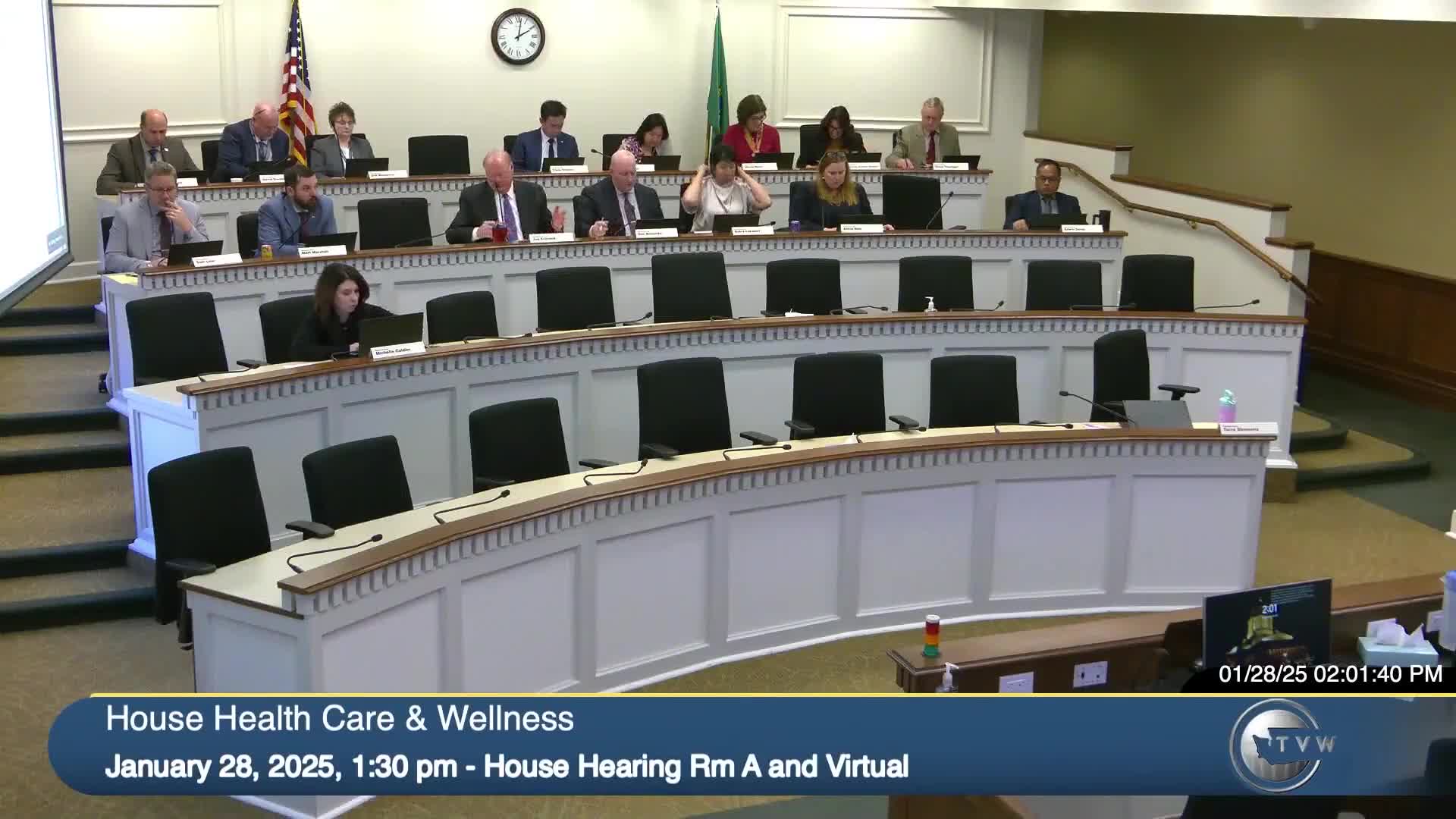
House Health Care & Wellness Committee members heard testimony on House Bill 1382, which would amend Washington’s all-payer claims database (APCD) statutes to remove references to “proprietary financial information,” align state law with federal price-transparency rules and broaden permissible reporting and use of claims data. The bill also allows, but does not require, the Health Care Authority to act as lead organization for the APCD and changes the Office of Financial Management’s reporting interval from biennial to every five years.
Staff explained that the APCD collects claims and paid-amount data and that existing statute restricts public use of reports that could “drive negotiated rates” because of the proprietary-information designation. Emily Pool, committee staff, said HB 1382 would remove those statutory restrictions so reports and analytics could better inform purchasers and policy makers.
Agency and transparency advocates supported the change. Evan Klein, special assistant for legislative and policy affairs at the Health Care Authority, said federal rulemaking and executive actions have increased public availability of negotiated rates and that the APCD already captures paid amounts; aligning state statute with federal policy would increase the APCD’s usefulness to smaller purchasers and policymakers who lack resources to use machine-readable federal files. Jane Beyer of the Office of the Insurance Commissioner said OIC has relied on the APCD for cost-driver and mental-health analyses and would like authority to report carrier-specific information where consistent with statute’s goals.
Patient-advocacy groups urged broader transparency. Emily Bryce of Northwest Health Law Advocates testified the APCD is a “critical tool” and that removing antiquated restrictions would help patients and purchasers access the negotiated prices that drive affordability.
Hospitals and health-plan associations urged caution and requested preserves for fair competition and data protections. Peggy Lewis Fu of the Association of Washington Health Care Plans warned that federal rules “balance transparency with protecting sensitive financial data” and said removing state protections could expose sensitive contract terms and increase risk of market manipulation. Katie Cohen of the Washington State Hospital Association said 2014 legislation intentionally restricted use of proprietary data for procurement and payment policy and urged removing procurement uses from the bill and ensuring equitable and affordable data-access fees for affected providers and organizations.
The committee received testimony on both the transparency benefits and the competitive risks; witnesses agreed the APCD remains a valuable analytic tool. The hearing closed with no recorded vote or amendment in the transcript.