Get Full Government Meeting Transcripts, Videos, & Alerts Forever!
Get email alerts on the Ambulance Billing topic
No spam. Unsubscribe anytime.
House committee reviews bill requiring standard consumer notice for ambulance bills after crashes
Summary
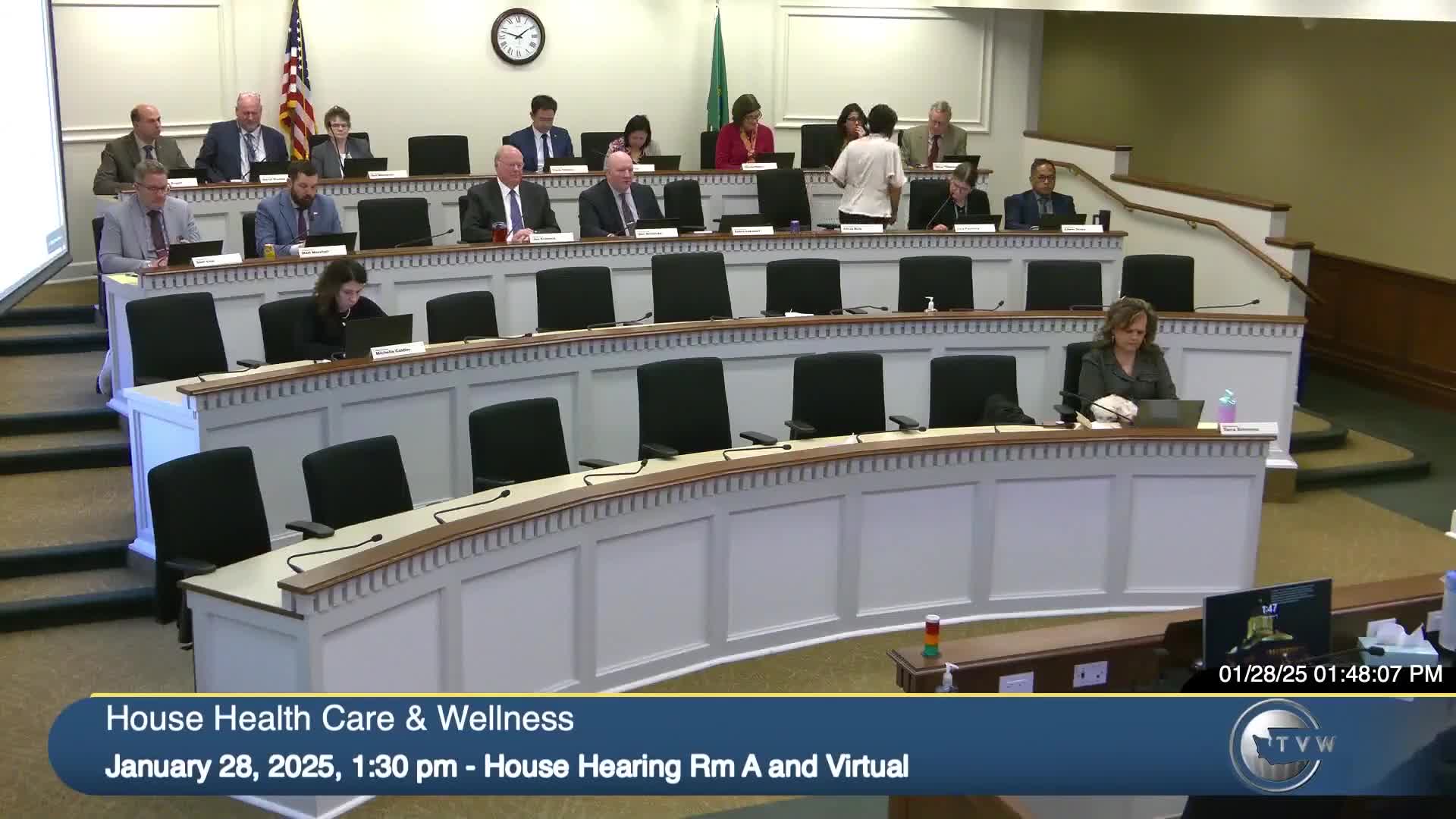
House Health Care & Wellness Committee heard public testimony Wednesday on House Bill 1187, which would require the Washington State Department of Health, in consultation with the Office of the Insurance Commissioner and other stakeholders, to develop a standard consumer notice about ambulance billing after motor vehicle accidents by Jan. 1, 2026.
House Health Care & Wellness Committee heard public testimony Wednesday on House Bill 1187, which would require the Washington State Department of Health, in consultation with the Office of the Insurance Commissioner and other stakeholders, to develop a standard consumer notice about ambulance billing after motor vehicle accidents by Jan. 1, 2026.
The bill would require ambulance services, including ground and air ambulances, to attempt to collect auto, personal injury and relevant health insurance information at the time of transport and to provide the DOH-created consumer notice at transport or within 60 days. If insurers are identified later, ambulance services must bill the insurer or the patient within 60 days of obtaining the information.
Supporters said the notice would help people confronted with unexpected bills after crashes. Sydney Regala, health policy analyst at the Office of the Insurance Commissioner, said OIC “supports the consumer protection elements and the education components of this bill” and recommended using the enforcement model developed for the Balance Billing Protection Act.
Representative Cindy Ryu, the bill’s prime sponsor, described a personal experience she said motivated the bill: “I was surprised with the collection notice 6 months later without ever having received the bill.” Ryu said she worked with agency staff during the interim to develop the proposal and invited committee members to stakeholder meetings with ambulance and firefighter associations.
Ambulance and fire-service groups testified in opposition or with concerns about operational impacts. Mike Battis, president of the Washington Ambulance Association and director of Ballard Ambulance in Wenatchee, said his association is opposed because requiring crews to gather extra insurance details at crash scenes could undermine patient care. “When we’re out dealing with emergencies, our primary task…has to be taking care of patients,” Battis said, adding that “it kind of reverses that order” if crews must act as billing agents.
Sean Ford, EMS section chair for the Washington Fire Chiefs Association and EMS division chief for the Camas Fire Department, raised similar operational concerns and questioned adding another written notice at the time of service. “We already have two other notices we have to provide a patient at the time of service,” he said, noting that handing multiple documents to people at the scene of an accident may not be effective.
OIC staff and ambulance groups said providers generally try to collect insurance data during transport or afterward via coordination with hospitals and their billing departments; Battis said many ambulance services promptly forward records to billing so claims are filed within days when information is available. OIC noted it will continue stakeholder discussions, including an advisory group that met during work on last year’s ground ambulance balance-billing legislation (SSB 5986).
The committee took testimony and closed the public hearing; no formal amendments or votes were recorded in the hearing transcript. The bill text sets the DOH deadline of Jan. 1, 2026, and the 60-day timing requirements for notices and billing.
Questions and further stakeholder work focused on practical implementation: when and how crews could collect insurance information without compromising emergency care, how hospitals and billing departments would assist, and how the notice and enforcement approach would mirror the Balance Billing Protection Act. The committee did not vote on HB 1187 during this hearing.