Get Full Government Meeting Transcripts, Videos, & Alerts Forever!
Get email alerts on the Housing topic
No spam. Unsubscribe anytime.
House committee hears testimony on bill to allow denser housing near transit
Summary
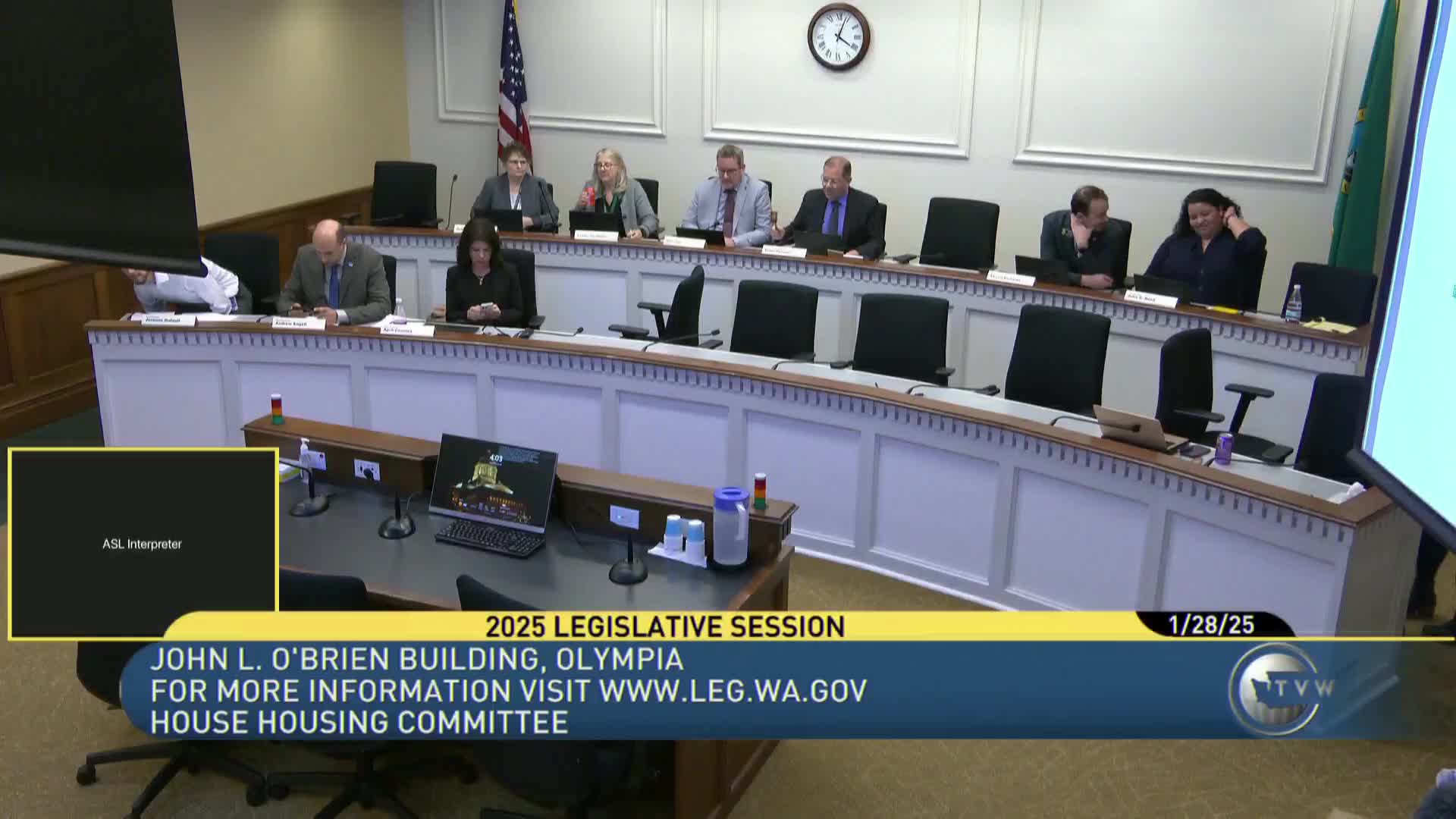
Representative Reid, sponsor of House Bill 1491, and state staff briefed the House Housing Committee on Jan. 28 on a proposal to require denser housing and related rules within designated transit station areas.
Representative Reid, sponsor of House Bill 1491, and state staff briefed the House Housing Committee on Jan. 28 on a proposal to require denser housing and related rules within designated transit station areas.
The bill would define a station area as a half-mile walking distance from an entrance to a rail or fixed-guideway stop and a quarter-mile from a bus rapid transit stop with fixed assets; it would require cities to allow multifamily housing where residential uses are allowed, set minimum floor-area ratios (FAR), limit off-street parking requirements in station areas, and provide a State Environmental Policy Act (SEPA) exemption for residential or mixed uses built in station areas. The measure also directs the Department of Commerce to administer a capital grant program to help cities provide infrastructure to accommodate transit-oriented development (TOD). No committee vote was taken; the hearing was informational.
Why it matters: Sponsors and many testimony witnesses framed the bill as a tool to expand housing near public transit, which supporters said would reduce sprawl, shorten commutes and increase housing options for working families. Opponents — including developers, some cities and commercial real estate groups — cautioned that state-mandated inclusionary affordability requirements could make projects financially infeasible and push development away from station areas.
What the bill would require and allow Serena Dolly, staff to the committee, summarized the core elements: the bill requires a minimum FAR of 3.5 in station areas centered on rail stops and 2.5 for bus rapid transit corridors, with a density bonus of 1.5 FAR where all units are permanent supportive or affordable housing. A newly built residential project in a station area would need to reserve at least 10 percent of units as affordable housing or 20 percent of rental units as workforce housing, though cities with certain existing affordability or density programs could be excepted. Cities must meet the bill’s requirements at the earlier of their next comprehensive-plan update or their five-year implementation progress report, Dolly said.
Dolly also explained other provisions: cities generally could not require off-street parking for residential or mixed uses inside a station area (subject to some exceptions), the bill would create a SEPA exemption for qualifying residential or mixed-use projects in station areas, and Commerce would run a capital grant program to fund infrastructure needed for denser development. The bill allows cities to apply to Commerce for extensions to density requirements in areas that are at high risk of displacement.
Supporters’ arguments Representative Reid (bill sponsor) described the proposal as an answer to the state’s housing shortage, saying denser housing around commuter rail, light rail and bus rapid transit will help working-age residents find housing near jobs and transit and ease long commutes. Reid told the committee that the bill “addresses the urgent need for housing by making it possible to build denser housing around our most used transit modes,” and pointed to an analysis by FutureWise estimating large development capacity gains in the Central Puget Sound region.
Nicholas Carr, the governor’s senior housing policy advisor, said the governor’s office supports the bill as part of a strategy to reach statewide housing targets and to reduce sprawl and pollution. “With the right regulations and incentives, the state-supported TOD policy will create more home options for working families already living in our communities,” Carr testified.
Advocates for affordable housing and labor also supported the bill. Michelle Thomas of the Washington Low Income Housing Alliance urged the committee to combine upzoning and infill with affordability to prevent displacement. John Treanor, legislative director for the Washington State Labor Council, AFL-CIO, said the bill would create jobs for construction workers and “more housing, accessibility to and from work, and the jobs to build it.” Ryan Donahue from Habitat for Humanity described several Habitat projects that would benefit from increased density.
Concerns and opposition Several groups and local officials raised reservations about specific provisions. Commercial real estate representatives and developers — including Mackenzie Darr of NAEP Washington State (Commercial Real Estate Development Association) and others — said they cannot support a state-calibrated, mandatory inclusionary housing requirement because it may not reflect local market realities and could reduce development feasibility. As Mackenzie Darr testified: “We cannot support this bill with the state-mandated and state-calibrated inclusionary housing provision.”
Association of Washington Cities representatives expressed cautious support for statewide affordability standards but said local conditions vary and some jurisdictions lack transit frequency or infrastructure to support major infill. Carl Schroeder of the Association of Washington Cities said the association “supports the affordability requirements” in principle while urging flexibility for local conditions and concern about parking reductions near some bus rapid transit stops.
Several smaller cities and jurisdictions raised implementation and infrastructure concerns: Sumner and other smaller jurisdictions cautioned against broad parking reductions where frequent local transit is limited; the Snow King Water District Coalition asked the committee to clarify how critical aquifer recharge areas would be treated and to include water and sewer districts in any infrastructure grant program; the City of Fife requested flexibility in how station-area boundaries are applied to avoid drawing industrial and manufacturing parcels into upzoning unintentionally.
Process, timeline and implementation Multiple witnesses noted sequencing questions between the bill’s upzones and local comprehensive-plan and code updates. Several speakers urged waiting for or coordinating with studies already funded by the legislature (including a joint transportation committee study) and recommended that the bill’s timing and implementation requirements be calibrated so jurisdictions updating development codes after updated comprehensive plans are not unfairly penalized. Some city representatives mentioned a later implementation date (for certain effects through 2030) and asked for additional funding for infrastructure grants to accompany the zoning changes.
What did not happen The committee did not vote on HB 1491 at the Jan. 28 hearing; the event was a public hearing and discussion of testimony. The chair closed the hearing by noting amendment deadlines and caucus room assignments for members, and said the committee would adjourn for the day.
Ending note Testimony spanned a broad coalition of state agencies, affordable housing advocates, labor unions, developers, local governments and community members. The bill blends statewide standards (FAR, inclusionary thresholds, parking and SEPA exemptions) with implementation flexibilities and a proposed Commerce capital grant program; its next steps will depend on further negotiations on affordability tools, implementation timing and infrastructure funding.