Get Full Government Meeting Transcripts, Videos, & Alerts Forever!
Get email alerts on the Clean Fuels Program topic
No spam. Unsubscribe anytime.
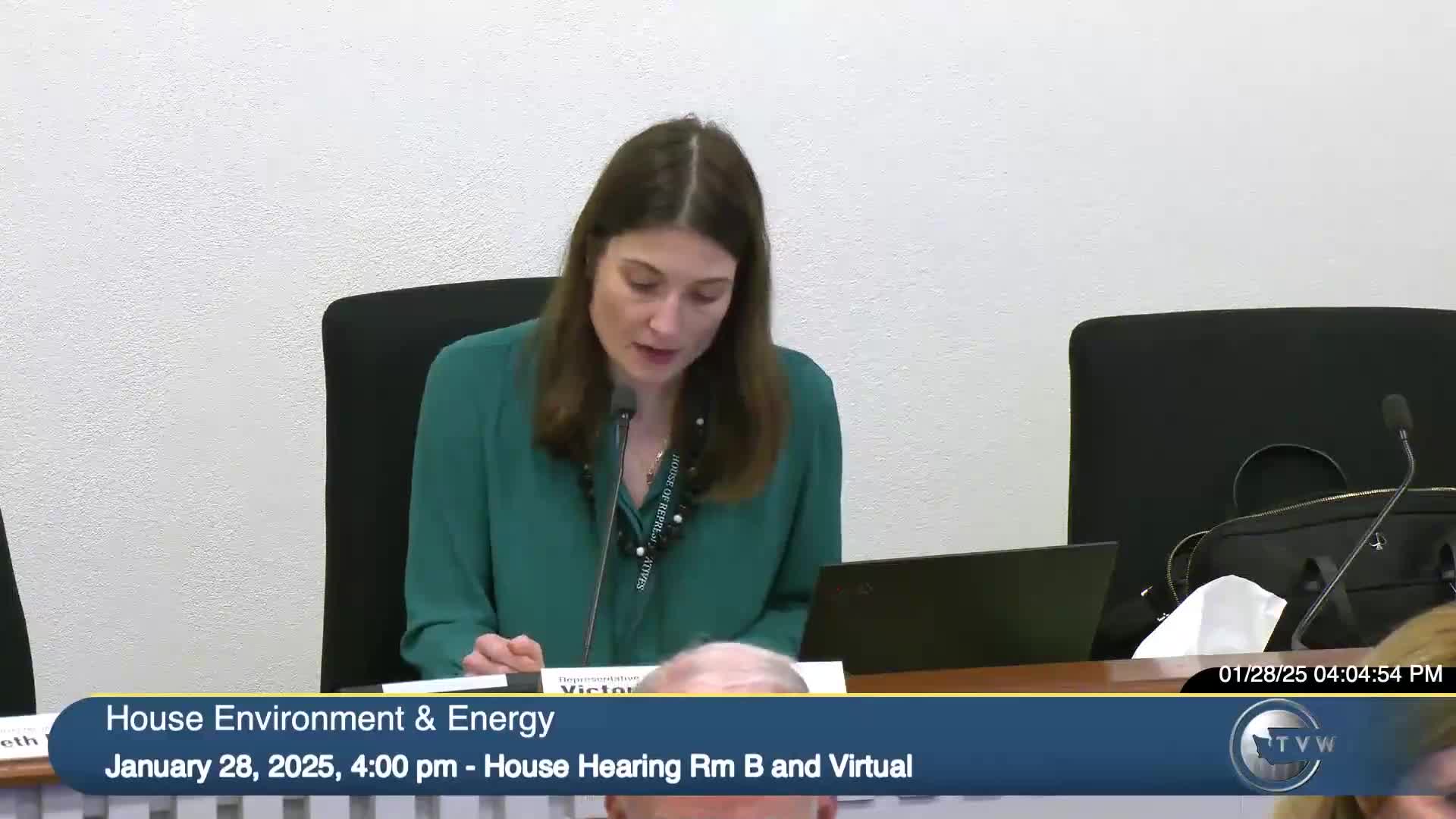
Washington committee hears mixed views on changes to clean fuels program in HB 1409
Summary
Representative Joe Fitzgibbon told the Environment & Energy Committee that House Bill 1409 would smooth and modestly tighten Washington’s Clean Fuels Program targets and replace Clean Air Act enforcement with program‑specific civil penalties.
Representative Joe Fitzgibbon, prime sponsor, told the Environment & Energy Committee that House Bill 1409 would smooth and modestly increase near-term carbon‑intensity targets in Washington’s Clean Fuels Program and replace the program’s current enforcement under the Clean Air Act with a tailored civil‑penalty structure. "I do not believe criminal penalties are appropriate for folks who are regulated by this program," Fitzgibbon said.
The bill matters because the Clean Fuels Program regulates the carbon intensity of transportation fuels and uses a declining standard and a credit market to incent lower‑carbon fuel production and use. Jacob Lipson, staff to the committee, summarized the current program: it assigns deficits to high‑carbon fuel production or import, allows credits for lower‑carbon pathways such as renewable natural gas, ethanol and electricity, and currently targets a 20% reduction by 2034 based on a 2017 baseline.
Supporters said the bill would help the program deliver on its climate and clean‑transportation goals by addressing an oversupplied credit market and by giving regulated parties more predictable year‑to‑year changes. Leah Missick of Climate Solutions said the program is "a critical tool for addressing our largest source of climate pollution in Washington" and called HB 1409 "an important step forward." Joel Creswell, climate pollution reduction program manager at the Department of Ecology, told the committee that rapid technology changes have produced an oversupply of credits and that "a stronger carbon intensity standard allows the clean fuel standard to better incentivize the transition to low carbon fuels." Creswell cautioned, however, that the bill does not change the program’s ultimate 2034 target and "may still leave the program at a competitive disadvantage" compared with Oregon and California.
Utilities and local governments also urged changes to improve market signals. Amy Higbee, policy advisor for Tacoma Power, said strengthened targets could "create opportunities for our utility as well as other utilities to increase investments in transportation electrification." Michael Briesch of Seattle City Light said a healthier market would produce "a critical source of revenue to invest in clean transportation and supportive infrastructure." Justin Leighton, executive director of the Washington State Transit Association, said his members have seen credit prices fall from over $100 early in the program to recent quarters near $26, and he urged measures that restore incentive value for transit agencies that sell credits.
Renewable‑fuel producers and industry groups urged the committee to remove triggers that link program growth to specific in‑state production thresholds. Clifford Traceman of Washington Conservation Action and Kent Hartwig of Gevo both said the thresholds and siting conditions add market uncertainty that discourages investment. Corianne Wynne and Scott Richards of Clean Fuels Alliance America said Washington’s program has already delivered emissions reductions but needs stronger, more predictable targets to attract more low‑carbon fuels.
Opponents, including agricultural representatives and some business groups, urged retention of in‑state production preferences. Ben Buckholz of Far West Agribusiness Association warned the bill would remove language that members view as a promise of new local markets for feedstock. Jody Muller of WISPA and Peter Godlowski of the Association of Washington Business flagged potential consumer price effects and said penalty levels should be closer to those used in Oregon and California. Tom Wolf of BP asked that Ecology have discretion to distinguish inadvertent errors from intentional violations and to align penalties with other states’ approaches.
On enforcement, the bill replaces Clean Air Act civil and criminal penalties with a menu of civil penalties specific to Clean Fuels Program activities. Lipson summarized examples in the draft: penalties above $1,000 could apply for illegitimate credit generation tied to an incorrect carbon‑intensity score, and penalties up to $10,000 per day could be assessed for failures to report production or import information.
The Department of Ecology told the committee it is required to track costs, including annual independent contractor cost‑impact reviews that calculate cents‑per‑gallon effects; Ecology staff said those reviews show program impacts are on the order of pennies per gallon, not dollars. Joel Creswell and other panelists noted that the program currently exempts several off‑road fuels and that decisions about interactions with the Climate Commitment Act (cap and invest) are complex but generally found to be complementary in prior economic analysis.
The committee did not take final action on HB 1409 at the hearing. The record includes extensive stakeholder testimony and an agency implementation briefing that Ecology said would continue as the bill moves through the process.
Ending: The bill will move forward for committee consideration; the committee record includes technical and policy questions for Ecology and multiple stakeholder proposals for changes to penalties, in‑state production language and the compliance trajectory. Committee members requested follow‑up data on price impacts and market modeling before making substantive amendments or a final vote.