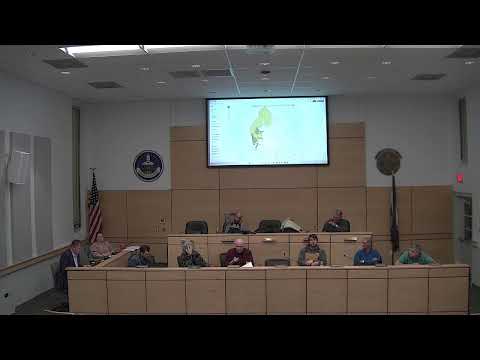
Madison County planners debate housing chapter language, metrics and limits
Summary
Planning commissioners spent the session revising the comprehensive plan’s housing chapter — debating affordable-housing metrics, whether to reference multifamily development, manufactured-home terminology, and tying housing goals to county service capacity.
Madison County Planning Commission members spent most of the meeting revising the housing chapter of the county’s comprehensive plan, debating how much the document should mirror Virginia law and how the county should describe and measure “affordable housing.”
Commissioners and staff discussed retaining much of the text already drafted and keeping supplemental material in appendices rather than in the main plan. They also debated what metric the plan should use to define affordability, discussed data sources, and questioned whether the plan should state a presumption in favor of multifamily or higher-density housing.
The commission reviewed the Rappahannock-Rapidan Regional Commission study as a partial data source for measuring housing need, but several participants said that study addresses low-income households only and does not answer how the plan should measure broader affordability. The 30-percent standard (households spending more than 30 percent of income on housing) was cited as a commonly used benchmark; participants also discussed using area median income (AMI) or HUD measures.
Speakers repeatedly raised the county’s existing service capacity — schools, water and sewer, public safety — as a limit on how much new affordable housing the county can accommodate. One participant said the plan should include metrics tying new housing capacity to service capacity and school enrollment thresholds rather than adopting a blanket commitment that could trigger unreimbursed infrastructure costs for current taxpayers.
Commissioners debated language that described “relatively dense and high density in and around the town of Madison” and whether that phrasing reflected practical market realities in Madison County. Several participants said investors and developers are unlikely to build large multifamily projects in the county without infrastructure and market demand; others noted zoning districts (A1, C1, R1, R2, R3) already allow manufactured housing and, in some zones, multifamily by right or special use permit.
The commission approved a voice vote to remove one sentence that stated an assumed demand for multifamily housing after members agreed the sentence was unsupported by local data. The motion was carried by voice vote; formal tallies were not recorded.
Members asked staff to keep the Rappahannock-Rapidan study in the document as a partial definition and to bring additional, verifiable data sources where the plan currently lists claims without citation. Several participants emphasized that final editorial and grammatical cleanup could be done after content decisions were resolved, but they asked staff to add clarifying metrics (e.g., 30% cost-burden threshold, AMI references) and to tie housing goals to service-capacity considerations.
The commission agreed to continue the chapter edits at future meetings and to review goals and strategies (rather than rewrite the entire prefatory text) to ensure policy direction matched the community’s and the county’s capacity.
Ending: Staff were asked to return with suggested wording to: (1) define how “affordable housing” is measured in the plan, (2) document the Rappahannock-Rapidan study’s limits as a low-income analysis, and (3) show where the plan ties housing growth to school, water/wastewater and public-safety capacity.
AI generated
The text on this page is AI generated. Summaries, highlights, analysis, and video transcripts are all produced from the original source material.
AI can make mistakes, so if you spot one, and we will fix it for everyone.
Note: the source content is unaltered by us. Any content source we link to, be it a video, an audio recording, or a document, is presented exactly as its publisher released it. That publisher is usually a government body, sometimes an individual official or another organisation.