Get Full Government Meeting Transcripts, Videos, & Alerts Forever!
Get email alerts on the Oag Budget topic
No spam. Unsubscribe anytime.
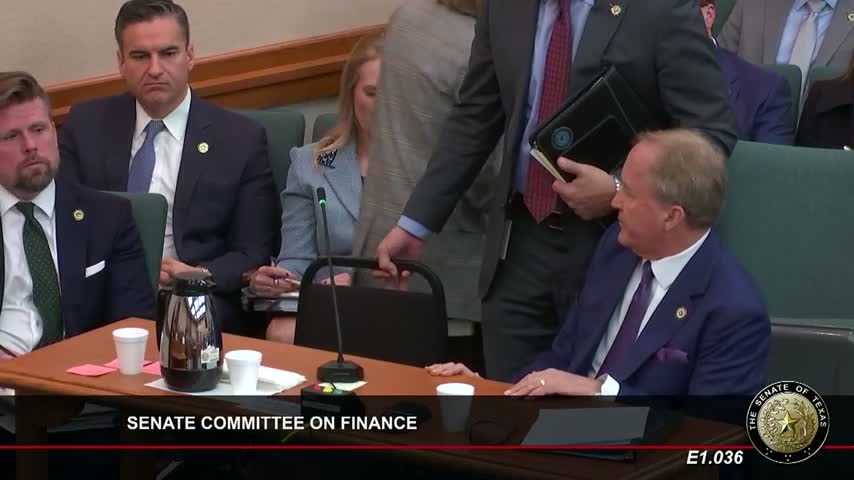
Senate Finance reviews Attorney General budget; LBB seeks cuts while Paxton urges payment of $1.4B Meta settlement and staff raises
Summary
Legislative Budget Board recommended reductions to the Office of the Attorney General budget, citing method-of-finance changes and program completions; Attorney General Ken Paxton asked the committee to approve outside counsel payments from the Meta settlement and requested salary increases and restored funding he said LBB erroneously removed.
The Senate Finance Committee on Sunday reviewed the Office of the Attorney General(OAG) budget, as Legislative Budget Board staff outlined $163.9 million in recommended reductions and several method-of-finance swaps while Attorney General Ken Paxton urged the committee to approve payment of outside counsel from a $1.4 billion Meta settlement and to restore funding he said was cut in error.
James Kessler of the Legislative Budget Board told the committee the recommendations "include a decrease of $163,900,000 from the 2024-25 biennium" and that the package "reduces the FTE cap by 3," while also describing two method-of-finance swaps and several rider deletions and adjustments. The packet also flagged a number of one-time items and exceptional items the LBB did not include in recommendations.
Why it matters: Committee members and agency officials focused on funding sources tied to victim services, an underused landowners compensation program and how a recent Federal Communications Commission rule limiting inmate phone fees has reduced anticipated revenue to a crime victimscompensation account.
LBB recommendations and account impacts
Kessler summarized items the board put forward, including reversal of an agency-proposed swap that would have replaced general revenue dedicated (GR-D) account 469 dollars with federal Victims of Crime Act (VOCA) funds for the crime victims compensation program. He also cited a projected biennial revenue loss to account 469 of about $40.5 million related to an FCC rule adopted in late 2024 limiting collection of inmate phone revenue.
Kessler walked senators through two specific swaps the agency proposed: $15.2 million from GR-D account 469 to be replaced by VOCA funds, and $10.8 million from child-support retained collections (a GR-D account) to general revenue fund 1 because of projected declines in retained-collection revenue. He told the committee the LBB's recommendations reverse the first swap and its matching federal funds.
Attorney General presentation and settlement payment request
Attorney General Ken Paxton told the committee the OAG is litigating nearly 32,000 matters and has generated substantial recoveries for the state. "As the state's chief legal officer, it's my agency's mission to champion liberty and justice for Texas," he said, and he listed recent recoveries and program results that, he said, support continued investment in the office.
Paxton discussed the $1.4 billion settlement with Meta, describing it as "the largest settlement ever obtained by a single state against a single company," and said outside counsel played an essential role. He and OAG staff explained the agency can negotiate hybrid contingency agreements that, in this case, resulted in a fee arrangement the AG estimated at about 10.2 percent rather than a standard 35 percent contingency fee.
Paxton asked the committee to authorize payment of the outside counsel fees tied to the Meta settlement and to adopt a rider that would create a pathway to pay comparable future fees between legislative sessions when statutory conditions are met. First Assistant Attorney General Brent Webster described the rider goal as creating a process so the state can pay fees when a settlement or judgment becomes final and the statutory requirements for outside counsel payments are met.
LBB error, riders and other reductions
Paxton and OAG Chief Financial Officer Michelle Price told senators the LBB's introduced bill contains a $38 million reduction that the OAG believes resulted from reversal of a method-of-finance swap and related technical steps. Price said the agency had proposed using expiring federal funds for some claim payments to preserve GR-D balances and that reversing that swap in the introduced bill produced the unintended cut.
Kessler and committee leadership repeatedly said the cut was not the LBBstaff's intent and pledged to work with the agency and comptroller staff to identify and correct technical issues.
Victim services, claim timeliness and account structure
The committee examined measures for the crime victims compensation program and related victim assistance grants. LBB recommended splitting previously combined performance measures to report forensic sexual-assault exam payments separately from crime-victims compensation awards; LBB staff said the split will provide more useful reporting because exams are usually billed and paid much faster than other claims.
Josh Reno, deputy attorney general for criminal justice, told senators the crime victims compensation program has lagged targets for compensation awarded each year and that the agency primarily attributes the shortfall to staffing constraints. Reno and other OAG staff also described outreach challenges for the new landowners compensation program created by Senate Bill 1133 (88th Legislature), which the agency said was launched only months before payments were tracked. Reno said the program was underused partly because claimants did not always associate damage with border-related crimes or were reluctant to use insurance as a first payer.
Landowners compensation program
Senators pressed the agency about the landowners compensation program created by Senate Bill 1133, which the OAG said the agency treated as a one-time appropriation and did not include as an exceptional-item request for the next biennium because unspent balances remain. Reno said the program did not begin operating until about May 2024 and that outreach and statutory constraints (including being payer of last resort) limited early claims. He told the committee the agency is willing to work with the Legislature to adjust eligibility and outreach to increase access.
Child support and other divisions
Paxton highlighted OAG child-support performance in testimony, saying the agency had collected nearly $44.2 billion in child support historically and touting child-support division improvements. Committee members asked about the effect of budget changes and LBB recommendations on enforcement and timeliness; Paxton and staff said they had restructured the program, saw fewer constituent complaints recently and requested continued support for technology and staff.
Medicaid fraud, high-profile investigations
Several senators asked about the OAG's Medicaid fraud and fraud-control work. Paxton and staff said the office has increased civil enforcement and prosecutions, is pursuing appeals in major cases (including a pending appeal in the Pfizer matter), and will continue investigations including matters involving Texas Children's Hospital. Brent Webster and Josh Reno said some investigations are ongoing and declined to disclose details while cases proceed.
Other requests, riders and totals
Kessler's packet also listed deletions of rider 38 through 41 and rider 43 in recommendations, noted removal of certain targeted salary-increase riders (riders 40 and 41, which had funded assistant attorney-general salary increases in 2024-25), and itemized exceptional items the LBB did not include in recommendations. The packet identified about $94.2 million in exceptional items and 24 FTEs that were not recommended.
What the committee directed or agreed to do
The committee and LBB staff agreed to review the technical swaps and the $38 million reduction, to provide the committee with lists of victim-assistance grantees on request, and to work with OAG staff on outreach and program design for the landowners compensation program. No formal votes were taken during the hearing portion captured in the transcript.
Ending note
The committee recessed for the Senate floor session after about two hours of testimony and questioning of OAG leadership and LBB staff; senators signaled they would continue work with agency and LBB staff on technical adjustments and follow-up information.