Get Full Government Meeting Transcripts, Videos, & Alerts Forever!
Get email alerts on the School Choice Esa topic
No spam. Unsubscribe anytime.
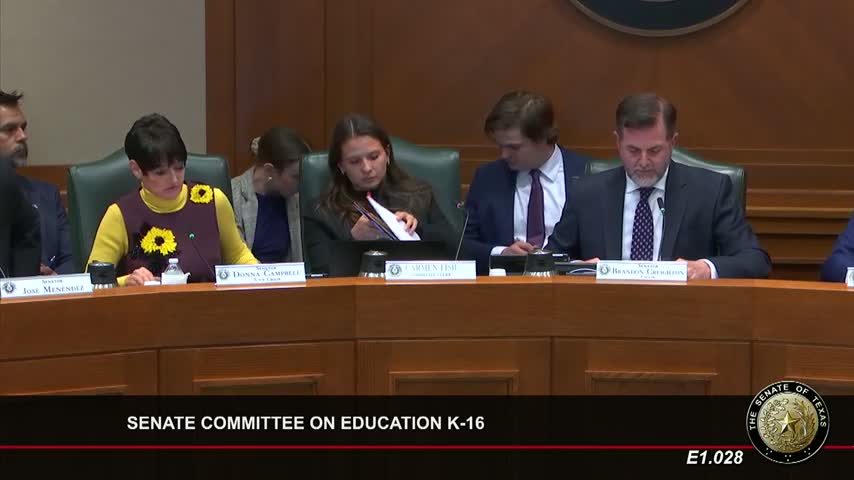
Texas Senate committee advances SB2, the "Education Freedom" bill, after hours of testimony
Summary
The Senate Education K–16 committee advanced Senate Bill 2, the Texas Education Freedom Act, which would create education savings accounts (ESAs) and redirect state funds to preapproved private providers and other approved uses. The bill passed the committee after an extended hearing featuring dozens of witnesses for and against the measure.
The Senate Education K–16 committee advanced Senate Bill 2, the Texas Education Freedom Act, after a long hearing that included hours of invited and public testimony both for and against the proposal. Chairman Brandon Creighton laid out the bill as a universal education savings account (ESA) plan that would initially set aside $200 million for a universal launch and an additional $800 million targeted to students with disabilities and students from households at or below specified poverty thresholds. Creighton described a multi‑tier ESA: a $2,000 minimum for unaccredited choices, a $10,000 award for students enrolling in accredited private schools, and a modest increase for students with disabilities, with administrative oversight assigned to the comptroller’s office and anti‑fraud controls included.
The committee adopted its proposed committee rules by unanimous consent. Members then heard prolonged debate and more than three hours of invited and public testimony. Proponents — including national choice groups, state affiliates, faith‑based school representatives, and some parents — said ESAs expand access for families currently shut out of other options and cited research they presented showing long‑term benefits in states with longstanding programs. Witnesses from private and sectarian schools, and organizations such as the Texas Catholic Conference and scholarship groups, said accredited private schools and nonprofit scholarship providers could quickly absorb new students and that many existing schools already serve low‑income and special‑needs students.
Opponents included public‑school advocates, several public‑school superintendents and school board representatives, disability advocates, parent groups and some teachers. They warned the proposal would divert state dollars from public schools (which educate roughly 94% of Texas students), reduce funds for already underfunded campuses, and leave students with disabilities and low‑income families without comparable protections. Special‑education leaders and disability groups said private providers are not bound by the Individuals with Disabilities Education Act (IDEA) or Section 504 and asked for statutory safeguards and clearer reporting requirements before any ESAs are created. Several witnesses from child‑care and early‑learning providers urged the committee to include licensed early‑childhood centers in the ESA eligibility, arguing those providers outperform some public pre‑K outcomes and that exclusion threatens the child‑care ecosystem.
Committee members pressed the author and comptroller’s staff on several details: how eligibility and priorities would be applied if demand exceeds funding; the role of the comptroller in approving providers; how ESAs would affect long‑term school finance and recapture; what anti‑fraud and cybersecurity protections would be required of Educational Assistance Organizations (EAOs); and how students with disabilities, charter school students and homeschoolers would be served. Senator Creighton said the bill includes background checks for vendors, norm‑referenced testing for participants, and “compelling‑government‑interest” language that he said mirrors existing law on religious freedom. He also said rollouts and appropriation would need legislative approval as the program grows.
After debate and public comment, committee members voted to report SB2 favorably to the full Senate. The roll call recorded a majority in favor (the roll call shown in the hearing transcript: Creighton, Campbell, Bettencourt, Hagenbooth, Hinojosa, King, Middleton, Parker, Paxton voted “aye”; Menendez and West recorded “nay” on the committee report vote). The committee also adopted its committee rules by unanimous consent earlier in the hearing.
What passed and what remains unresolved: The committee advanced the bill to the Senate, but several key implementation details remain unresolved and will be central to negotiations: precise poverty thresholds and prioritization rules if applications exceed funding; certification and oversight standards for EAOs and private providers; whether and how private providers that accept ESAs would be required to follow federal disability law (IDEA/Section 504) or comparable protections; transparency and public reporting of audits; cybersecurity requirements for EAO data handling; and whether licensed private early‑learning programs should be explicitly included. Advocates on both sides asked the committee to either add clear protections (disability and reporting requirements, public audits) or to preserve parental autonomy (particularly homeschool parents who fear future regulation).
The committee’s action sets the bill up for full‑Senate consideration. The fiscal exposure claimed by opponents depends heavily on take‑up assumptions; the Legislative Budget Board note used a high take‑up scenario, while the author and some supporters pointed to lower launch uptake observed in most states’ initial years. The comptroller would administer the program under the bill as presented to the committee; rulemaking and the detailed operations of the program, including cybersecurity protections and EAO oversight, would be implemented by the comptroller if the legislature enacts and funds the program.
The bill’s next step is the Senate calendar and floor debate where the unresolved items listed above are likely to dominate amendments and negotiation.