Get Full Government Meeting Transcripts, Videos, & Alerts Forever!
Get email alerts on the Education topic
No spam. Unsubscribe anytime.
Senate committee advances Education Freedom Act establishing scholarship program, facilities fund and teacher bonus
Summary
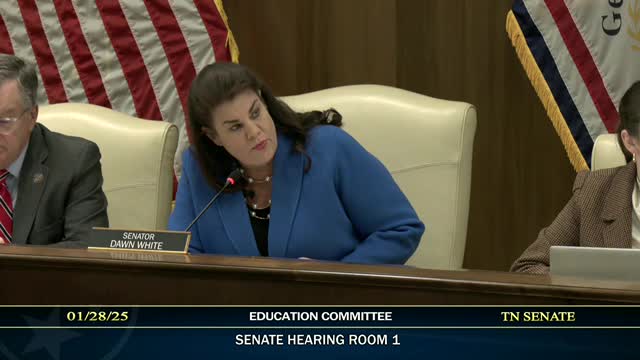
The Tennessee Senate Education Committee voted 8–1 to send Senate Bill 6001, the Education Freedom Act of 2025, to the Finance Committee after a multi‑hour hearing that combined a new scholarship program with capital funding and a teacher bonus.
The Tennessee Senate Education Committee voted 8–1 to send Senate Bill 6001, the Education Freedom Act of 2025, to the Finance Committee after a hearing that ran more than two hours and included state education officials, legal counsel and public testimony for and against the proposal.
Leader Johnson, presenting the bill on behalf of Governor Bill Lee, said the measure has three central pieces: a facilities fund for public school maintenance and construction, a $2,000 one‑time bonus for classroom teachers, and an Education Freedom Scholarship program for families to use at participating private schools. "This bill would direct 80% of these dollars to a new fund to be managed by the treasurer of the state to be used by LEAs for the construction and maintenance of public school buildings," Leader Johnson said when explaining the facilities component.
Why it matters: the bill combines an expansion of school choice with targeted state investments in school facilities and a teacher bonus, and it includes provisions intended to stabilize public school funding as scholarships are used. Supporters said the measure expands family options and provides capital money to districts; opponents raised concerns about accountability, special‑education protections and long‑term impacts on local school funding.
Key provisions and funding - Facilities fund: The bill would direct 80% of the state’s privilege tax on sports wagering into a new facilities fund administered by the state treasurer. Fiscal staff projected roughly $77,235,000 available for fiscal year 2025–26; the bill proposes roughly $25 per student in certain prioritized LEAs as a first distribution priority, a 15% set‑aside (of remaining funds) for schools damaged by natural disasters, and a remainder for other capital or maintenance needs as determined by the treasurer. The amendment adopted on the committee floor clarified distribution priorities and allows transfers to protect the HOPE Scholarship program if that program’s revenues decline.
- Teacher bonus: The bill authorizes a $2,000 one‑time bonus for classroom teachers, estimated to reach about 86,000 educators; Leader Johnson said the total one‑time cost including employment taxes would be just under $200,000,000. The committee amendment clarified the bonus would be payable contingent on local education agency (LEA) participation and would exclude a legislator who is employed by K–12 public schools during the 2024–25 school year.
- Education Freedom Scholarship program: The bill would create scholarships equal to the state portion of the TISA (Tennessee Investment in Student Achievement) per‑pupil amount; the fiscal estimate and department discussion put that amount at approximately $7,296 per scholarship in the coming fiscal year. The program would begin with 20,000 scholarships; priority in the first year would go to low‑ and moderate‑income families for 10,000 of those awards. The bill includes a growth trigger: if scholarship utilization reaches 75% of capacity (15,000), the program would add 5,000 slots the following year, subject to appropriation.
Administration, testing and accountability - Participating private schools must be categorized as category 1, 2, or 3 and already administer either the TCAP or a nationally norm‑referenced test; test results for scholarship students would be provided to parents and sent to the Office of Research and Education Accountability (OREA). The amendment moved rulemaking authority for scholarship administration to the State Board of Education and clarified other implementation details.
- The bill preserves private school autonomy over admissions, curriculum and operations, and it does not change private schools’ current ability to set admissions criteria. Committee witnesses and legislators repeatedly emphasized that participating nonpublic schools retain autonomy; several senators pressed department staff on whether that autonomy limits the state’s ability to enforce academic or nondiscrimination standards for schools accepting public funds.
Special education and eligibility - The bill excludes homeschool families from scholarship eligibility, and committee discussion indicated undocumented students would not be included in the scholarship program; Department of Education counsel noted that public schools must provide enrollment to students regardless of immigration status under federal law. Parents of students with disabilities and disability advocates told the committee that private schools do not provide the same scope of services and legal protections as an IEP under the Individuals with Disabilities Education Act (IDEA). Candace Ashburn, a parent of a student with intellectual and developmental disabilities, testified that language in the bill claiming scholarship recipients have "the same rights under the federal IDA" (as quoted from the draft) is incorrect and that equitable services provided in private settings are not equivalent to IEP protections.
How scholarships would be used - Department witnesses said scholarship funds would not be paid directly to families; funds would be maintained in scholarship accounts and directed to tuition and allowable educational expenses. Jack Powers, assistant commissioner for policy and legislative affairs at the Tennessee Department of Education, described administrative similarities to the existing Education Savings Account (ESA) pilot that operates in Davidson, Shelby and Hamilton counties, and said, "At the broadest level, the Education Savings Act program enacted by the general assembly is designed specifically for low income students in struggling districts… as opposed to the Education Freedom Act program, which is designed, more holistically for all 95 counties."
Committee actions and votes - Amendment (drafting code 2431) from Leader Johnson, clarifying distribution of facilities money and allowing transfers to protect the HOPE scholarship, was adopted by the committee (voice vote) after a motion and second on the amendment. - Other proposed amendments were withdrawn or failed for lack of a second. A separate amendment that would have required participating private schools to administer TCAP for grades 3–11 and to be barred from accepting scholarship students if performance fell 15% below the state average was moved by Senator Actberry but died for lack of a second. - Final committee action: the committee voted 8–1 on a recorded roll call to refer Senate Bill 6001 to the Finance Committee. The clerk recorded Senator Ockberry as the sole no vote; all other committee members present voted aye.
Voices from the hearing - Supporters, including parents and private school leaders, described cases where families used alternative schools to meet individual needs. Drew Middleton, a parent, said the program would "give kids like our daughter a chance to receive the education that we, her parents, believe is best for her."
- Opponents raised concerns about accountability, fiscal impacts and special‑education access. Candace Ashburn, a parent of a student with an intellectual disability, testified that private schools often decline to serve children with significant special needs and that private settings do not provide the same IEP protections under federal law.
Next steps and outstanding questions - The bill now moves to the Finance Committee for consideration of appropriation language. Committee members repeatedly stressed that several elements — rulemaking, specifics of implementation, and whether the program expands beyond the initial cap — will depend on later appropriation decisions and rulemaking by the State Board of Education and implementing agencies.
- Outstanding issues flagged in the hearing include: the long‑term effect of scholarship growth on local funding beyond the hold‑harmless period, protocols for families who apply but do not find private‑school seats, the extent of private‑school obligations for students with disabilities, and whether additional academic comparability or accountability measures should apply to scholarship recipients.
Ending note: The committee split was 8 ayes, 1 no; the bill was referred to Finance for appropriation considerations and further debate.