Get Full Government Meeting Transcripts, Videos, & Alerts Forever!
Get email alerts on the Immigration Enforcement topic
No spam. Unsubscribe anytime.
Senate committee approves bill to expand state immigration enforcement, creates grant program and new enforcement division
Summary
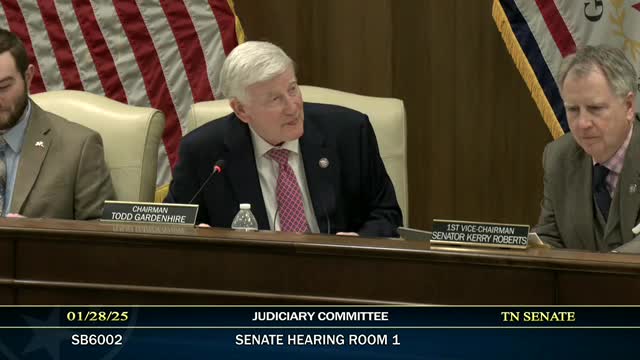
Senate Bill 6002, which its sponsor described as aligning state policy with federal immigration enforcement and expanding local-state cooperation, was advanced by the Tennessee Senate Judiciary Committee after debate and three failed amendments.
Senate Bill 6002, which its sponsor described as aligning state policy with federal immigration enforcement and expanding local-state cooperation, was advanced by the Tennessee Senate Judiciary Committee after debate and three failed amendments.
The bill would create a centralized immigration enforcement division in the Department of Safety overseen by a governor-appointed chief immigration enforcement officer, establish a $5 million grant program to help local governments participate in the federal 287(g) program, add new restrictions on eligibility for state-issued identification and add enforcement mechanisms for local officials who adopt or enforce so-called sanctuary policies.
Sponsor Senator Watson summarized the measure at length, saying the bill “creates a centralized immigration enforcement division within the Department of Safety to coordinate our immigration enforcement efforts” and describes four main components: the new division, a grant program for participation in the federal 287(g) program, criminal penalties tied to sanctuary policies, and changes to driver’s-license issuance and renewal. Watson also said the bill includes sunset provisions for the new division and the grant program.
Committee members pressed for details about the bill’s cost and oversight. The bill’s fiscal note, as explained in committee, contemplates roughly $5,000,000 for the grant program and about $500,000 for operations of the new division, including the chief immigration enforcement officer and four additional staff. Elizabeth Stroker, legislative director for the Department of Safety, said the Department would be “responsible for the reporting and auditing specifically of this division,” and added that the department “is subject to the oversight of the comptroller through our regular audit process.” Stroker confirmed the comptroller “has the authority to audit our department for any reason, so I don't see how that would change with this bill.”
Members debated how local jurisdictions would enter 287(g) agreements and whether local elected officials could be criminally penalized for adopting policies contrary to the bill. Witnesses from the Sheriff's Association said current MOUs in Tennessee have been signed by elected sheriffs in the counties that participate; Jimmy Musick, representing the Sheriff's Association and Chiefs of Police Association, told the committee his group was aware of two Tennessee counties with 287(g) MOUs (Knox and Greene). Tennessee District Attorneys General Conference Executive Director Steven Crump and deputy legal director Mike Donovan said prosecution decisions would be fact-specific and noted Tennessee district attorneys are the constitutionally authorized prosecutors for the state.
Several senators questioned the constitutional risk of criminalizing local officials for adopting sanctuary policies. Committee counsel summarized relevant law, including the state speech-and-debate protections and an appellate decision addressing judicial treatment of legislative acts, and the committee heard testimony that courts ultimately would determine any constitutional challenges. After debate the committee considered and rejected three amendments that would have removed criminal penalties for elected officials or limited enforcement near schools and other “safe zones.” Those amendment votes failed on roll call (amendment votes: 3–6; 2–7; 2–7, respectively). The bill as amended in committee passed on a roll-call vote of 6–3 and was recommended to the full Senate.
Opponents raised civil-rights and litigation concerns. Attorney Bill Kramer told the committee about a 2008 case involving Davidson County and the 287(g) program and warned that expanding 287(g) statewide could produce substantial litigation costs beyond the grant funding. Kramer said his jury award in a past case “was $200,000” and that his firm later received nearly $1,000,000 in fees; he argued the fiscal note did not address potential legal expenses tied to expanded enforcement.
The committee also discussed operational details: the sponsor and Department of Safety clarified the 287(g) program is optional for local jurisdictions, the Department would administer the grant fund and maintain returned funds in a dedicated account rather than sending them to the general fund, and the bill imposes a requirement that some driver-license renewals will require proof of U.S. citizenship effective Jan. 1, 2026. The bill’s grant program and the new division include sunset language that, as drafted in committee, would cause those provisions to expire in January 2029 unless the General Assembly reauthorizes them.
The committee’s passage sends Senate Bill 6002 to the full Senate with the committee’s amendments and with the sponsor’s request that the body consider the measure.
Votes at a glance: The committee recorded three roll-call defeats of amendments that would have removed criminal penalties for elected officials or created safe zones (amendments failed 3–6; 2–7; 2–7). The committee then approved the bill as amended by a roll-call vote of 6–3.