Get Full Government Meeting Transcripts, Videos, & Alerts Forever!
Get email alerts on the Mental Health Services Emr Consent Decree topic
No spam. Unsubscribe anytime.
Mental health agency reorganizes leadership, seeks EHR and other investments while preparing for consent‑decree obligations
Summary
Oklahoma’s new mental health commissioner told the health appropriations subcommittee the agency will reorganize to focus on a hospital enterprise model, needs a modern electronic medical record and upgraded incident‑reporting systems, and is preparing for costs tied to competency‑restoration requirements in a pending consent decree.
Commissioner Carrie Friesen and senior leadership of the Oklahoma Department of Mental Health and Substance Abuse Services (ODMHSAS) briefed the Appropriations and Budget Subcommittee on Health about an agency reorganization, technology needs, facility conditions and the fiscal implications of an anticipated consent-decree settlement over competency restoration services.
New leadership and organizational priorities: Friesen said she has reorganized the department into three functional “buckets”: (1) the hospital enterprise that runs state-operated facilities, (2) central/ shared services (administration, finance, IT), and (3) community and contracted provider services. She said the reorganization aims to improve accountability and clinical quality at the department’s 11 state-operated facilities and 12 satellite locations.
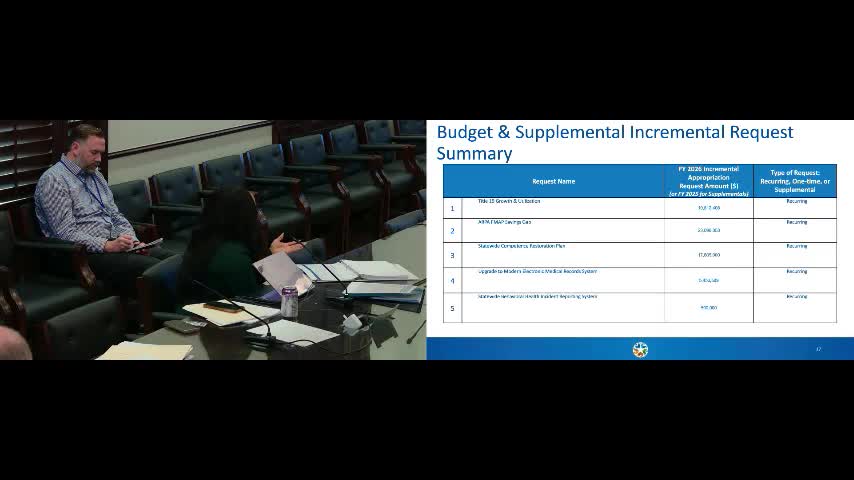
Electronic medical record and incident reporting upgrades: Friesen told lawmakers ODMHSAS needs a modern EHR to replace paper-based medication, billing and clinical systems. Deputy Commissioner Kim Corcoran said the department has accumulated a technology debt of many years and that implementing a comprehensive EMR will improve patient safety, billing capture and recruiting, and should enable other efficiencies. The department also requested funds for a modern incident-reporting system to track safety events, analyze trends and manage corrective actions; joint-commission reviewers have required such a capability.
Competency restoration and the Briggs consent decree: Friesen discussed a class-action settlement process (Briggs) and said the department has been negotiating implementation details and consultant work. The department estimated a range of costs tied to compliance and capacity-building that depends on scope and performance metrics; she said the current, conservative planning range over multiple years is roughly $26,000,000 to $45,000,000, and in-year first-cost ranges were estimated at $6,500,000 to $9,500,000 for year one in a scenario discussed at a recent settlement conference. Friesen said the department expects early fines may be higher but sees the settlement’s program recommendations as aligned with its ongoing priorities.
Facility needs and existing capital projects: Friesen and deputy commissioner Kurt Rawls described aging infrastructure across the state-operated facilities. They said Griffin Memorial Hospital (Oklahoma City) is functionally usable, but recent HVAC repairs are temporary fixes and the building needs replacement; other facilities such as SSM South have a 32-bed secured unit that could be used more quickly, with renovation work required for additional wings. Friesen said the department is coordinating with MAPS 4 and local authorities for replacement projects and expressed concern about funding and timing for comprehensive facility modernization.
Narcan distribution and prevention strategy: Friesen said the department will continue to distribute naloxone and fentanyl test strips but paused a vending-machine pilot after program managers concluded it did not reliably deliver useful distribution data; the department retains mail distribution, law-enforcement partnerships and school arrangements. She said public education and community partnerships remain central to overdose prevention.
Budget posture and next steps: Friesen said some FY-25 line items driven by federal payment-rate changes (FMAP) produced adjustments across Medicaid-related funding; but she emphasized ODMHSAS intends to present a multi-year efficiency plan and said the agency will not present one-off gap requests without a long-term plan for sustainability. She invited the committee to a future briefing on the Briggs consent decree specifics and confirmed the department would provide follow-up documentation on facility condition assessments and a prioritized capital plan.