Get Full Government Meeting Transcripts, Videos, & Alerts Forever!
Get email alerts on the Election Administration topic
No spam. Unsubscribe anytime.
State Election Board requests up to $35 million for voting-system replacement, plans statewide absentee tracking
Summary
Secretary Paul Zierich told the appropriations subcommittee that Oklahoma recorded more than 2.4 million registered voters for the 2024 general election, plans to roll out USPS intelligent-mail barcode absentee tracking statewide in 2025, and estimates roughly $35 million as a working figure to replace the state's aging voting system.
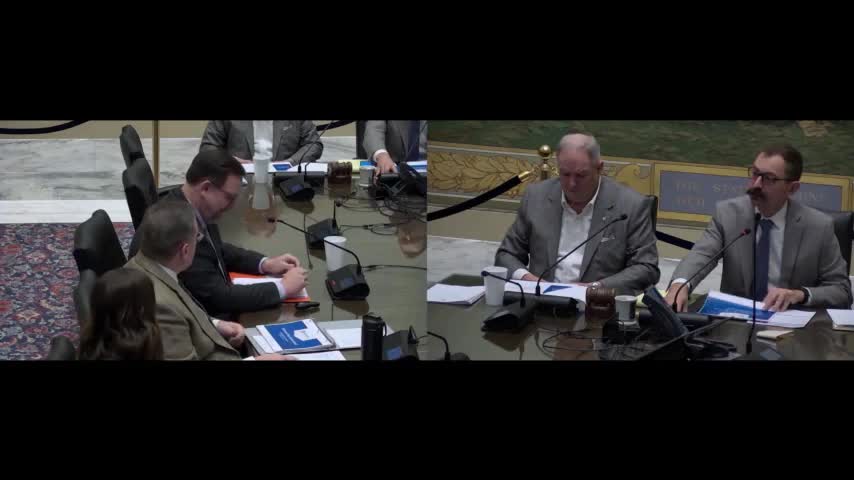
Paul Zierich, secretary of the State Election Board, told the Appropriations and Budget Subcommittee that the agency is preparing a major technology refresh and other operational changes after a record-high 2024 turnout.
Zierich said Oklahoma had more than 2.4 million registered voters ahead of the 2024 general election and that in-person absentee voting (now commonly called early voting) reached about 293,000 ballots — more than double previous levels. "There were almost 300,000, about 293,000 votes cast by that method," he said.
Zierich urged the committee to consider long-term funding to replace the state's voting system. The agency's current estimate is about $35,000,000 to purchase, implement and provide initial maintenance for a new system; he said the final cost will be determined by a competitive request for proposals. "If the funding is available, we would be able to go out for it, put out an RFP in, in calendar year 2026, award it by the end of the year," Zierich said.
Why it matters: Zierich said the current system remains accurate but is showing increasing reliability and parts-availability problems and is approaching the point where replacement will be required to avoid operational risk. State law will require certain reporting changes when the system is replaced, such as reporting absentee ballots by precinct in Tulsa and Oklahoma counties where that was previously not technically feasible.
Planned technology and operations changes The state election board successfully piloted intelligent-mail barcoding with the U.S. Postal Service in Canadian County to track absentee ballots; Zierich said the board will roll the tracking system out statewide in 2025. He described the barcoding as a way for county election officials to locate specific absentee mail pieces and assist voters who ask about the status of ballots.
The board also continues monthly voter list maintenance and reported about 101,000 voters removed through those processes in calendar year 2024; Zierich said about 71,000 of those were people who moved to a different jurisdiction and nearly 26,000 matched death records.
Budget context and costs Zierich said the doubling of precinct-official pay enacted by the Legislature increased election operating costs. He asked the subcommittee to recognize that a single statewide election now costs roughly $2 million to $2.2 million, compared with an earlier typical cost around $1.2 million.
The board requested that the committee consider setting aside funds for a voting-system replacement in a multi-year special fund. Zierich said he expects implementation would be a multi-year effort involving an RFP, county rollout and training.
Other items Zierich described continuing work on improved election-management software, post-election audits (conducted since 2022), and preparations for special elections and candidate filings that were underway for state House Districts 71 and 74 and Senate District 8. He also described voter-registration milestones and routine list maintenance required by law.
No formal action or vote was taken during the presentation. Zierich asked the committee to consider the funding request and to preserve recent base increases covering precinct-official pay and other inflationary costs so the agency does not face a shortfall in a future election cycle.