Get Full Government Meeting Transcripts, Videos, & Alerts Forever!
Get email alerts on the State Health Department Ehr Titlex topic
No spam. Unsubscribe anytime.
Oklahoma State Department of Health details ARPA EHR rollout, seeks transfers for program moves and hopes Title X funding will return
Summary
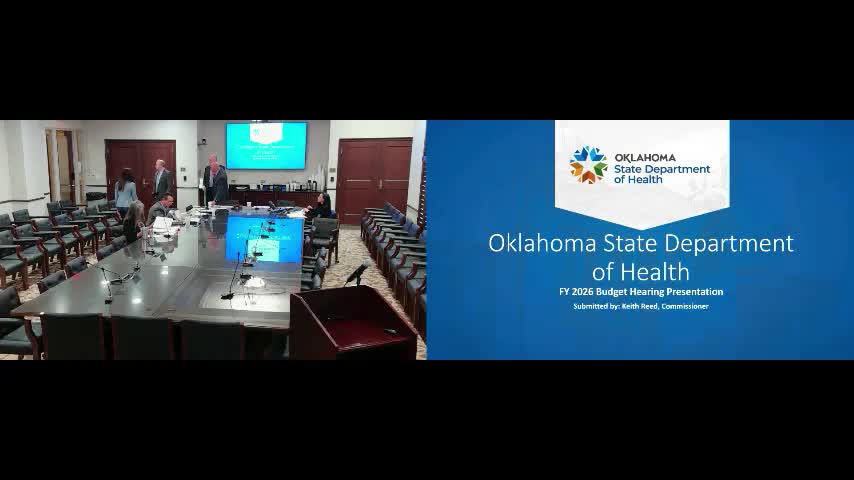
Oklahoma State Department of Health Commissioner Keith Reed told lawmakers the agency will use ARPA funds to deploy an electronic health record system in county clinics and asked for housekeeping transfers while urging federal restoration of Title X family-planning funding.
Oklahoma State Department of Health Commissioner Keith Reed told the Appropriations and Budget Subcommittee on Health that the agency is using ARPA funding to modernize clinical records and to pass through some federal ARPA awards, while urging lawmakers to help restore long-standing federal family-planning (Title X) grant funding.
Electronic health record and ARPA projects: Reed said the department is piloting an electronic health record (EHR) to replace largely paper-based clinical systems in more than 80 county and public health clinics. He said the EHR rollout is ARPA-funded and scheduled to phase into pilot sites in the months ahead with broader statewide deployment over roughly a year; the upgrades are intended to improve clinical documentation and revenue capture for services currently billed or underbilled.
Budget makeup and federal grants: Reed explained that federal grants account for almost two-thirds of the department’s budget and that the FY-25 appropriation includes more than $150,000,000 in multi-year federal grants that remain unspent on the state ledger until drawn down. He said that budget presentation inflates FY-25 totals because it must show full grant amounts even though money will be drawn down as the state spends for each grant.
Title X family-planning grant status: The commissioner discussed a long-running dispute with the federal government over Title X family-planning funding after the state’s implementation of a new abortion law. Reed said HHS removed the department as the Title X recipient in a prior review; the state has filled the resulting funding gap with a $4,500,000 appropriation but seeks an administrative outcome under the U.S. HHS direction so that funds can be restored. He said the department expects the new federal administration to modify conditions of participation that had been central to the dispute and that the department and state leadership are pursuing administrative and legal remedies.
Transfers and budget housekeeping: Reed asked the committee to formally move smaller programs into OSDH’s budget lines for FY-26: a Rx for Oklahoma program (previously with Department of Commerce) — $706,383 — and the Office of Client Advocacy transfer from DHS; he explained those are bookkeeping moves rather than new spending. He said his staff had worked with DHS to reconcile the client advocacy program’s costs and requested a transfer to reflect the program’s actual cost base.
Other items: Reed listed public-health priorities including modernizing IT and improving county health operations; he said the agency has reduced FTEs compared with pandemic staffing levels and is working to centralize administrative processes and improve financial controls.
Committee follow-up: Members asked about Title X program contents (STD screening, contraception), use of ARPA EHR funds, and whether the department can share county-level performance metrics. Reed said Title X-style services (STD treatment and contraception) would likely be included again once the federal grant is restored if federal conditions revert; he reiterated the department’s intent to use EHR modernization to improve billing and public-health surveillance.