Get Full Government Meeting Transcripts, Videos, & Alerts Forever!
Get email alerts on the Veterans Homes Budget topic
No spam. Unsubscribe anytime.
Oklahoma Department of Veterans Affairs seeks funding to cover rising costs at state veterans homes
Summary
Jay Bynum, executive director of the Oklahoma Department of Veterans Affairs, told a legislative budget panel the department needs new funding and operational changes to cover higher costs at its veterans homes and to make room for the new Sallisaw facility.
Jay Bynum, executive director of the Oklahoma Department of Veterans Affairs, asked the Legislature’s Appropriations and Budget Subcommittee on Health for continued funding to cover higher-than-expected costs at the department’s veterans homes and to support operations as a new facility in Sallisaw opens.
Bynum told the subcommittee the agency manages a $175,000,000 enterprise that largely consists of its HOMES mission — roughly $145,000,000 of that total — and supports about 1,598 employees. He said the agency’s typical funding model blends federal reimbursements tied to resident census, private pay, and a state-appropriated share that historically represented about 22% of cost for care at the homes. “Our goal now … is to serve the veterans and their families in the state of Oklahoma,” Bynum said, describing a two-track focus on services and long-term care operations.
Why it matters: costs of delivering nursing and long-term care rose sharply in recent years and state appropriations have been largely flat, Bynum said. From 2019 through 2023 the total cost of care rose about 66 percent while federal cost-of-living increases covered roughly half of that rise. At the same time, average length of stay decreased — “now they’re staying less than 90 days in many cases,” Bynum said — increasing acuity at admission and operating costs per resident.
Bynum said ODVA is pursuing several strategies to limit future requests for emergency supplements: converting contract labor to state employees (he said about 240 pins were converted, saving about $4,000,000), bringing some nursing contracts in-house to avoid 25–30 percent pass-through fees, reorganizing the services side to centralize veterans services under a single lead, and hiring a data scientist to measure outcomes and target outreach. He described an outreach “sales” approach to raise awareness of services and to improve bed fill rates, and said the agency’s Veterans Registry has produced a line on more than 270,000 Oklahomans who might be served.
Deferred maintenance and capacity: ODVA told the committee it has roughly $240,000,000 in deferred maintenance across its homes, with some facilities more than a century old. Bynum said the agency recently closed Unit 1 at Ardmore and relocated 38 residents because of water under the foundation and roof leaks; he estimated the lost revenue from those full-cost residents at about $6,000,000 annually. The new Sallisaw facility will expand capacity to 1,423 beds statewide; ODVA said enterprise census has not exceeded 1,000 beds since August 2020.
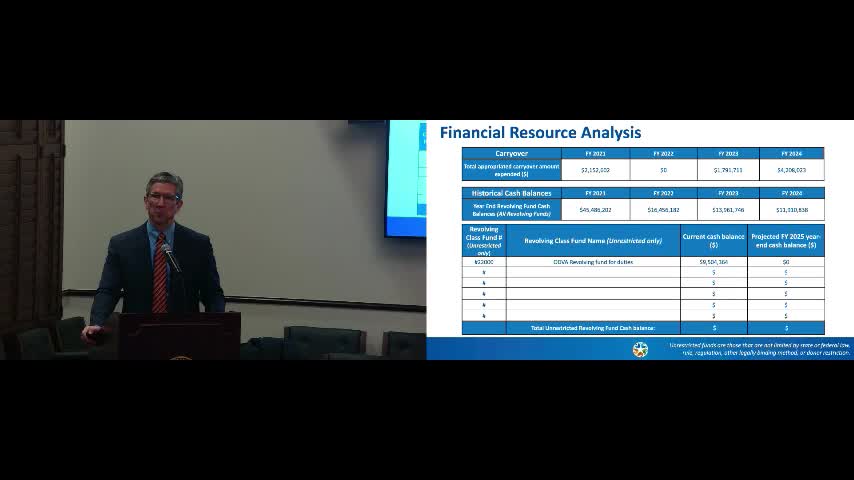
Budget ask details: Bynum described a FY-26 budget request that reflects higher operating costs and the incremental cost of opening Sallisaw. He said there was a one-time $4,000,000 supplemental provided for Sallisaw operations until VA reimbursement begins, and that the department is aiming for at least 3 percent enterprise efficiencies. Bynum also said shifting certain contract roles to state hires and reclassifying resident reimbursement records produced about $16,600,000 in higher reimbursements that helped avoid another $10,000,000 in supplemental requests last year.
Committee response and next steps: Committee members asked whether federal grant changes would affect ODVA operations; Bynum said day-to-day operations should continue but emergency or infrastructure grants are more vulnerable. He invited the committee to the Sallisaw ribbon-cutting and said staff would come to individual member offices to brief them on progress. Subcommittee questions focused on census, deferred maintenance priorities (Ardmore and Sulphur were named), and the mix of federal reimbursements versus state funding.
What’s next: ODVA said it will continue pressing for the state appropriation component of funding the HOMES mission while working to reduce operating costs and raise occupancy. Bynum emphasized the department’s goal of tying budget requests to measurable outcomes and said the agency will present more data as its modernization and outreach efforts proceed.