Get Full Government Meeting Transcripts, Videos, & Alerts Forever!
Get email alerts on the Zoning Text Amendment topic
No spam. Unsubscribe anytime.
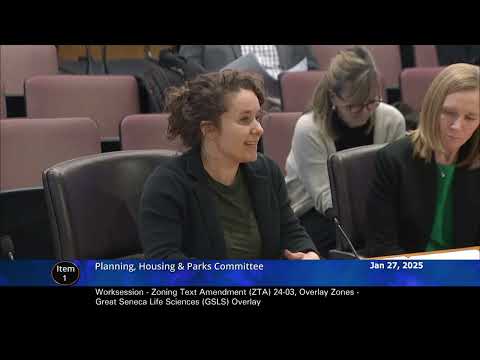
Committee forwards ZTA 2403 to full council, keeps life‑science focus and several technical fixes
Summary
Montgomery County Planning, Housing, and Parks Committee on Jan. 27 forwarded Zoning Text Amendment (ZTA) 2403 to the full County Council 3‑0, establishing a Great Seneca Life Sciences (GSLS) overlay zone, approving several technical and substantive amendments and leaving the BLT requirement as introduced after a 2‑1 committee split.
The Montgomery County Council Planning, Housing, and Parks Committee on Jan. 27 voted to forward Zoning Text Amendment (ZTA) 2403, which would create a Great Seneca Life Sciences (GSLS) overlay zone, to the full Council with a 3‑0 committee recommendation.
The measure implements recommendations from the Great Seneca master plan and would allow greater height and density in the plan area in exchange for publicly beneficial amenities, change parking rules in the overlay and use a tiered “incentive density” system to award additional floor‑area ratio (FAR) credits for public benefits.
Council staff said the ZTA makes optional‑method development available for projects above 0.5 FAR and sets a tiered credit system that can award between 0.25 and 1.0 FAR depending on the cost and complexity of the public benefit. It also removes some existing caps by stating limits that previously capped residential uses at 30% and retail at 15% would not apply within the overlay, allowing more mixed use than the current LSC underlying zone.
Why it matters
The committee described the overlay as a primary implementation tool for the Great Seneca plan, intended to attract and support life‑science employers and related development while encouraging a mix of housing, infrastructure and open space. Staff noted the overlay could increase greenhouse gas emissions at full build‑out because surface parking lots would be redeveloped and more people would live and work in the area, but that many incentivized public benefits in the ZTA are intended to reduce emissions.
Key decisions and amendments
- Parking and nonconforming uses: The committee accepted a planning‑board recommendation to add the word “new” to the prohibition on “surface vehicle parking between a building and a public or private street.” Committee members said the change preserves the plan’s long‑term vision while avoiding immediate nonconforming status for existing parking that could block renovation or expansion. Chair (unnamed) said, “Without objection, we will accept that amendment.”
- Hospital parking flexibility: Adventist Hospital had asked to modify a tier‑1 requirement that would prefer placing on‑site parking below grade or wrapping structured parking. Planning staff explained that the item is one option among several tier‑1 benefits and not a mandatory fixed requirement; Maren Hill (Planning staff) told the committee, “Yes. We have talked to Adventist. We went over the ZTA with them as proposed, and, I think that we made it clear that this is a menu, so it is optional and that there are lots of paths to get to the desired FAR.” The committee directed staff to follow up directly with Adventist Hospital.
- Incidental storage and warehouse uses: The committee approved language clarifying that incidental storage associated with medical/scientific manufacturing and production would be allowed (so that needs of life‑science firms are not inadvertently prohibited). Planning and council staff agreed the ZTA should not change separate definitions for self‑storage. The committee also agreed to allow incidental warehouse/storage tied to biotech uses after staff review.
- BLT (build‑to‑lot) / public benefit contributions: Committee discussion focused on whether hospitals in the overlay should be exempt from the BLT purchase requirement. Jessica McBary (Council/Planning staff) summarized the staff intent: “our overall goal was to bring down that percent in the LSC zone to make it equal to the CR zone. So that's really the heart of this section ... to make it so that the BLT requirement in the overlay zone is 7 and a half percent rather than 50 percent.” Planning staff told the committee their modeling assumed the lower 7.5% rate. The committee voted 2‑1 to keep the ZTA as introduced (i.e., not to add an explicit exemption for hospitals in the overlay), and members asked that staff revisit the hospital exemption issue during the forthcoming incentive‑zoning update. The committee chair said the 2‑1 split will be reflected in the packet.
- Technical and cross‑reference fixes: The committee authorized staff to make technical renumbering and cross‑reference corrections to account for ZTA 2404 and other near‑concurrent code updates. The committee also accepted an addendum clarifying that projects must use the gross floor area allowed by the mapped commercial or residential FAR of the underlying zone before receiving additional incentive density.
Votes at a glance
- Forward ZTA 2403 (create Great Seneca Life Sciences overlay) to full Council with committee recommendation: Committee vote 3‑0 in favor; outcome: referred to full Council. - Add “new” to prohibition on surface vehicle parking between a building and a street: accepted without objection; outcome: amendment approved. - Clarify incidental storage allowed as part of medical/scientific manufacturing and production: accepted; outcome: amendment approved. - Retain ZTA language on BLT requirement as introduced (no hospital exemption included in overlay): committee decision 2‑1 to keep as introduced; outcome: amendment not adopted (ZTA stays as introduced). Committee requested staff revisit hospital exemptions during the incentive zoning update. - Technical renumbering and cross‑reference corrections (including addendum clarification on gross floor area): approved as technical amendments.
Discussion vs. decision
Committee members and staff distinguished discussion points (hospital concerns about parking and BLT exemptions; developer requests to limit when incentive density applies) from formal committee actions. Several requested amendments from developers and hospitals were discussed; some were accepted as clarifying or technical changes while others were not adopted. Planning staff emphasized the overlay implements prior modeling and policy choices and asked that certain broader policy questions be resolved in the separate incentive‑zoning update rather than in the overlay ZTA.
What’s next
Planning and council staff will make the agreed technical edits and staff will follow up with Adventist Hospital about available incentive options. The committee forwarded ZTA 2403 to the full County Council with a 3‑0 recommendation; the Council will consider the ordinance and the related incentive‑zoning updates in a future session.