Get Full Government Meeting Transcripts, Videos, & Alerts Forever!
Get email alerts on the Tourism topic
No spam. Unsubscribe anytime.
Visit Montgomery outlines grants, agritourism work as hotel-tax revenue softens
Summary
Visit Montgomery presented FY24–FY25 accomplishments and several federal and state grants it is implementing while officials flagged a projected decline in hotel‑motel tax receipts that could tighten its revenue for FY26.
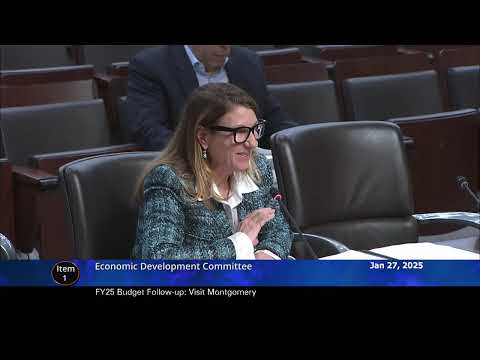
Visit Montgomery, the county's destination marketing organization funded by a dedicated 7% hotel‑motel tax plus any supplemental county appropriations, briefed the Montgomery County Council Economic Development Committee on Jan. 27 about recent grants, marketing work and possible service expansions as hotel tax receipts show signs of weakening.
The discussion centered on four federal and state grant programs Visit Montgomery is implementing, marketing and data investments, and an agritourism strategy. “Year to date fiscal year ’25 through Nov., it’s only up about 1%,” Visit Montgomery senior staff said of hotel tax collections; packet materials cited a separate fiscal note projecting a larger possible FY26 decline. The group emphasized that because Visit Montgomery’s baseline revenue is tied to the hotel‑motel tax, fluctuations in that tax can materially alter their budget and ability to sustain new positions or programs.
Why it matters: the county routes a fixed 7% of the county’s hotel‑motel tax to the Conference and Visitors Bureau (Visit Montgomery). Supplemental county funding has been used in prior budgets to support additional staff and initiatives; any multi‑percent drop in transient lodging revenue will require either cuts to proposed enhancements or additional county funding.
Visit Montgomery highlighted four active grant projects. The C&O Canal collaboration links Montgomery County with neighboring jurisdictions to market the canal corridor; Visit Montgomery said a related corridor management plan being pursued by partners could be an approximately $800,000 grant if approved, with each participating destination committed to a modest annual match. A $250,000 meetings‑marketing grant will fund a multi‑jurisdictional “Meet in Maryland” effort to market meeting business. Visit Montgomery also is implementing a rural branding strategy with a consultant (Civic Brand) and a smaller food‑and‑beverage initiative, MOCO Eats, that will include a March 30–31 showcase and hospitality conference at the Hilton Rockville.
Staff noted new data capabilities, including a recently launched reservations platform and third‑party location analytics (packet mentions Placer.ai and an aggregator called Symphony), that allow the organization to track bookings and visitor behavior more closely. Sales staff reported 16,000 room nights booked from July through December and estimated a fiscal‑year economic impact of roughly $1.1 million and about 5,000 room nights attributable to specific “sales wins” listed in the packet.
Committee members questioned Visit Montgomery on workforce pressures in hospitality, strategy for trade shows and conferences, and how Visit Montgomery will deploy additional investments if revenue permits. Visit Montgomery said it is pursuing a mix of strategies — more sponsorships and familiarization (“fam”) tours, consideration of a mobile visitor center or branded shuttle, an expanded advertising program, and potentially hiring a full‑time agritourism specialist if the county funds the position. On leveraging the Washington, D.C., market, the presenters said they work with Destination DC and state partners but deliberately position Montgomery County as the capital region’s neighbor rather than as part of the city itself.
Packet figures and next steps: the county executive’s FY25 recommendation previously cited $2,360,000 for Visit Montgomery (a figure the packet said was about $165,905 above the 7% baseline in that year); the agritourism position was not funded last year, and packet memos flagged an OMB projection of a mid‑single digit decline in hotel‑motel tax for FY26 plus a separate internal memo noting a larger, approximately 9.43% decline scenario. Councilmembers asked Visit Montgomery to track those revenue scenarios and return with specific budgetary implications if revenue falls.
The committee did not take a formal vote. Visit Montgomery agreed to provide additional detail on the grant projects, the cost estimates for new staffing and sponsorship programs shown in the packet (page 8), and analytics that tie trade‑show attendance to specific booked room‑nights.