Get Full Government Meeting Transcripts, Videos, & Alerts Forever!
Get email alerts on the Civil Commitment topic
No spam. Unsubscribe anytime.
Legislators hear overview of Oregon civil‑commitment law, case counts and eligibility questions
Summary
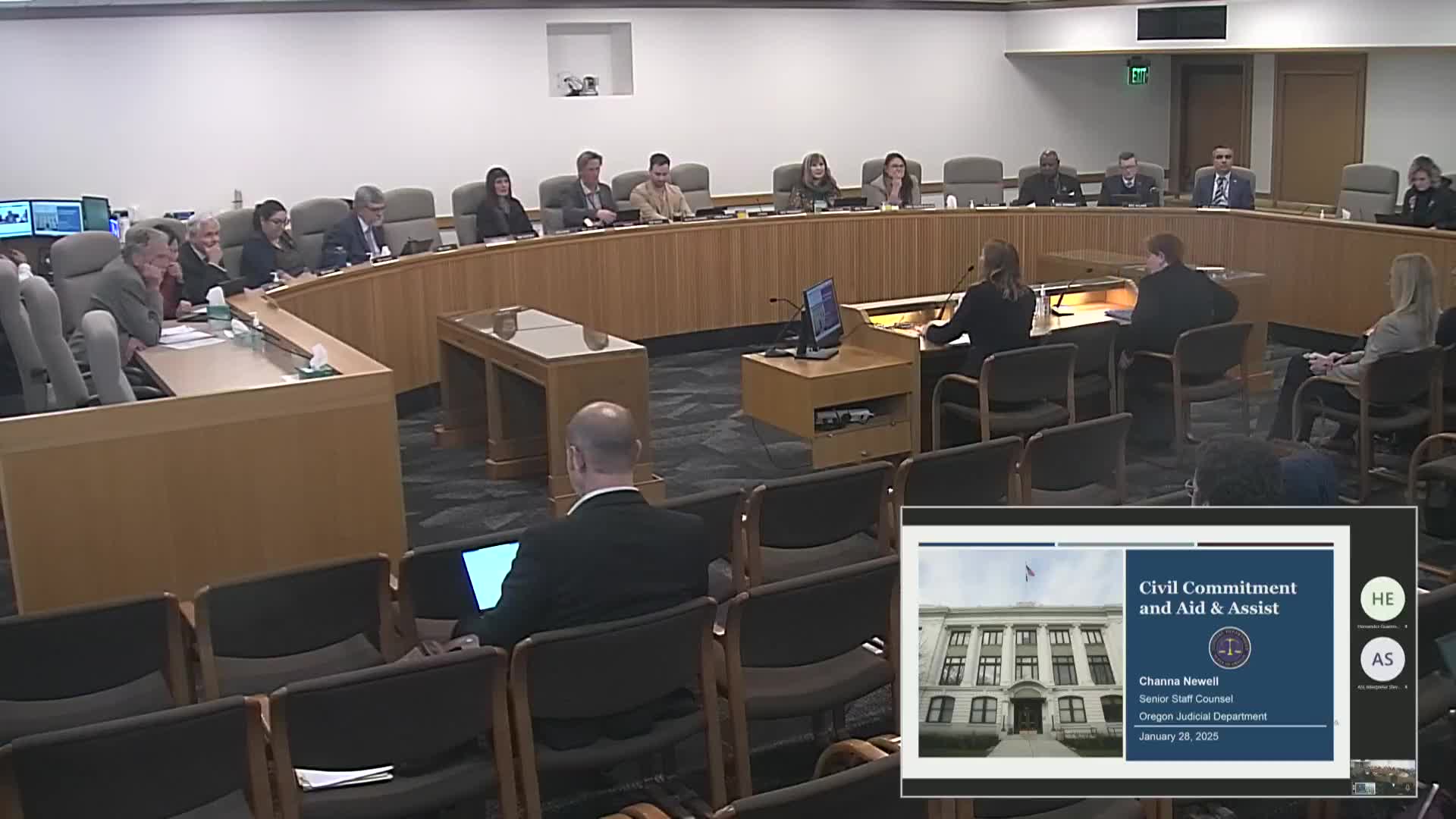
Chana Newell, senior staff counsel at the Oregon Judicial Department, told a joint Senate and House Judiciary Committee hearing that civil commitment is “involuntary treatment of a person after a finding that they are a danger to themself, a danger to others, or unable to meet their basic needs.”
Chana Newell, senior staff counsel at the Oregon Judicial Department, told a joint Senate and House Judiciary Committee hearing that civil commitment is “involuntary treatment of a person after a finding that they are a danger to themself, a danger to others, or unable to meet their basic needs.”
Newell gave committee members a statutory primer on Oregon’s civil‑commitment framework and basic annual counts, saying the most common pathway is a 426 mental‑illness commitment and that the state files nearly 8,000 to 9,000 notice‑of‑mental‑illness (NMI) filings each year. She said most NMIs do not reach a full commitment hearing: “14% end up in some kind of diversion, and about 6% end up in a commitment hearing.”
The numbers reflect a short timeline in statute: a person placed on certain holds must be brought to a hearing within five days, Newell said, and counties must complete investigations, a probable‑cause check and an examiner’s evaluation within that span. A voluntary 14‑day diversion option exists for people willing to accept treatment; Newell said practice varies across the state.
Why the matter matters: Commitments remove a person’s liberty and attach stigma, Newell told the committees, so courts balance individual liberty and public safety. Newell and lawmakers also flagged statutory gaps and interpretive questions that affect who can be committed and how: for example, the 427 commitment process for intellectual disability requires an IQ at or below 70 and significant adaptive impairment manifesting before age 18. Several legislators and witnesses said that leaves a gray area for people who have autism, late‑diagnosed developmental conditions or traumatic brain injury.
Representative Susan Mannings said the “gray area” worries her as a policy question: “There is such a wide gray area that we have a lot of people ... sleeping under bridges and wandering the streets who are not deemed eligible for the civil commitment process?” Newell replied that one committee question this session is what the statutory standard for commitment should be and that work groups are examining clarity and consistency.
Other statutory details explained at the hearing:
- Holds and NMIs: Holds may be initiated by law enforcement, hospital staff, community mental‑health providers or in limited cases by two‑person petition. An NMI is paperwork that prevents an individual from leaving while the process proceeds.
- Burden and proof: A civil commitment requires proof that a person has a qualifying mental disorder and, because of it, poses an immediate threat to self or others or is unable to meet basic needs; Newell said the standard of proof in these hearings is clear and convincing evidence.
- Duration and alternatives: If the court finds commitment criteria met, the maximum custodial term is generally up to 180 days; courts often consider less‑restrictive placements, trial visits into the community or early discharge depending on treatment response.
Contested definitional points and stakeholder concerns
Several witnesses and legislators emphasized a lack of clarity about which conditions belong under ORS chapter 426 (mental‑illness commitments) versus chapter 427 (intellectual‑disability commitments). Senator Gelser Bluhin and other committee members noted that the 427 statute’s focus on IQ and early onset may exclude people with late‑diagnosed autism or other developmental differences, creating confusion about the appropriate procedural path and services.
Jay Cornett, CEO of Disability Rights Oregon, said the 427 changes trace to the closure of state training centers and a 2013 statutory update. Cornett cautioned that the statute’s language can unintentionally sweep many people into civil‑commitment pathways and raised concerns about stigma and loss of voluntary services for people with developmental disabilities.
Public defender and civil‑commitment counsel Lisonbee (Lis) Knight said defense attorneys play a key role in keeping patients’ voices in the process and urged that reforms protect dignity and provide consistent practice statewide. She said the local experience of the same statute varies by county.
Clarifying details from the hearing (as provided by speakers):
- NMI filings: nearly 8,000–9,000 per year (Chana Newell). - Diversion: the statutorily allowed voluntary 14‑day diversion; practice varies statewide (Chana Newell). - Hearing timeline: 5 days from hold to initial hearing (Chana Newell). - Recommitment filings: Newell said follow‑up data show roughly 130 persons per year are subject to recommitment after an initial commitment, and she offered to provide committee staff more detailed data. - Commitment duration: a committed custodial period may be up to 180 days, with potential community‑based trial visits or less‑restrictive placements (Chana Newell).
What remained unresolved: Committee members and advocates asked whether civil commitment standards should be relaxed, tightened or clarified for particular populations (for example, people with autism spectrum disorder or traumatic brain injury). Participants agreed legislation must be coordinated with investments in services, because commitments without placement or treatment resources can cause displacement and further harms.
Ending note: Committee members and witnesses agreed the session’s immediate goals are clarifying statute language, creating more consistent statewide practice and identifying people who may be in the criminal system but better served through civil treatment pathways. Multiple speakers urged pairing statutory changes with expanded community services and hospital capacity so commitments lead to appropriate care rather than merely shifting where people are held.