Get Full Government Meeting Transcripts, Videos, & Alerts Forever!
Get email alerts on the Tax Court Standing topic
No spam. Unsubscribe anytime.
Bill would let associations seek declaratory rulings in Oregon tax court; business groups back change
Summary
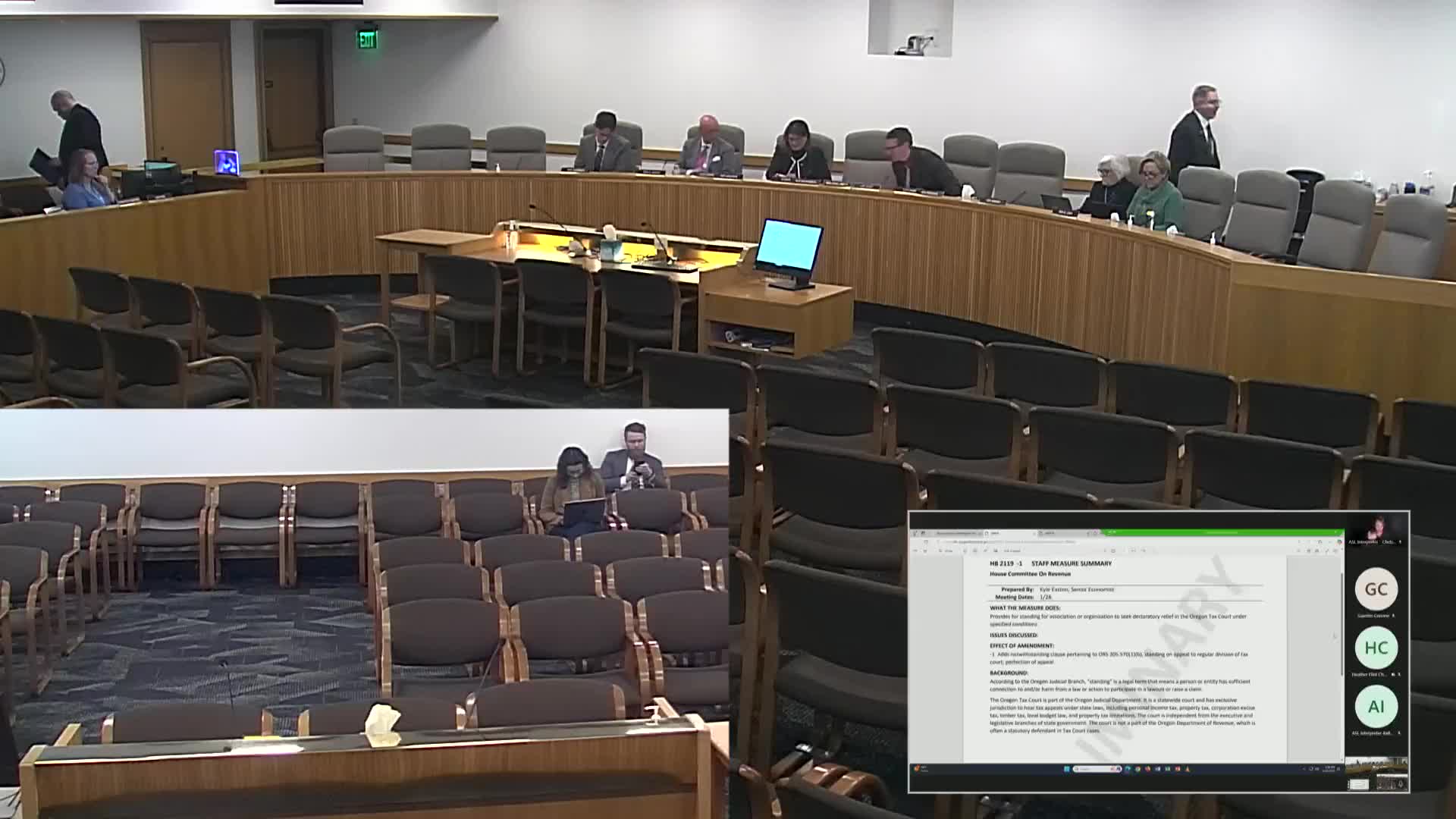
House Bill 2119 would grant associations and organizations standing to seek declaratory relief in Oregon Tax Court under specified conditions; trade and banking associations told the House Committee on Revenue the change would streamline resolution of tax questions that affect many members.
The House Committee on Revenue heard testimony on House Bill 2119 (reintroduced from 2023), which would allow associations or organizations to seek declaratory judgments in the Oregon Tax Court on tax questions that would harm their members, subject to specific standing requirements.
Representative E. Reschke, the bill sponsor, said the measure is intended to let associations obtain legal clarity “before it harms our members,” enabling trade groups to seek rulings on statutory or constitutional tax questions without waiting for an individual member to suffer a loss and bring suit. Reschke framed the bill as a preventive tool: “an ounce of prevention is worth a pound of cure.”
Derek Singston, policy director and counsel for Oregon Business and Industry (OBI), testified in support and said HB 2119 would “streamline the litigation process” by allowing associations to seek declarations for issues that affect many members. Scott Bruin, president and CEO of the Oregon Bankers Association, testified that the bill is “narrowly tailored” to declaratory-judgment actions and would conserve judicial resources by avoiding multiple duplicate suits.
Committee members asked staff about definitions of “association” or “organization” and whether the bill’s scope is limited to trade groups. Sponsors and witnesses said the bill is intended to apply broadly to associations and organizations that represent members with a shared interest and that the measure would not be limited to business groups. Legislative staff said the bill does not itself define the term and that counsel would need to advise on precise statutory language if the committee advances the measure.
No committee vote was recorded at the hearing. Supporters asked the committee to consider HB 2119 as a narrowly tailored method to resolve tax questions for groups of taxpayers without imposing new broad litigation burdens on the state.