Get Full Government Meeting Transcripts, Videos, & Alerts Forever!
Get email alerts on the Wildfire Mitigation topic
No spam. Unsubscribe anytime.
IBHS tells Oregon senators: home‑level and neighborhood mitigation — especially the 5‑foot zone — reduce home ignitions from wildfires
Summary
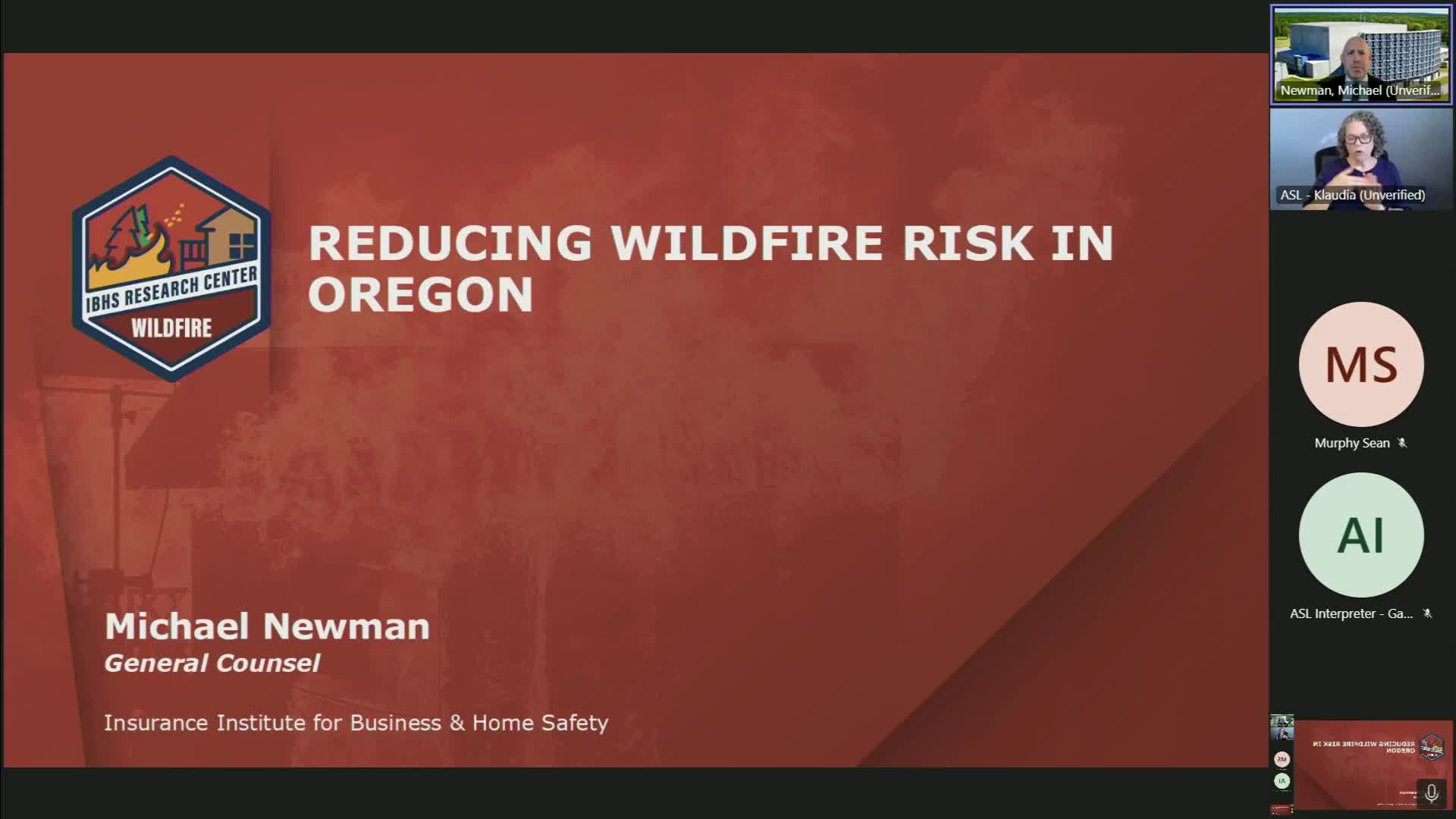
Michael Newman of the Insurance Institute for Business & Home Safety told the Senate Committee on Natural Resources and Wildfire on Jan. 28 that wildfire science increasingly treats structure loss as a home ignition problem and that coordinated home‑ and neighborhood‑scale mitigation can reduce conflagration risk.
Michael Newman of the Insurance Institute for Business & Home Safety (IBHS) told the Senate Committee on Natural Resources and Wildfire on Jan. 28 that wildfire science increasingly treats structure loss as a ‘‘home ignition’’ problem rather than solely a wildfire suppression problem, and that parcel‑ and neighborhood‑scale mitigation can reduce the likelihood of conflagration.
Newman described three ignition mechanisms—embers, flames and radiant heat—and said embers often travel ahead of flame fronts and start new ignitions in neighborhoods. He said IBHS research and full‑scale testing identify a system of mitigation measures that collectively reduce home ignition risk: a well‑maintained Class A roof, noncombustible gutters, ember‑resistant vents, six inches of noncombustible clearance at wall bases, upgraded decking and siding where feasible, and a maintained defensible space around structures.
Why it matters: IBHS argues that coordinated home and neighborhood measures can slow or prevent structure‑to‑structure spread—conflagration—so that fires are more survivable for communities and less disruptive for households and insurers.
Key points from the presentation: IBHS said the 0–5 foot area around a home (sometimes called zone 0 or the home ignition zone) is critically important because embers tend to collect there and ignite combustible materials; even small combustible items—trash cans, stacked firewood or mulch—can start fires that transfer to the building. Newman said exterior building materials, structure spacing and connective fuels (for example, wooden fences or close vegetation) together determine whether a conflagration will develop when wildfire enters a community.
IBHS described two voluntary programs: Wildfire Prepared Home (an owner‑level designation verified by inspection) and a Wildfire Prepared Neighborhood standard now in beta. Newman said Wildfire Prepared Home is now available in Oregon and that early evidence from California—the first state where the home designation was deployed—shows some participants have received pricing considerations and in some cases avoided falling into the state Fair Plan; he cautioned that neighborhood standards are still being piloted and that long‑term actuarial evidence will take time to accumulate.
Newman said neighborhood resilience depends on collective action: structure spacing, reduction of connective fuels, and targeted parcel upgrades can create fuel breaks that protect clusters of homes. He emphasized that mitigation is a system—no single retrofit guarantees survivability—and commended proposed local programs that would provide technical assistance and certified risk assessors to guide neighborhood upgrades.
Ending: Committee members discussed how to integrate neighborhood programs into state policy and legislation, referenced Senate Bill 85 (a prior legislative proposal to support neighborhood protection cooperatives), and asked whether insurers would recognize these standards. Newman said IBHS is piloting neighborhood tools and that insurer engagement on neighborhood programs will grow as the science is field‑tested and standards are finalized.