Get Full Government Meeting Transcripts, Videos, & Alerts Forever!
Get email alerts on the Endangered Species Conservation topic
No spam. Unsubscribe anytime.
Oregon State Parks seeks federal grant to fund Taylor's checkerspot conservation planning
Summary
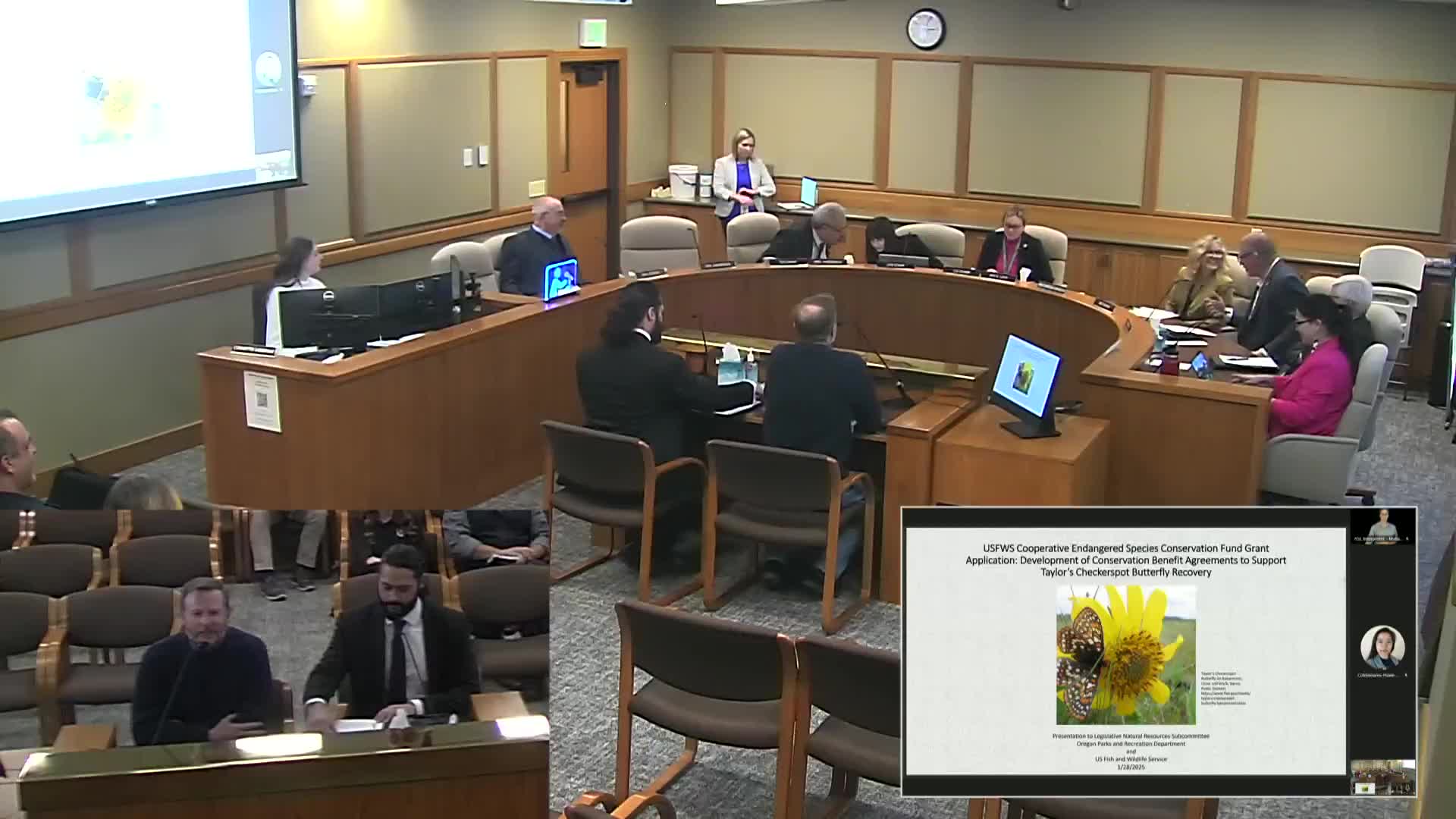
Oregon State Parks asked the Joint Subcommittee on Natural Resources on Jan. 28 for permission to apply for a $241,525 U.S. Fish and Wildlife Service grant to support conservation planning and habitat work for the federally endangered Taylor's checkerspot butterfly.
Oregon State Parks asked the Joint Subcommittee on Natural Resources on Jan. 28 for permission to apply for a $241,525 U.S. Fish and Wildlife Service grant to support conservation planning and habitat work for the federally endangered Taylor's checkerspot butterfly.
State parks specialist Noel Bachelor, introduced the grant request and said the agency would pass the full award through to a nonprofit subgrantee, the Institute for Applied Ecology, which would conduct surveys, site assessments and outreach to willing private landowners to identify potential habitat management and reintroduction opportunities. "This particular work that's being planned this year is on the Taylor's checkerspot butterfly, which is an endangered species under the Federal Endangered Species Act," Bachelor said.
The grant would come from the Cooperative Endangered Species Conservation Fund (commonly called the Section 6 grants program). Bachelor described this application as a Conservation Planning Assistance request — a less-frequent, nontraditional pool that requires one-off legislative approval. He said the requested amount is approximately $241,525, the application deadline is March 14, 2025, and the required match is 10% to be provided by Benton County and the Institute for Applied Ecology. "There's no state funding match required," he said, and added that Oregon State Parks would not retain any overhead; the money would be passed to the subgrantee.
Sen. Michelle Gorsek confirmed that the project spans Oregon and Washington; Bachelor said the Institute for Applied Ecology would do work in both states. Committee members asked about the lack of an overhead fee to the state; Bachelor said the agency has historically not charged indirect costs on these pass-through grants so as not to jeopardize funding competitiveness, though he said there may be capacity to include modest overhead on future nontraditional grants.
The Chief Financial Office recommended approval. The Legislative Fiscal Office recommended approval. A committee member moved the LFO recommendation; there was no recorded roll call and no objections were raised, and the motion passed by voice.
The request seeks permission only to submit the application; it does not obligate state funds. If the federal award is made, the project would be administered by Oregon State Parks as the pass-through and implemented by the Institute for Applied Ecology in coordination with the U.S. Fish and Wildlife Service and participating private landowners.
Questions raised during the work session focused on the pass-through arrangement, the reduced 10% match (down from the usual 25% because the project spans states), the short application timeline, and the small amount of state staff time to administer the award (estimated at roughly 40–60 total hours over the grant lifespan).