Get Full Government Meeting Transcripts, Videos, & Alerts Forever!
Get email alerts on the Infant Mental Health And Early Childhood Policy topic
No spam. Unsubscribe anytime.
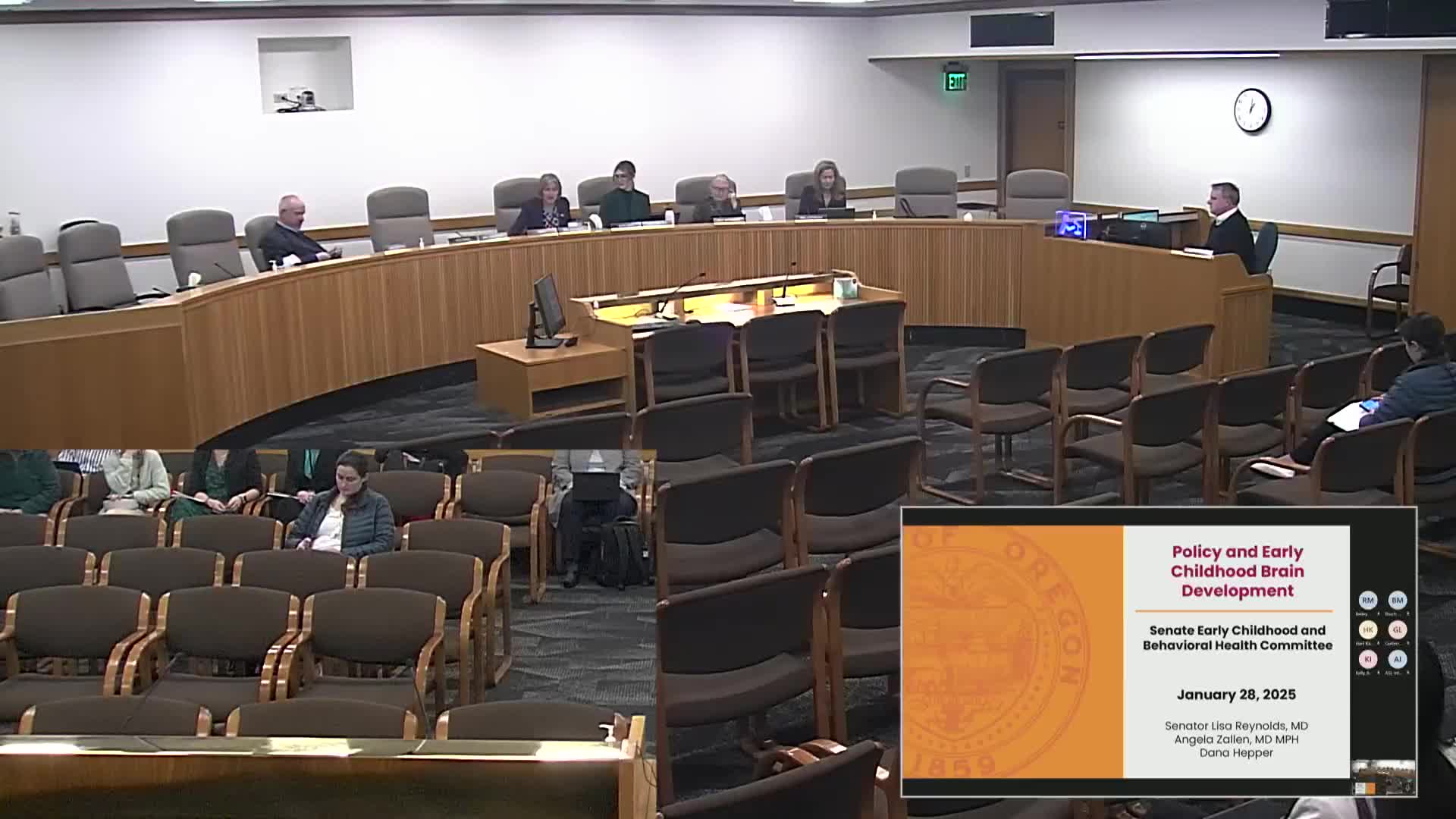
Senate committee hears experts on infant brain development, gaps in services for Oregon’s youngest children
Summary
State senators heard pediatric and policy experts outline how rapid infant brain development raises risks from toxic stress and why Oregon’s existing programs (home visiting, Medicaid parent–child services, paid leave) reach only a fraction of children who could benefit.
State senators convening the Senate Committee on Early Childhood and Behavioral Health heard pediatric and policy experts on infant brain development, adverse childhood experiences (ACEs) and gaps in Oregon’s prevention and treatment services.
The meeting, opened by State Senator Lisa Reynolds, featured pediatric hospitalist Dr. Angela Zellin and Dana Hepper, director of policy and advocacy at the Children’s Institute, who described how rapid brain growth in the prenatal period through the first year of life creates both ‘‘incredible potential and also incredible vulnerability,’’ and cited program and coverage shortfalls that leave many high‑risk infants without proven services.
The experts emphasized timing: ‘‘The newborn brain is about 10% of their body weight’’ and ‘‘more than doubles in mass in the 1st year of life,’’ Dr. Angela Zellin said, outlining neural proliferation, pruning and the sensitivity of gene expression to early experiences (epigenetics). Zellin said prolonged activation of the stress response—so‑called toxic stress—can alter brain architecture and raise long‑term risks for anxiety, depression, substance use disorders and chronic physical disease.
Dana Hepper summarized population statistics discussed in the briefing: ‘‘There are 5,392 infants and toddlers in Oregon that are homeless,’’ she said, noting that equals about 3.3% of the state’s infants and toddlers, and that 64% of children experience at least one ACE while 17% experience four or more. Hepper added that half of the ACEs a child will experience occur by the third birthday.
Panelists described Oregon programs intended to reduce risk and support early relational health: a child tax credit for 0–5 families launched in 2023, Paid Leave Oregon, universal newborn hearing screening, continuous Medicaid eligibility for children 0–6, the Oregon Parenting Education Collaborative (Student Success Act funding), and an array of evidence‑based parent–child therapies such as child‑parent psychotherapy and parent–child interaction therapy (PCIT). Hepper named an array of home‑visiting programs but said they currently reach ‘‘about 20% of families with significant risk factors.’’
Participants cited access gaps and workforce limits. Hepper said that only about 4.2% of families on Medicaid are accessing birth‑to‑5 parent–child social‑emotional services and that the Oregon Health Authority has set an access target of 11% for that metric. Committee members described geographic disparities in available providers and long waits in rural areas: one behavioral health provider told members a child could not get an appointment until February when the need was identified in September.
Senators asked about financing and clinical coding for two‑generation services. Hepper said Oregon has done ‘‘a fair amount of work to make sure our codes allow for that kind of, 2‑generation service,’’ but added that more workforce training and technical assistance are needed so clinicians will use the billing opportunities and deliver parent–child modalities.
On newborns exposed to substances in utero, Zellin said she did not have statewide counts but described clinical trends: since the arrival of fentanyl she has seen longer hospital stays and more infants requiring pharmacologic treatment and feeding supports. ‘‘I’ve seen a significant change since Fentanyl came into being,’’ she said, describing longer lengths of stay measured in weeks rather than days for some infants.
Committee members and panelists discussed existing entry points to services—pediatric primary care screening, Early Head Start/Head Start developmental screening and child welfare contacts—and strategies to strengthen rural access such as ECHO‑style tele‑mentoring for primary care and use of family support specialists. Hepper and Zellin also recommended expanding home visiting capacity, parent education and two‑generation treatment models that address parental mental health and substance use alongside child services.
The informational session included no formal votes. Hepper said she would follow up with more detail on Medicaid reimbursement rules and coding for parent‑child therapies. The committee closed after about an hour of presentations and questions.
Ending: Senators and presenters framed infant mental health as both a public‑health and budgetary issue—panelists argued that earlier, lower‑cost investments can reduce later, higher‑cost needs but acknowledged the political and financing challenges of expanding preventive services while still meeting immediate high‑need demands.