Get Full Government Meeting Transcripts, Videos, & Alerts Forever!
Get email alerts on the Renewable Energy Siting topic
No spam. Unsubscribe anytime.
Purdue Extension details solar siting, planning steps for Decatur County officials
Summary
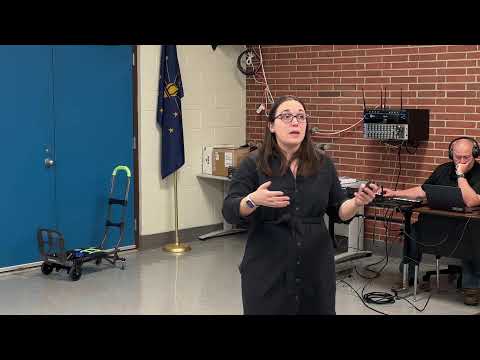
Tamara Ogle, regional educator with Purdue Extension Community Development, told Decatur County planning officials and residents at an evening presentation that communities face a complex mix of market, engineering and regulatory factors when utility‑scale renewable projects are proposed.
Tamara Ogle, regional educator with Purdue Extension Community Development, told Decatur County planning officials and residents at an evening presentation that communities face a complex mix of market, engineering and regulatory factors when utility-scale renewable projects are proposed.
Ogle opened by noting the grant behind the outreach: “we were awarded a grama from the Department of Energy last year, to provide capacity building to communities to make better informed decisions around utility scale renewable energy,” and said the Purdue team will run workshops, a needs assessment and a GIS tool for local decision‑makers.
The presentation laid out why renewables are appearing across Indiana, and why local planning matters. Ogle summarized statewide energy context she used throughout the talk: Indiana has been using more electricity than it produces since about 2012; the state imported roughly 13% of its electricity in 2022; about 14% of generation in 2023 came from renewable sources (largely wind); and roughly 5,000 megawatts of coal capacity have retired in recent years.
Nut graf: Those supply and market shifts, plus transmission limits and independent‑system‑operator interconnection rules, mean counties must weigh comprehensive‑plan goals, infrastructure impacts, and ordinance language before permitting large solar projects. Ogle emphasized that solar and wind proposals typically reach local permitting late in a long development sequence and that many technical and market conditions (transmission capacity, power‑purchase agreements, interconnection queue status) drive whether a project can proceed.
Key technical and market points
- Market economics: Ogle cited levelized‑cost analyses showing solar and wind are among the lowest‑cost new generation options and noted tracking systems boost solar output by roughly 15–20%. - Transmission and interconnection: Projects require available transmission capacity and may face substantial upgrade costs; developers often must have a power‑purchase agreement before entering the independent service operator (MISO) queue. Ogle explained Indiana sits mostly inside the MISO footprint (some areas sit in PJM) and contrasted that with ERCOT, which is not as interconnected with neighboring markets. - Timing: Utility‑scale projects involve a multi‑stage process (prospecting, site design, financing, power‑purchase agreements, interconnection studies, local permitting) and can appear dormant at times while backlog or queue issues are resolved.
Local planning, roles and legal context
Ogle reviewed how local bodies in Indiana operate and what decisions fall where. She described Decatur County as an Area Plan Commission (APC) jurisdiction — meaning the plan commission prepares comprehensive plans and makes ordinance recommendations, while the county commissioners (the legislative body) adopt plans and ordinances. The Board of Zoning Appeals (BZA) is a quasi‑judicial body that hears special exceptions, variances and appeals of administrative decisions.
Decatur County ordinance and special‑exception process
Ogle reviewed the county's current approach: Decatur County permits utility‑scale solar by special exception in AG‑1 and AG‑2, Business‑1/2/3 and Industrial‑1/2/3 zones, with BZA review and additional use standards. Required materials listed in the ordinance include a site plan; a written statement with illustrations; a road‑use agreement with the Decatur County Highway Department; an engineer‑stamped drainage plan; a visual‑impact analysis; a facility‑maintenance and removal (decommissioning) agreement; and a certificate of insurance and indemnification.
The county's construction and facility standards mentioned on the record included:
- 8‑foot fencing and neutral color for accessory structures; fencing must not cast shadows on neighboring properties. - A noise limit set at 50 decibels at the property line or at the nearest resident. - A decommissioning/removal requirement with a bond and a restoration standard (land to be restored to a minimum of 5 feet below grade).
Ogle cautioned that Indiana code does not set specific criteria for special exceptions the way it does for variances, so local governments should adopt clear, consistent criteria for special‑exception decisions and then use that criteria to assemble findings of fact. She showed Hendricks County as an example of a special‑exception criteria set (compatibility with zoning and the comprehensive plan, public‑service capacity, traffic and environmental impacts, etc.).
Discussion highlights from the public Q&A
- Utilities and reliability: Multiple attendees asked whether Indiana faces an electricity shortfall and what happens if the state does not replace retiring coal plants. Ogle said localized brownouts and rotating outages are possible where capacity is insufficient, and she described utilities' options, including delaying retirements or adding other generation and battery storage. She said prioritization during shortages typically protects critical services such as hospitals. - Economics and community benefits: Attendees raised community benefit agreements and how tax or economic development payments from projects could be directed by counties. Ogle said Purdue Extension can help inventory economic development agreements and facilitate local discussions about how revenue is used. - Agrivoltaics and soil protection: Residents asked about grazing (sheep) and crop production under panels, soil testing and preserving topsoil. Ogle recommended distinguishing community‑level regulation (zoning/ordinance standards) from private lease provisions between landowners and developers, and she noted agrivoltaics raises questions about panel height, spacing and local processor capacity for any agricultural products produced. - BZA support and training: Several attendees, including planning commissioners and staff, asked where boards can get technical help. Ogle pointed to Purdue Extension workshops, APA Indiana resources, the citizen‑planner course, peer contacts with other county planners and the project's ordinance inventory and county Snap Sheets.
What Decatur County can act on now
Ogle urged counties to: (1) map how comprehensive‑plan goals align or conflict with energy development goals and state guidance; (2) adopt clear special‑exception criteria and findings‑of‑fact worksheets so BZAs can make consistent decisions; (3) include construction, drainage and decommissioning standards in ordinance language; and (4) consider community benefit agreement templates and outreach for landowners negotiating leases.
Resources and next steps
Ogle said the Purdue team is running regional workshops, bus tours to view operating facilities, a needs assessment and a growing online resources page. The DOE‑funded effort is a three‑year grant and is partnered with Ball State and APA Indiana, among others. She asked attendees to complete a brief voluntary, anonymous evaluation and the project's needs‑assessment survey to help direct future workshops.
Tamara Ogle and Doug Westerfeld provided contact details on the project site and encouraged local officials and landowners to use the resources and training Ogle described. Doug Westerfeld, Decatur County’s new Director of Area Plan, opened the session by introducing Ogle and the program.
Ending: Ogle closed by offering follow‑up help: “If you have any questions, please feel free to reach out. Happy to have conversations.”