Get Full Government Meeting Transcripts, Videos, & Alerts Forever!
Get email alerts on the Hb2017 Delivery topic
No spam. Unsubscribe anytime.
ODOT: House Bill 2017 delivered many projects but rising costs and limited maintenance share pose funding gaps
Summary
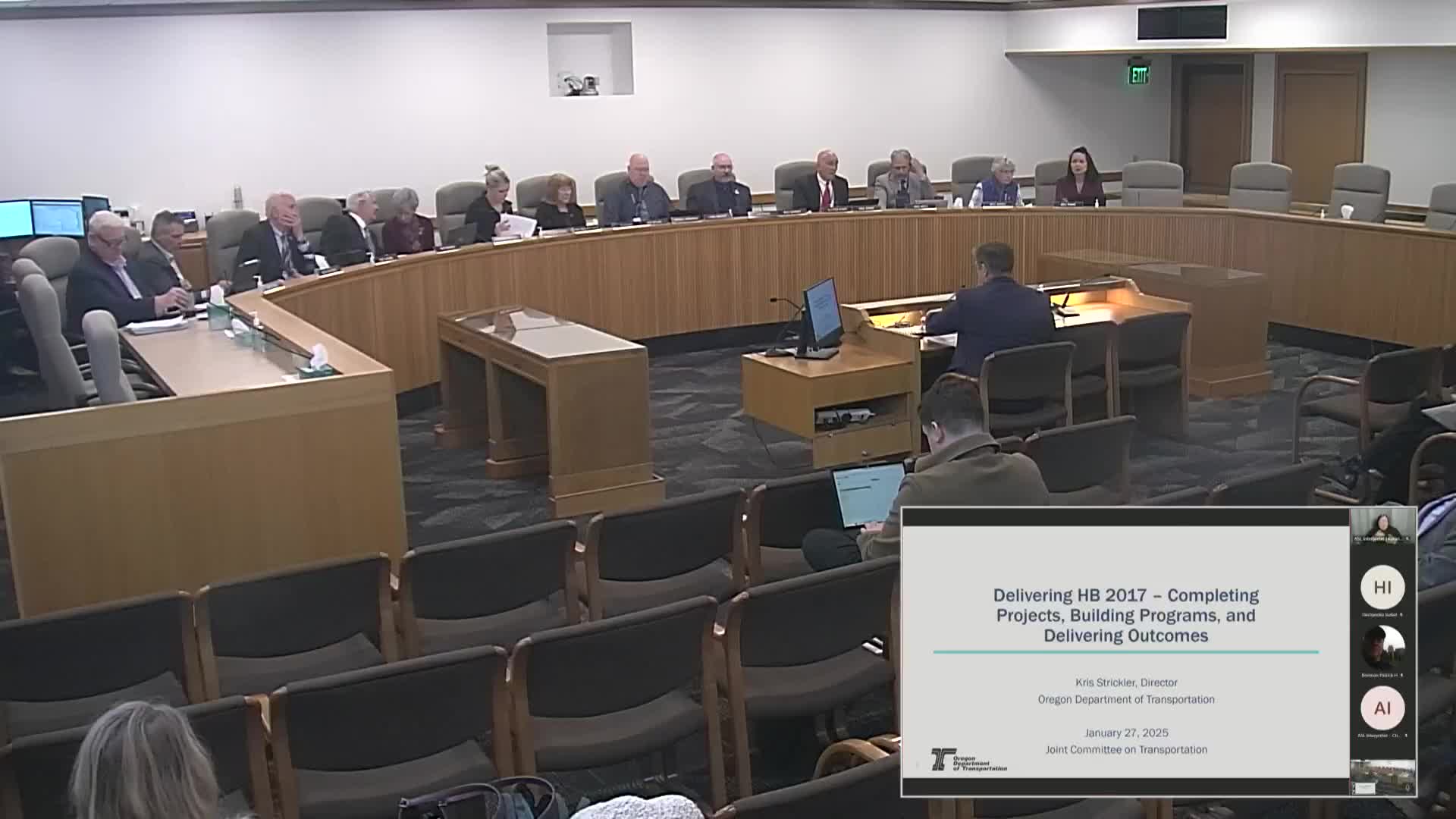
Chris Strickler, director of the Oregon Department of Transportation, summarized the agency’s delivery and accountability work under House Bill 2017 during a Jan. 27 joint informational meeting.
Chris Strickler, director of the Oregon Department of Transportation, summarized the agency’s delivery and accountability work under House Bill 2017 during a Jan. 27 joint informational meeting.
Strickler told committee members that HB2017 was the largest transportation investment in Oregon’s history and that it reframed how the state funds and reports on transportation. He said the package included new revenue sources and dedicated funds for non-highway modes, programmatic improvements and a set of named projects with legislative direction on sequencing and delivery. "House Bill 20 17, I would say, set the stage. It really doubled down on the accountability aspect," Strickler said.
ODOT provided a suite of delivery metrics and project-status figures. The department reported a State Highway Fund portfolio with roughly $1.7 billion in annual sources and a net ODOT portion of about $813 million (after apportionments and takedowns). Of that pool, ODOT showed an available operations and maintenance amount of roughly $370 million. Strickler cited HB2017-generated annual increases to highway-related funding of roughly $658 million (as of the most recent increase), and he noted that House Bill 2017 funding itself represented a small share of total maintenance spending once the whole portfolio is considered.
Strickler walked the committee through named projects and program outcomes. Key figures the department reported: 17 legislatively named local projects and 23 state projects in HB2017; about 133 non-named projects identified and delivered or advanced since 2018 (about 60 completed, 29 in construction, 44 in design); more than 500 bridge rehabilitations and 30-plus bridge replacements on the state system; and roughly 2,700 bridges the state maintains (the larger total bridge inventory is roughly 6,000 statewide when local bridges are included).
Programs created or expanded by HB2017 and the presentation included Safe Routes to School (initial set-aside: $10 million beginning in 2018, then $15 million annually beginning in 2023; staff said the program is oversubscribed), the Connect Oregon competitive program (funded by a light-vehicle dealer privilege tax and used for aviation, marine and rail projects), and expanded transit funding through a 0.1% payroll tax that feeds the Statewide Transportation Improvement Fund (STIF/STF) and has supported new routes, vehicles and subsidized student fares.
Committee members asked specific questions about cost increases and funding sources. Strickler explained common drivers of higher final project costs: elective scope additions requested while the project is underway, underestimates in preliminary scopes, inflation and federal/local processes (for example, MPO or NEPA local-endorsement and permitting steps). He used the state dashboard to show delivery performance from contract advertisement ("68% on time, 97% on budget") while also noting that earlier planning and scoping stages show lower on-time performance ("26%") and need improvement.
Members pressed on signature projects and funding gaps. The Center Street Bridge and several other named projects showed higher projected costs after further environmental review; ODOT described some projects as partially funded by HB2017 and later supplemented by commission reprogramming, federal awards or local contributions. The I-5 Rose Quarter project has federal Reconnecting Communities grant funding (Strickler cited a $450 million federal award) but remains only partially funded overall; the department said remaining phases are unfunded. Committee members also asked about the paused tolling/value-pricing work; Strickler said the tolling effort was paused in 2024 while bridge-replacement and interstate bridge finance plans still assume tolling in some finance scenarios.
On maintenance and preservation, Strickler highlighted an ongoing funding challenge: HB2017 increased resources but rising construction costs and inflation have eroded purchasing power. "We're projecting funding to flatten. When I say flatten, no additional revenues coming in and then fuel economies, continuing to increase," Strickler said, summing up the fiscal pressure facing maintenance budgets.
The presentation included several project-level examples showing where HB2017 funding was intended as full funding, partial start-up funding, or design-phase funding; ODOT staff said the July 7 memo and subsequent OTC actions guided sequencing and, in some cases, reprogramming. The committee asked staff to provide additional detail about which projects used federal funds or reprogrammed state funds to close gaps and to return with more analysis on rural allocations and the distribution mechanism for transit payroll-tax dollars to smaller providers.
No formal motions or votes occurred during the informational presentation; the session was for briefing and committee questions only.