Get Full Government Meeting Transcripts, Videos, & Alerts Forever!
Get email alerts on the Higher Education Labor topic
No spam. Unsubscribe anytime.
Unions tell House committee Oregon higher education needs sustained funding, pay parity and transparency
Summary
Representatives of AFT Oregon, OEA, SEIU and AAUP testified that Oregon's public higher-education institutions are underfunded, relying increasingly on low-paid adjunct and contingent labor, and urged the legislature to fund pay parity, increase state support and require more transparency from university foundations.
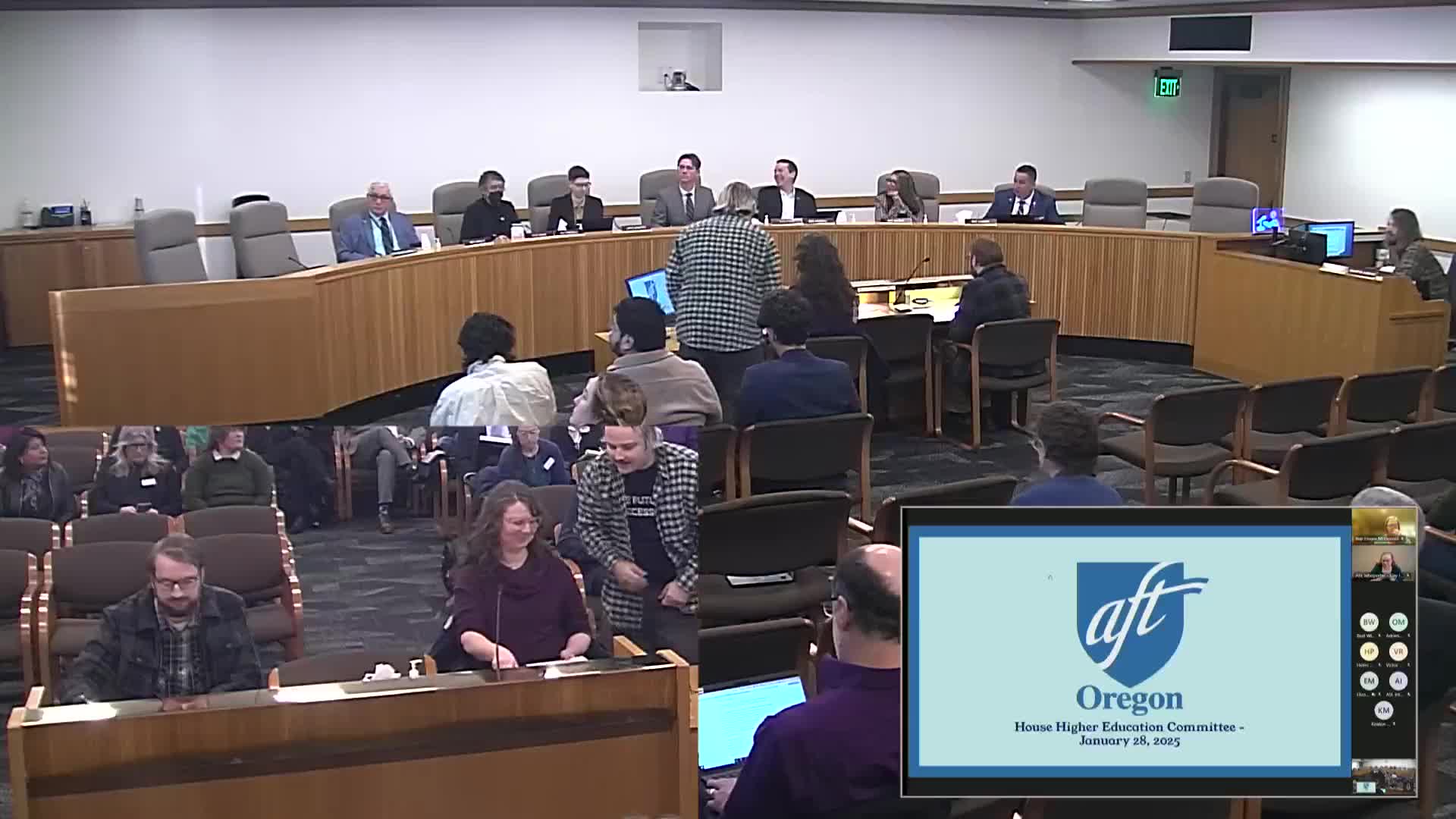
Multiple labor organizations told the House Committee on Higher Education on Jan. 28 that Oregon's public colleges and universities face chronic underfunding, increases in contingent adjunct labor and staffing pressures that threaten services and student success.
"Teaching conditions and working conditions are also the learning conditions for our students," Ariana Jacob, president of AFT Oregon, said, urging stable funding, improved pay for adjunct faculty and measures to prevent what she described as a shift toward precarious adjunct labor.
Why it matters: Union speakers called for concrete legislative changes including community college pay parity, greater budget transparency for public-university foundations and funding to stabilize workforce and students' supports. They argued state investment is necessary to retain staff and faculty and to preserve programs that feed the state's workforce.
AFT testified that Oregon ranks 35th in the nation for the percentage of tax revenue allocated to higher education and that tuition and program costs have risen substantially over the last two decades. Jacob listed legislative priorities including House Bill 2669 (community college pay parity), the Public University Foundation Sunshine Act and the Student Basic Needs and Workforce Stabilizations Act.
Graduate-student testimony echoed the funding and staffing concerns. Luke Nearhud, a graduate employee at Oregon State and member of the Coalition of Graduate Employees, described a bargaining cycle that led to a strike in mid-November and resolution in early December after mediation and bargaining. Nearhud gave a timeline of negotiations that began in August 2023, entered mediation, declared impasse in September and resulted in a strike that he said addressed salary and contract-length issues. He said the minimum salary in his unit moved from 17.62 to 19.91 (figures provided in testimony).
Community-college speakers described student need and workforce connections. Adrienne Mitchell of Lane Community College said community colleges prepare nurses, paramedics, dental hygienists and skilled tradespeople and that state funding for community colleges has stagnated when adjusted for inflation. She cited a Hope Center finding that 41% of community-college students were food insecure in the prior month and 52% were housing insecure in the previous year.
Chemeketa adjunct Michelle Kennedy told the committee her bargaining unit had been without a new contract for more than 200 days, said part-time faculty perform many of the same duties as full-time instructors and urged pay parity.
SEIU leaders and classified-staff representatives described similar pressures across the seven public universities and smaller regional institutions. Johnny O'Rourke, president of SEIU, said classified staff perform essential roles from custodial to technical work and that many employees cannot afford to live in the communities where they work.
The American Association of University Professors (AAUP) representatives emphasized academic freedom, shared governance and transparency. Victor Reyes, AAUP Oregon executive director, asked the legislature to support HB 3213 to improve transparency around public-university foundations and recommended greater state investment in the public university support fund. Keaton Miller, a University of Oregon associate professor, said roughly one-third of his bargaining unit takes home less than $50,000 a year and argued that low pay harms recruitment and curricular development.
Ending: Labor groups asked for legislative funding, pay-parity laws and transparency measures and said immediate and sustained investment is needed to retain faculty and staff and to keep classes and student services operational. Committee members requested data on the state fiscal impacts of low employee pay and were invited to receive additional research from unions.