Lifetime Citizen Portal Access — AI Briefings, Alerts & Unlimited Follows
Committee advances ALTCS screening changes, nurse circulator rule and other measures; votes at a glance
Loading...
Summary
The Arizona House Health & Human Services Committee voted to advance six bills after presentations and testimony, including a modified ALTCS cognitive screening bill, a circulator‑nurse requirement for surgeries, marijuana ad restrictions, an acute‑at‑home extension and licensing reforms for behavioral health and behavior analysts.
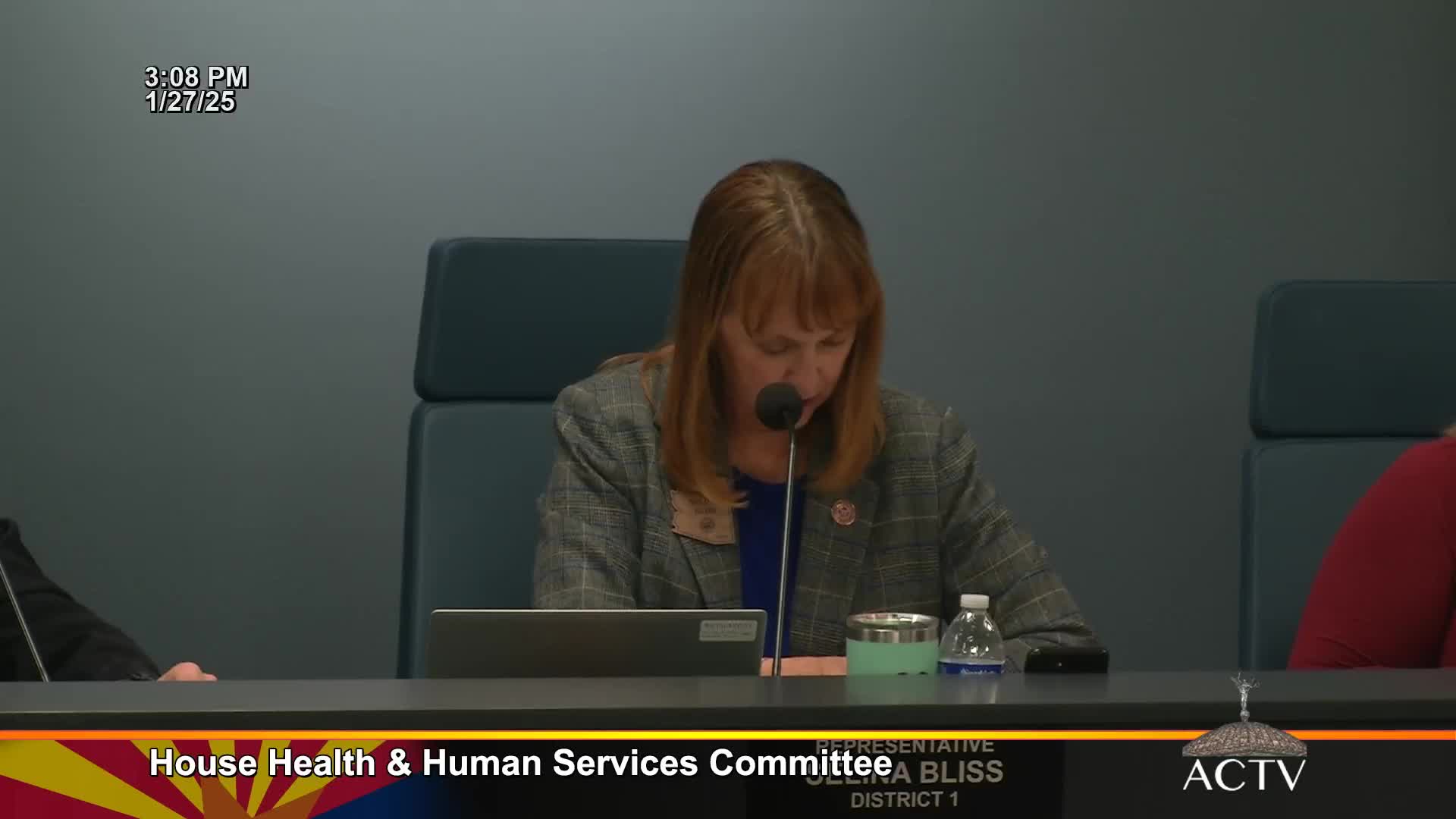
The Arizona House Health and Human Services Committee advanced six measures after presentations and testimony on workforce and rural access. Lawmakers passed or recommended passage for bills that would modify the Arizona Long‑Term Care System (ALTCS) screening process, require an RN circulator for most surgeries, restrict marijuana advertising near child‑focused locations, extend an acute‑care‑at‑home pilot, and alter licensing procedures for behavioral‑health professionals and behavior analysts.
Votes at a glance
- House Bill 2182 (ALTCS pre‑admission cognitive screening) — Passed in committee as amended, 12–0. Sponsor: Rep. Selena Bliss. The Bliss amendment (Jan. 24, 2025, 09:22 a.m.) removed a requirement that ACCESS conduct in‑residence interviews with caregivers, family, neighbors and medical providers; it maintained existing ALTCS pre‑admission screening procedures and added an effective date of July 1, 2027. ACCESS staff said redesigning the assessment tools and testing would carry a fiscal and operational cost; stakeholders including the Alzheimer’s Association supported the bill as a way to better identify cognitive decline in applicants.
- House Bill 2132 (Registered‑nurse circulator in operating rooms) — Passed as amended, 9–3. Sponsor: Rep. Bliss. The Bliss amendment (Jan. 23, 2025, 04:55 p.m.) exempts a hospital or outpatient center from the RN‑circulator requirement during an extraordinary number of emergency surgical cases resulting from unique or mass‑casualty events and defines “extraordinary.” Proponents, including perioperative nurses, argued a single dedicated RN per case is a patient‑safety standard; some hospitals and business groups warned the mandate could strain staffing and increase costs in understaffed facilities.
- House Bill 2179 (Marijuana advertising restrictions) — Passed, 12–0. Sponsor: Rep. Bliss. The bill restricts marijuana advertising and requires warning labels; it bars billboards within 1,000 feet of parks, playgrounds, child‑care centers, schools, substance‑use recovery facilities and churches and includes a Proposition 105 clause. Testimony included physicians and pediatricians who showed examples of ads they said targeted youth; hemp and paraphernalia businesses urged technical changes to avoid unintentionally encompassing lawful hemp products.
- House Bill 2180 (Acute‑care services at home pilot extension) — Passed, 11–1. Sponsor: Rep. Bliss. The bill extends the pilot program repeal date to Jan. 1, 2029. Mayo Clinic and other proponents said the program — hospital‑level remote monitoring and twice‑daily nursing or EMT visits in the patient’s home — has shown positive outcomes and high patient satisfaction; committee members asked for more outcome data tied to readmissions and costs.
- House Bill 2001 (Temporary license for behavioral‑health graduates) — Passed, 10–2. Sponsor: Rep. Breus. The bill would allow a temporary license, valid for 90 days after graduation, for applicants who have completed required graduate training and are working under qualified supervision while their associate‑level application proceeds; proponents said it avoids care interruptions for clients who otherwise lose their graduate‑intern clinician on graduation day.
- House Bill 2027 (State Board of Behavioral Analysts) — Passed, 10–2. Sponsor: Rep. Bliss. The bill moves the Committee of Behavior Analysts out of the Board of Psychologist Examiners and establishes a State Board of Behavioral Analysts (seven members), cites duties and sets a sunset date of July 1, 2034. Supporters said the change will reduce licensing delays and board quorum issues without increasing staffing or state costs.
Key details and committee discussion
ALTCS pre‑admission screening (HB 2182): ACCESS staff said updating the functional assessment tools to capture cognitive decline will require contractor support, extensive testing and fiscal resources; they estimated work to modify multiple assessment instruments and to model fiscal impacts. The Alzheimer’s Association, dementia‑care providers and owners of specialized facilities described cases where applicants were financially eligible for ALTCS but denied on functional measures and urged the committee to approve the amended approach to ensure cognitively impaired applicants receive appropriate assessment.
Circulator‑nurse requirement (HB 2132): Perioperative nurses testified that a dedicated RN circulator is best practice to maintain infection prevention, correct‑site verification and to detect subtle signs of patient deterioration; some hospital groups said the mandate could aggravate nursing shortages in some facilities and proposed an accreditation‑based exemption. The adopted amendment includes a narrowly drawn emergency exception.
Marijuana advertising (HB 2179): Pediatricians and prevention advocates emphasized ads that use cartoons or holiday themes visible to children; dispensary and hemp stakeholders sought technical fixes to avoid sweeping in lawful hemp products or constraining non‑marijuana businesses unintentionally. The bill sponsor signaled intent to work with stakeholders on clarifying amendments before floor action.
Other measures: HB 2180 (acute‑care at home) drew questions about the scale of current use, targeted diagnoses (pneumonia, cellulitis, COVID, sepsis and certain post‑op recoveries were cited) and insurer coverage for home‑based acute care. Supporters said Mayo Clinic has performed hundreds of admissions under the pilot and offered to provide outcomes and readmission data to staff. HB 2001 and HB 2027 address licensing processes and board structure; supporters said the changes would reduce avoidable delays and preserve continuity of care for clients of newly graduated clinicians.
What passed and next steps
All six bills received committee approval and will move to the House floor with sponsor commitments to work on technical amendments where stakeholders flagged concerns (notably HB 2132 and HB 2179). Sponsors and committee staff indicated they will supply fiscal notes, contractor reports (for ALTCS updates) and outcome data (for the acute‑at‑home pilot) before floor debate.