Get Full Government Meeting Transcripts, Videos, & Alerts Forever!
Get email alerts on the Cryptocurrency Policy topic
No spam. Unsubscribe anytime.
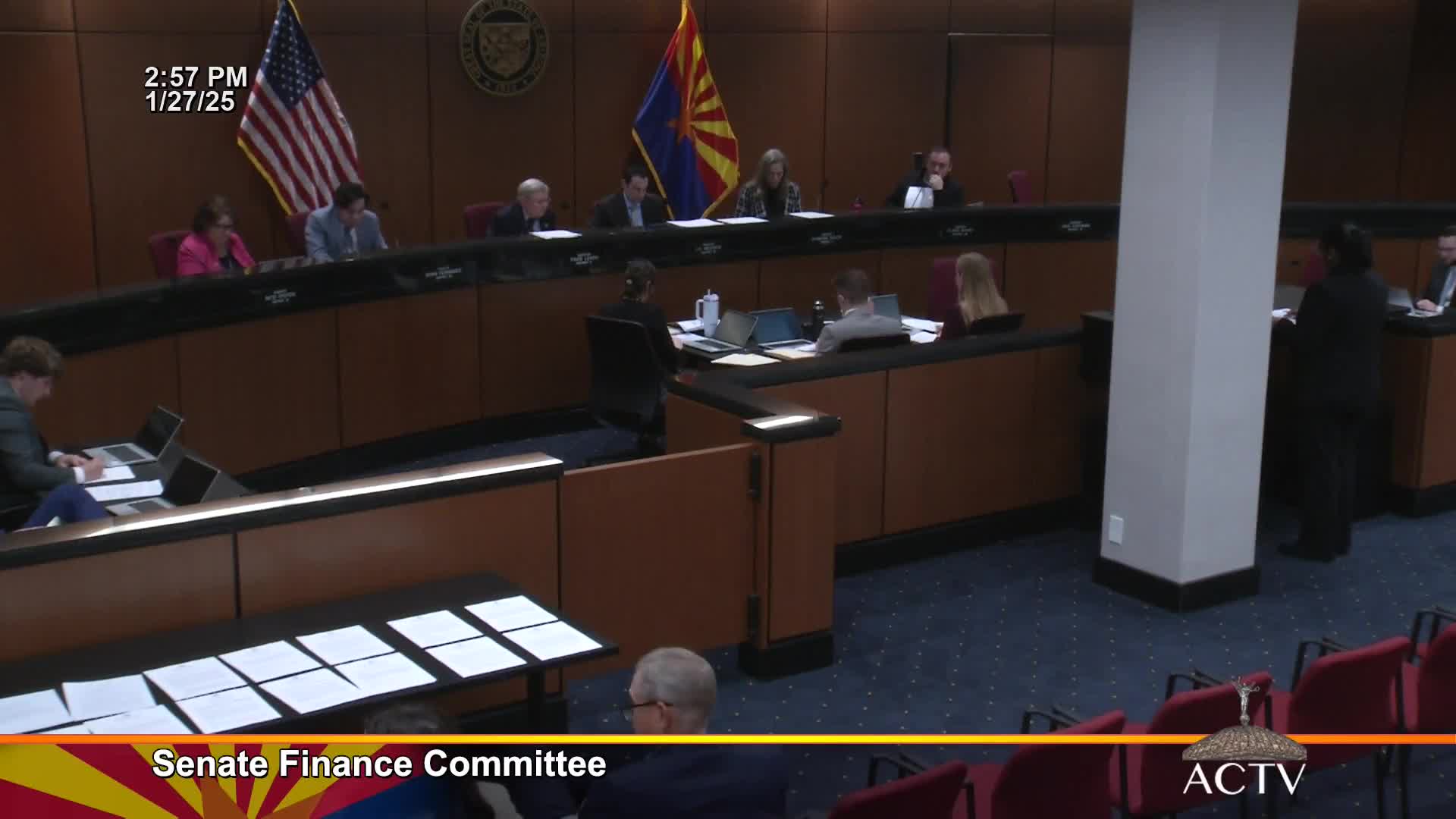
Senate Finance advances package of cryptocurrency measures on payments, investments and tax treatment
Summary
The Arizona Senate Finance Committee on Jan. 24 advanced a group of measures to allow state agencies to accept cryptocurrency payments, permit retirement and treasury funds to invest in virtual currency, and change property-tax treatment of virtual currency if voters approve a constitutional amendment.
The Arizona Senate Finance Committee on Jan. 24 advanced several measures that together expand how state government may accept, hold and treat cryptocurrencies.
Senate Bill 1024 would allow a state agency — beginning Jan. 1, 2026 — to contract with a cryptocurrency service provider so the agency may accept cryptocurrency as payment for amounts due. Senate Bill 1025 would permit the state treasurer, the Arizona State Retirement System (ASRS) and the Public Safety Personnel Retirement System (PSPRS) to invest up to 10% of the public monies under their control in virtual currency holdings. Senate Bill 1026 and companion SCR 1001 would, if the constitutional resolution passes voter approval, exempt virtual currency from property tax; the statutory counterpart (SB 1026) is conditional on voter approval of SCR 1001. SCR 1005 asks retirement systems to study Bitcoin and other digital-asset exchange-traded funds and report back. Senate Bill 1062 would add cryptocurrency to the definition of legal tender across Arizona Revised Statutes.
Senator Wendy Rogers, who sponsored several of the measures, framed the package as expanding payment and investment options and making Arizona "crypto friendly." Rogers said the bills are permissive — they authorize options but do not require agencies to accept cryptocurrency or treasurers to invest in it. She told the committee that Bitcoin and other digital assets can serve as a hedge against inflation and that other states are pursuing similar steps.
Opponents and skeptical members raised several practical concerns. Senator Brian Fernandez asked how agencies and the state would handle price volatility, service fees and the operational burden of accepting or converting crypto. Senator Mitzi Epstein pointed to risk and consumer-protection questions and asked whether the systems and staff exist in many agencies to manage such transactions. Committee members and staff described the likely arrangements as similar to foreign-currency processing: agencies would typically convert received crypto into U.S. dollars promptly through exchanges or use dollar-linked stablecoins to limit value fluctuations. Several members emphasized that the bills are discretionary and leave specifics — which coins to accept, which processors to hire, and how to manage float and fees — to the contracting agency.
Committee members split on the measures. SB 1024 (allowing agencies to accept crypto payments) was returned with a favorable recommendation by a 4–3 vote. SB 1025 (authorizing up to 10% investments in virtual currency) was returned with a favorable recommendation by a 4–3 vote. SB 1026 as amended (statutory exemption) and its companion SCR 1001 (constitutional amendment for the exemption) were returned with a favorable recommendation by 5–2 votes on each measure. SCR 1005 (encouraging ASRS and PSPRS to study digital-asset ETFs) passed 5–2, and SB 1062 (adding cryptocurrency to definition of legal tender) was passed 4–3.
Supporters argued the authority would let modern payment options and investment choices be available to state entities and retirement systems that choose them; critics warned about volatility, processing costs, limited staff expertise in agencies, and the risk of granting implied credibility to digital assets through repeated statutory references.
Votes at a glance (committee roll-call tallies): SB 1024 — 4 yes, 3 no (returned with do-pass); SB 1025 — 4 yes, 3 no (do-pass); SB 1026 (as amended) — 5 yes, 2 no (do-pass); SCR 1001 — 5 yes, 2 no (do-pass); SCR 1005 — 5 yes, 2 no (do-pass); SB 1062 — 4 yes, 3 no (do-pass).
The committee left the specifics of contracts, coin selection and risk mitigation to agencies and trustees, and several members requested follow-up briefings or reports to track implementation and any operational problems.