Get Full Government Meeting Transcripts, Videos, & Alerts Forever!
Get email alerts on the Comprehensive Plan Zoning topic
No spam. Unsubscribe anytime.
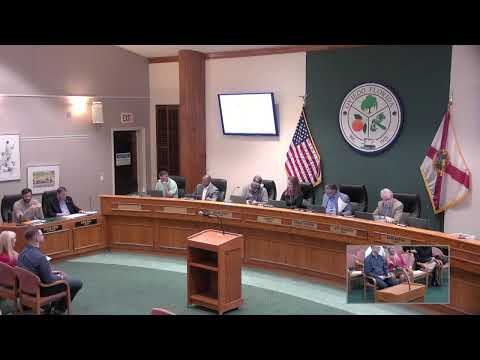
Oviedo planning agency pauses vote on mixed-use proposal after residents raise traffic and drainage concerns
Summary
The Oviedo Local Planning Agency voted to continue two related ordinance items tied to a proposed 172-unit age-restricted mixed-use development on about 9.62 acres at Lockwood Boulevard and County Road 419, giving the developer 30 days to meet with neighbors and staff.
The Oviedo Local Planning Agency voted to continue two measures tied to the “Aria Adovito” mixed-use proposal — Ordinance No. 17-54, a future land-use map amendment, and Ordinance No. 17-55, a zoning map amendment establishing a planned unit development (PUD) and development agreement — for up to 30 days to give the developer time to meet with nearby homeowners and address concerns.
The project would change the future land-use designation for about 9.62 acres on the east side of Lockwood Boulevard north of County Road 419 from low-density residential to mixed-use and would allow a development of 172 age-restricted multifamily units and about 6,156 square feet of retail commercial space under the proposed development agreement. City staff described the proposal as a small-scale comprehensive plan amendment and recommended approval of both ordinances, subject to minor edits in the development agreement staff identified.
Josh Enott of Kemmihorn and Associates, the applicant's representative and an Oviedo resident, told the board the proposal is a 55-plus apartment complex with limited retail and that the developer would provide additional detail later. "Our proposed development's a 55 plus apartment complex with a small retail portion," Enott said.
Planning staff reviewed statutory and code requirements and told the board there is sufficient capacity for water, sewer, solid waste and recreation to serve the project and that the development agreement would limit uses in the retail portion (restaurant uses were specifically prohibited by the draft agreement). Staff also identified corrections to the development agreement tables (density, parking and open-space calculations) and recommended the developer amend the conceptual development plan to reflect those corrections prior to city council consideration.
A significant portion of the meeting focused on public comment. More than half a dozen residents from River Oaks and River Oaks Reserve urged the board to reject or delay the proposal, citing traffic safety at the Lockwood/County Road 419 intersection, drainage and wetlands, increased noise and project density. Robert Strumbecki, president of the River Oaks homeowners association, told the agency he was worried additional runoff could overload the neighborhood drainage and lead to future expenses for residents. "Drainage is our main concern," Strumbecki said. "If it runs north into that system, it's gonna put a strain on our system."
City and applicant traffic experts responded with the project's traffic analysis. Cochón Ma, the city’s transportation consultant, told the board that, using Institute of Transportation Engineers trip-generation rates, the 172 age-restricted units would generate roughly the same number of trips as about 38 single-family units under a low-density residential designation and would produce far fewer trips than the full commercial development that could be built under existing commercial entitlements. "This site at 9.63 acres, if left as low density residential, would be permitted to construct, I think it's 38, single family units. Those 38 single family units, would generate roughly the same number of trips as the 172, age restricted units," Cochón Ma said. He also said his review found applicant responses addressed his comments.
Board members expressed divided views. Some members said the site is outside the city’s mapped priority mixed-use areas and that the scale of 172 units felt large relative to existing neighborhood character. Others and staff noted that leaving the parcel as fully commercial could produce more traffic overall and that mixed-use with age-restricted residential might reduce peak traffic impacts compared with large commercial development.
After the public comment period, a board member moved to recommend approval to city council for Ordinance 17-54; after additional discussion and at the developer's request the mover amended the motion to continue both Ordinance 17-54 and Ordinance 17-55 for up to 30 days to allow the developer to meet with the homeowners association and staff to address concerns. The board voted in favor of the continuance by voice vote.
The continuance pauses the LPA’s recommendation to city council and schedules time for additional outreach; staff asked residents to meet with city planning staff as well to review the comp plan and application materials. If the applicant proceeds with revised materials the ordinances will return to the LPA and then to the City Council for hearings required under Florida law.
Details the board flagged for further work included traffic- and striping-related safety improvements in the shared access area near Walgreens and Publix, final corrections to the development agreement’s density/parking/open-space tables and documentation that water capacity letters are current. Staff noted that the development agreement limits retail uses to the city’s C-1 uses and specifically prohibits restaurants.