Get Full Government Meeting Transcripts, Videos, & Alerts Forever!
Get email alerts on the Communications Security topic
No spam. Unsubscribe anytime.
Security expert warns Ericsson-linked systems pose risk to 911 portability and emergency communications
Summary
A committee briefing outlined alleged historical misconduct by Ericsson, concerns about a subsidiary that controls telephone porting to emergency services, and a call for a state-funded task force and redundant communications systems such as low-orbit satellite service.
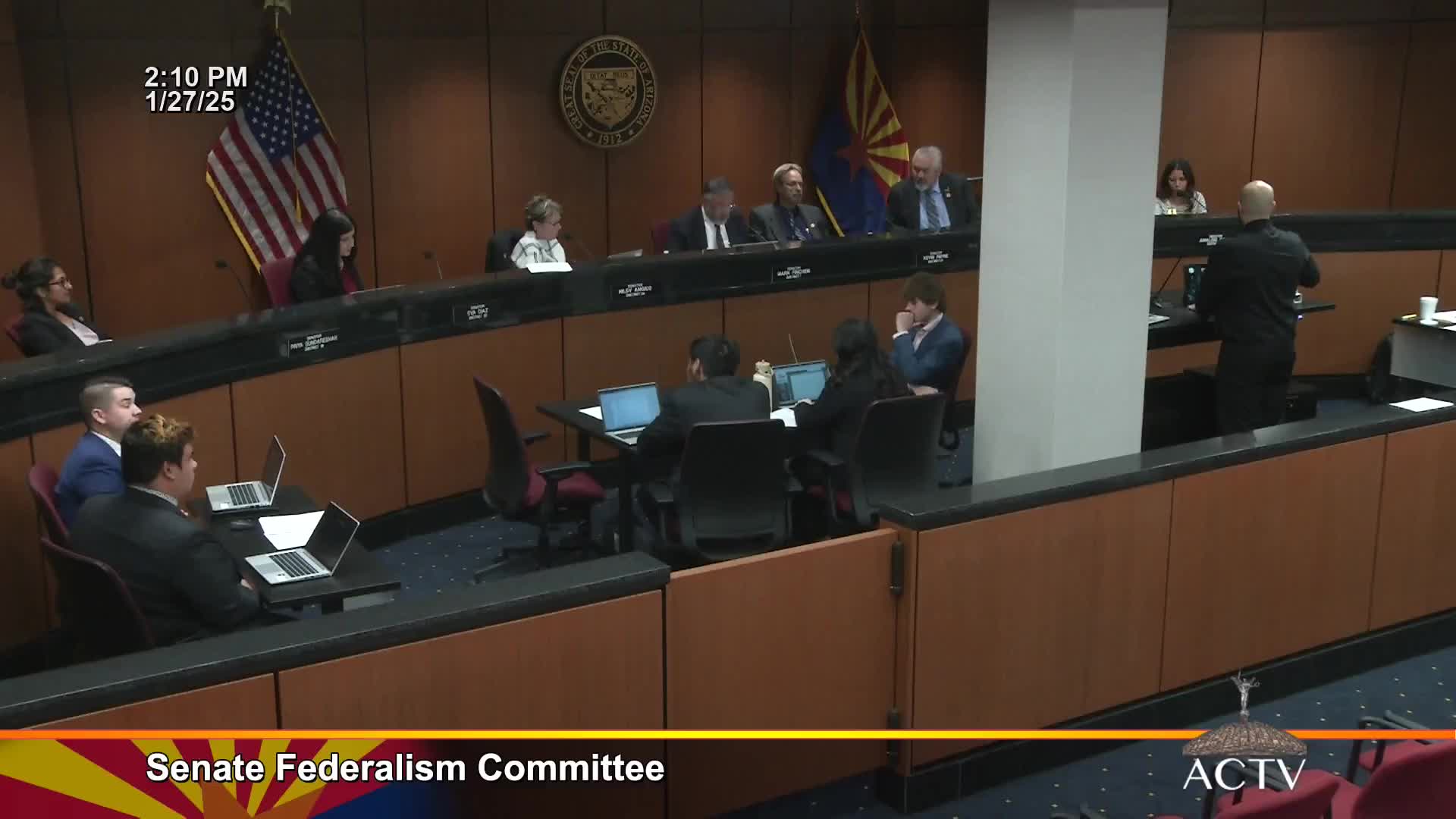
Michael Ray Curry, a private researcher, told the Arizona Senate Federalism Committee on Jan. 24 that an Ericsson subsidiary controls the technology that ports calls and data to emergency services and that historical misconduct and corporate practices create national-security and emergency-response risks.
Curry summarized what he said is a multi-year investigation and public reporting about Ericsson and its subsidiary iConnective (formerly Telcordia Technologies). “The Ericsson list reveals that the Swedish telecom giant sought permission from the terrorist group known as the Islamic State to work in an ISIS controlled city and paid to smuggle equipment into ISIS areas,” he said, citing descriptions in his report. Curry said the 2019 Justice Department settlement with Ericsson over Foreign Corrupt Practices Act violations — which he described as a roughly $1 billion enforcement outcome with a $325 million criminal penalty component — illustrated the company’s conduct in Iraq.
Why it matters: Curry told senators the company that “controls all porting for all data is iConnective,” and that if those systems are compromised it could affect 911 portability, emergency routing and law-enforcement access. He urged Arizona lawmakers to consider creating a task force and to study redundant emergency communications — including low-orbit satellite services such as Starlink — to ensure continuity when terrestrial networks are overloaded or compromised.
Curry described a range of allegations drawn from public reporting and court filings, including the Justice Department’s 2019 resolution. He also cited reporting he attributed to the International Consortium of Investigative Journalists and referenced internal emails and cables reportedly made public through leaks. “If Ericsson were to get hacked, that would make the hack an internal issue that our government can do absolutely nothing about,” Curry said, arguing that foreign corporate ownership and private cloud/endpoint control limit government oversight.
During questions, senators probed how those risks manifest in emergencies. Curry offered the Las Vegas mass-shooting response of Oct. 1, 2017 as an example in which some callers could not reach emergency services. When asked whether that failure could have been a simple overload, Curry said the likely answer from carriers would be that the network was overloaded, but he emphasized porting and interoperability issues tied to the systems Ericsson controls. He also discussed the use of Starlink as a redundant emergency communications option and said lower-orbit satellites can reach locations where traditional towers do not.
Committee chair Mark Finchem and other senators asked how blockchain-based financial systems might be affected by compromised telecommunications infrastructure. Curry warned that if data and communications infrastructure are effectively controlled by private or foreign entities, that raises risks for data access, financial networks and any system that depends on private terms of service and proprietary control.
Curry provided the committee with a full PDF of his report for distribution to members and recommended further legislative study and a funded task force to examine the state’s communications resilience.
Ending: The committee did not take immediate formal action on Curry’s recommendations during the Jan. 24 meeting. The researcher made his materials available to committee staff for follow-up and said he would work with staff to distribute the full report.