Get Full Government Meeting Transcripts, Videos, & Alerts Forever!
Get email alerts on the Retail Modernization Hb2068 topic
No spam. Unsubscribe anytime.
Grocers push bill to expand bag-drop access and formalize People’s Depot as alternative redemption center
Summary
Grocers and small-format retailers outlined House Bill 2068, a package to incentivize bag-drop sites, collapse some convenience zones, and create an alternative redemption-center status; downtown Portland retailers warned of safety and service gaps if large grocers stop in-store returns without matched downtown capacity.
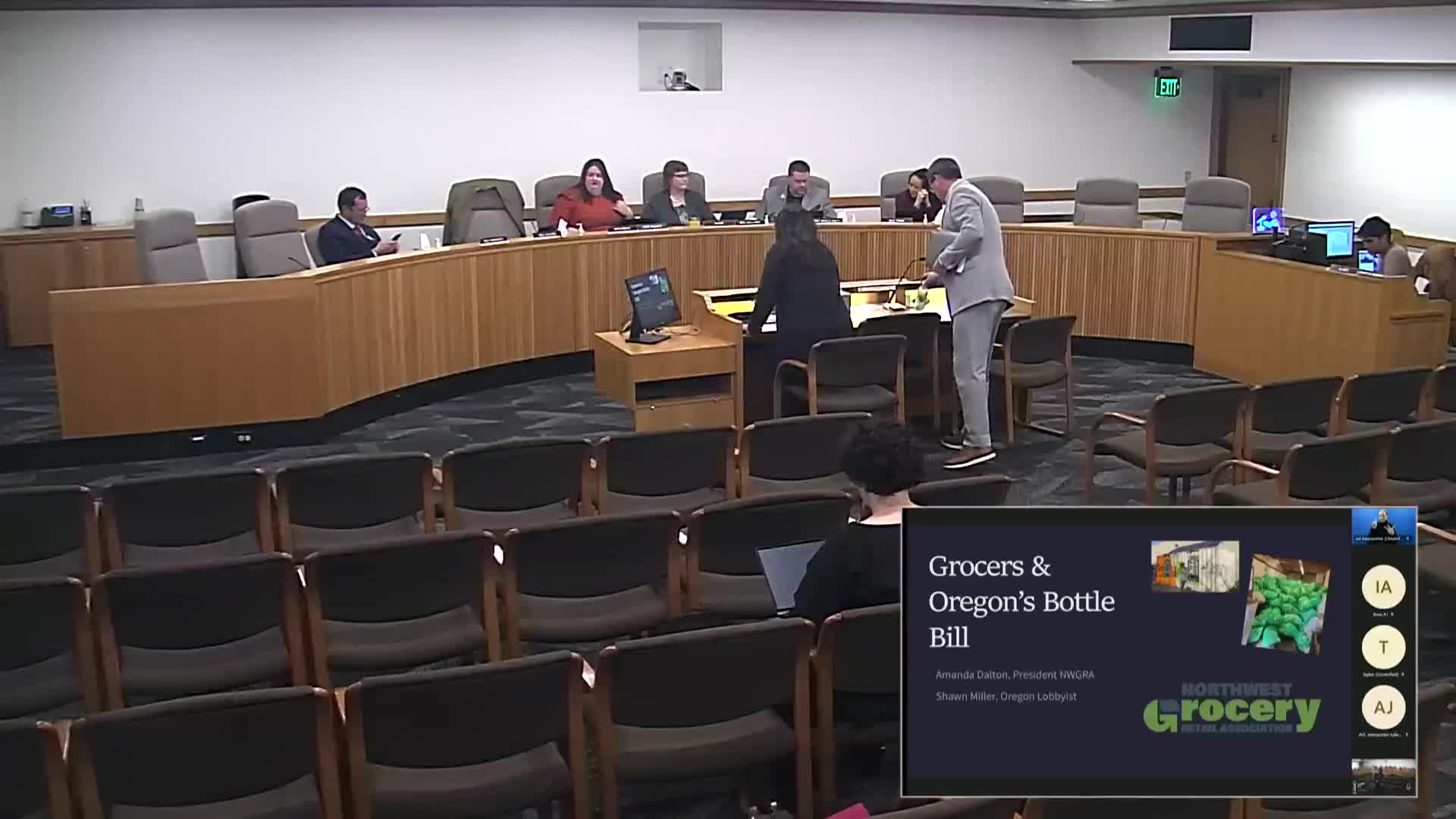
Amanda Dalton, president of the Northwest Grocery Retail Association, told the committee that retailers “contribute an average of $34,000,000 a year into operations around the bottle system,” a figure the association said covers labor, capital and site costs for in-store returns and dealer redemption centers. Members are sponsoring House Bill 2068 to change convenience-zone geography, incent more bag-drop locations and create an alternative access path for community-run depots.
The Nut Graf: Retailers say modernizations would increase convenience, reduce in-store handling of containers and improve employee safety; small-format retailers and downtown convenience stores said the changes must protect overnight access and not concentrate returns where safety or hours are limited.
What retailers propose: HB 2068 (as described to the committee) would authorize an “alternative access redemption center” status for qualified community depots, expand incentives for bag-drop (dealer redemption) sites, allow the OLCC to adopt narrowly prescribed temporary shutdown authority for safety or emergency cleaning, and propose collapsing Oregon’s two statutory convenience zones into a single zone in many areas based on updated data. Sean Miller of the Northwest Grocery Retail Association said the group concluded “we can take 22 out of the 27 redemption centers, collapse those 2 convenience zones into 1 and it would be a very low impact.”
Why downtown Portland matters: Amanda Dalton and Sean Miller described a large gap in downtown convenience-zone coverage and said retailers have borne heavy return workloads there. Jonathan Polonsky, CEO of Plaid Pantry and chair of the Oregon Stores Association, emphasized the downtown, late-night use pattern: many small-format stores serve as the only 24/7 return points and “in Downtown Portland, that's pretty tough to enforce, and it's pretty tough to ask somebody, 1 of my associates at 3 in the morning to enforce that, on somebody.” Polonsky said he supports expanded alternative access generally but asked for protections specific to downtown Portland so safety and access for customers who rely on late-night returns are preserved.
People's Depot as partner: Retailers told the committee they have been working with the People's Depot (a community-run site) and city partners to identify a permanent downtown location and to make the depot a formally recognized alternative access point. Amanda Dalton said the People's Depot is on track to process millions of containers and retailers and OBRC could co-fund a depot operation to relieve retail pressure.
Points of disagreement and unresolved details: grocers urged that wine containers remain under the Recycling Modernization Act (Senate Bill 582) rather than be added to the bottle bill, citing a projected 77,000,000 containers and system capacity concerns. Retailers and community partners differed on siting, hours and whether alternative centers can absorb overnight volumes if large grocers reduce in-store returns. No formal vote was taken.