Get Full Government Meeting Transcripts, Videos, & Alerts Forever!
Get email alerts on the Flag Display And Free Speech topic
No spam. Unsubscribe anytime.
Rules committee backs HB 2113 after counsel recommends floor amendment to narrow scope of flag-display restrictions
Summary
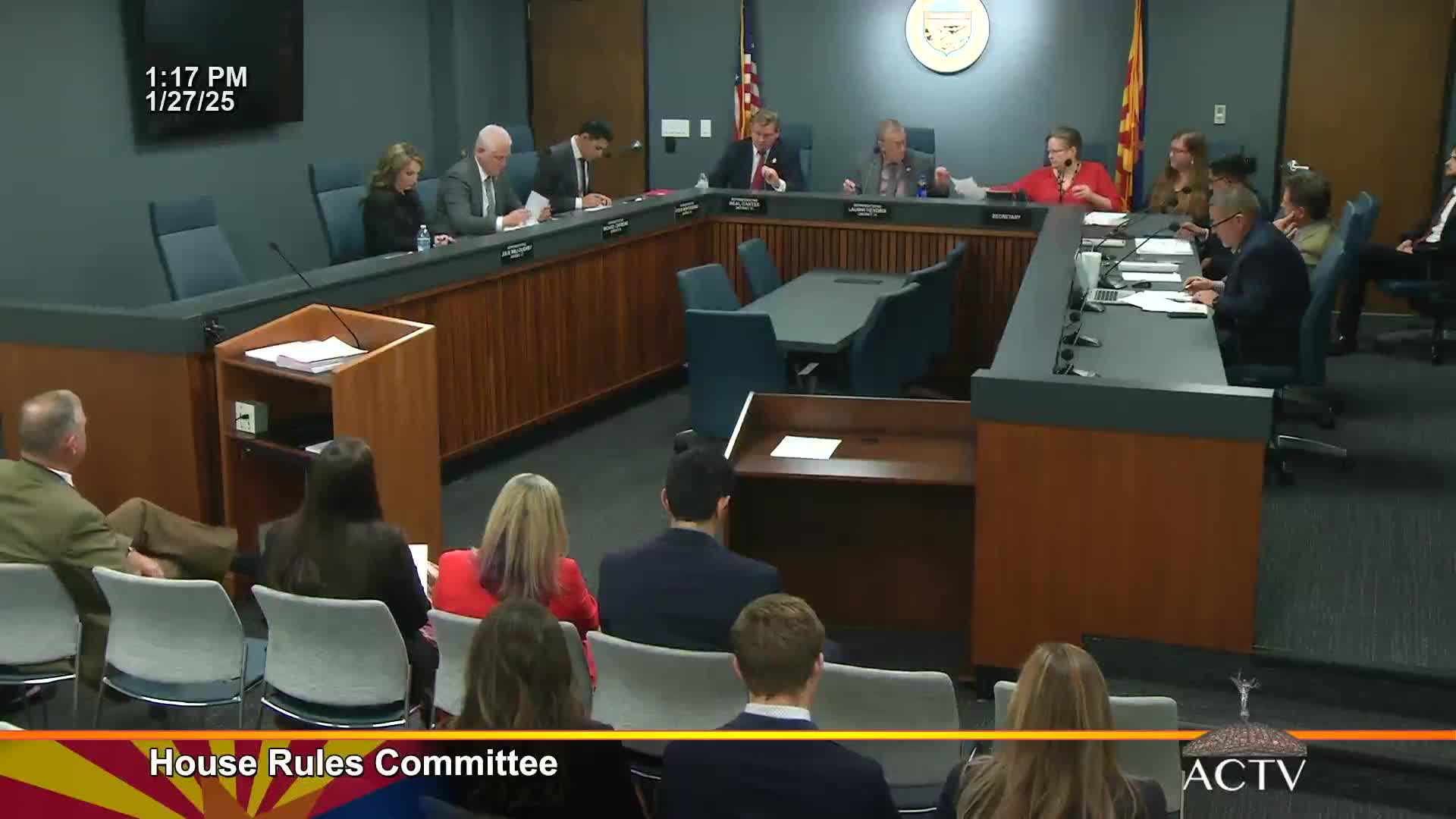
The Rules Committee recommended House Bill 2113 be found constitutional and in proper form by a 5-3 vote after rules counsel said a floor amendment narrowing the bill to government speech would address First Amendment concerns and potential vagueness.
The Arizona House Rules Committee voted 5-3 to recommend House Bill 2113 as "constitutional and in proper form," while rules counsel advised a floor amendment to narrow the measure's restrictions to government officials acting in an official capacity.
Tim Fleming, rules attorney, told the committee the bill as originally presented could be overbroad in light of First Amendment protections for private expression and cautioned about the bill's potential to limit an individual's private speech. "What the First Amendment does protect is an individual's ability to engage in their own, private expression," Fleming said, adding that the government speech doctrine allows government entities to control their own messaging but does not fully eliminate individual-expression protections.
Fleming outlined a proposed floor amendment that would narrow the measure to restrict flag displays only when a person is acting in an official government capacity and would add a construction clause: "nothing in this section shall be construed to prohibit approved educational curricula, or to deny the civil and political liberties of any person as guaranteed by the United States and Arizona constitutions." Fleming said that language would help a court limit vagueness or overbreadth by providing a statutory rule of construction.
Representative Chris Mathis asked whether potential overbreadth remained after the amendment language; Fleming said the risk existed but the proposed changes reduced it. "I guess there's the potential is there, but I that neither neither myself or miss Holder felt that the, the risk was high enough to have serious concern about it," Fleming said, referring to his and co-counsel's view.
The recorded roll call on the motion to recommend HB 2113 as constitutional and in proper form recorded the following: Michael Carbone — aye; Lupa Contreras — no; Oscar de Los Santos — nay; Chris Mathis — nay; Steve Montenegro (speaker) — aye; Julie Willoughby — aye; Vice Chair Carter — aye; Lauren Hendricks (chair) — aye. The committee tally was 5 ayes, 3 nays.
Fleming said the sponsor and staff had worked together on the clarifying amendment and that, with the floor change, the measure would be in proper form. The committee's action was limited to the rules committee determination of form and constitutionality; the transcript does not record whether the proposed floor amendment was subsequently filed or adopted on the House floor.
Ending: The committee advanced HB 2113 to the House with counsel's recommendation that a floor amendment narrow the restriction to official government speech to reduce First Amendment and vagueness risks.