Get Full Government Meeting Transcripts, Videos, & Alerts Forever!
Get email alerts on the Gender Definition And Civil Rights topic
No spam. Unsubscribe anytime.
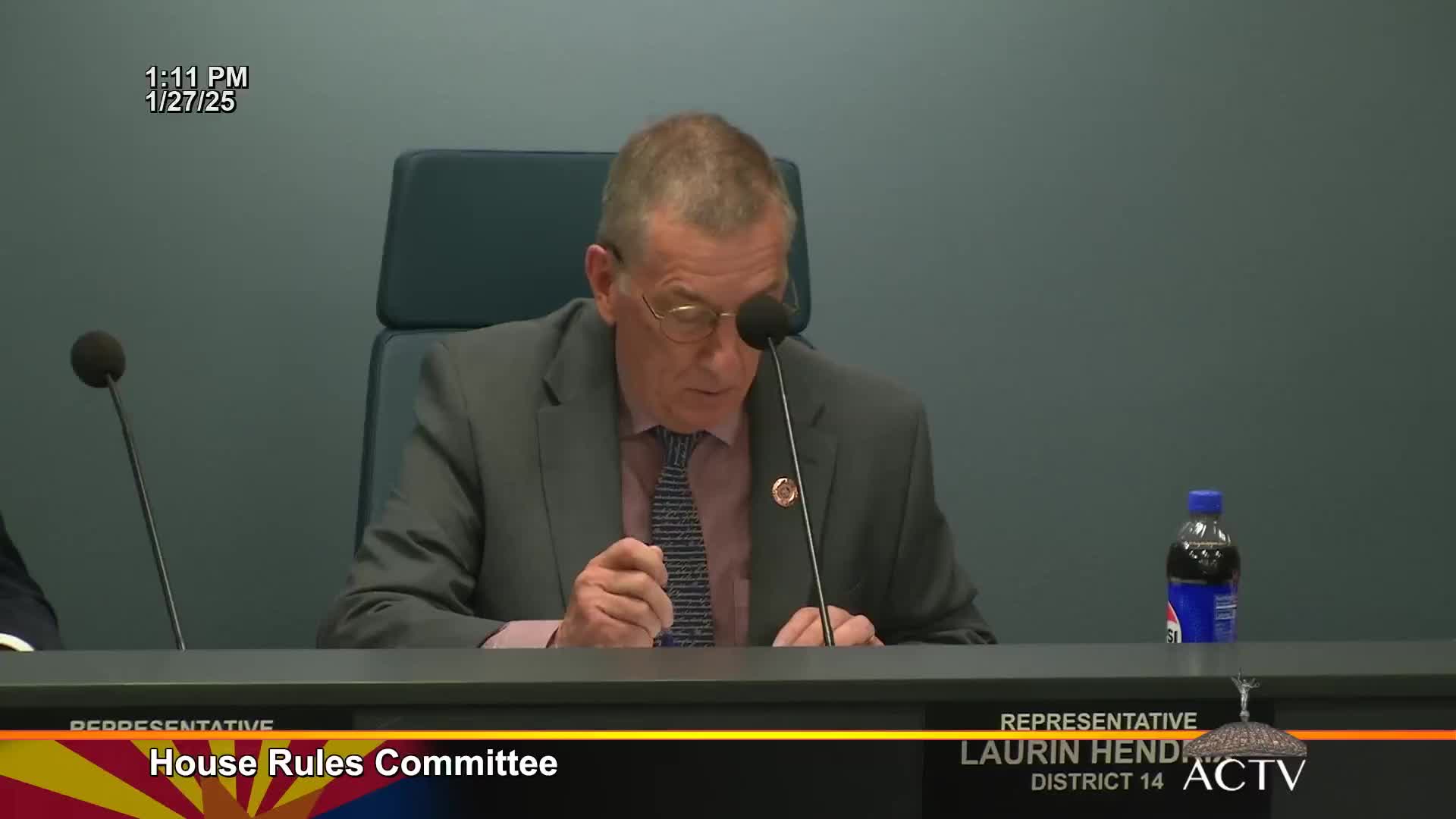
House Rules Committee recommends HB 2062 'in constitutional and proper form' after attorney flags federal conflicts
Summary
The Arizona House Rules Committee voted 5-3 to recommend that House Bill 2062 be found constitutional and in proper form, while a rules attorney warned of possible "as-applied" conflicts with federal law and the Equal Protection Clause.
The Arizona House Rules Committee on an unspecified date voted 5-3 to recommend that House Bill 2062 be given a due-pass recommendation as "constitutional and in proper form." The committee considered attorney guidance that the bill could raise "as-applied" conflicts with federal civil-rights law and the Equal Protection Clause of the U.S. Constitution.
Tim Fleming, a rules attorney for the House, told the committee the bill defines sex in biological terms and would require that laws prohibiting discrimination also prohibit "unfair treatment of a female or male in relation to a member of the opposite [sex]," language he said could produce as-applied legal issues. "There could be, as applied type consequences," Fleming said, citing potential conflicts under federal statutes and equal-protection jurisprudence and noting splits among federal circuit courts.
Fleming told members the committee has seen similar measures in prior sessions and that the bill could permit political subdivisions to establish single-sex facilities by biological sex, which could create conflicts for transgender individuals seeking to use facilities aligned with their gender identity. He cited uncertainty in federal law, saying some circuits have held such laws unconstitutional while others have not.
Representative Chris Mathis asked Fleming to clarify the concerns; Fleming pointed to possible interactions with Title VII or Title IX and the Equal Protection Clause and noted a split in the federal circuits on comparable issues. "We probably should talk more about these kinds of things in about 3 or 4 years, what the full state of the law is as it settles out," Fleming said.
The motion to give HB 2062 a due-pass recommendation was moved at the committee by the member identified in the transcript as Mr. O'Crowder. The roll call recorded the following votes: Michael Carbone — aye; Lupa Contreras — no; Oscar de los Santos — nay; Chris Mathis — nay; Steve Montenegro (speaker) — aye; Julie Willoughby — aye; Vice Chair McCarter — aye; Lauren Hendricks (chair) — aye. The committee tally was 5 ayes, 3 nays.
The committee's recommendation was limited to whether the bill was "constitutional and in proper form"; Fleming and staff repeatedly framed concerns as potential "as-applied" conflicts rather than a determination that the bill is facially unconstitutional.
The committee also noted a minor internal reference correction in the government committee amendment (page 2, line 32 of the amendment) that, according to Fleming, made the bill "in proper form." No committee amendment to change substantive policy was adopted during the rules committee consideration.
Votes at the Rules Committee carry a recommendation to the full House; the transcript does not record further floor action on HB 2062.
Ending: The committee deferred detailed resolution of the federal-law issues to future developments in case law and accepted the technical amendment that corrected an internal reference. The bill moves forward to the House with the committee's recommendation that it is constitutional and in proper form.