Get Full Government Meeting Transcripts, Videos, & Alerts Forever!
Get email alerts on the Human Services Budget Process topic
No spam. Unsubscribe anytime.
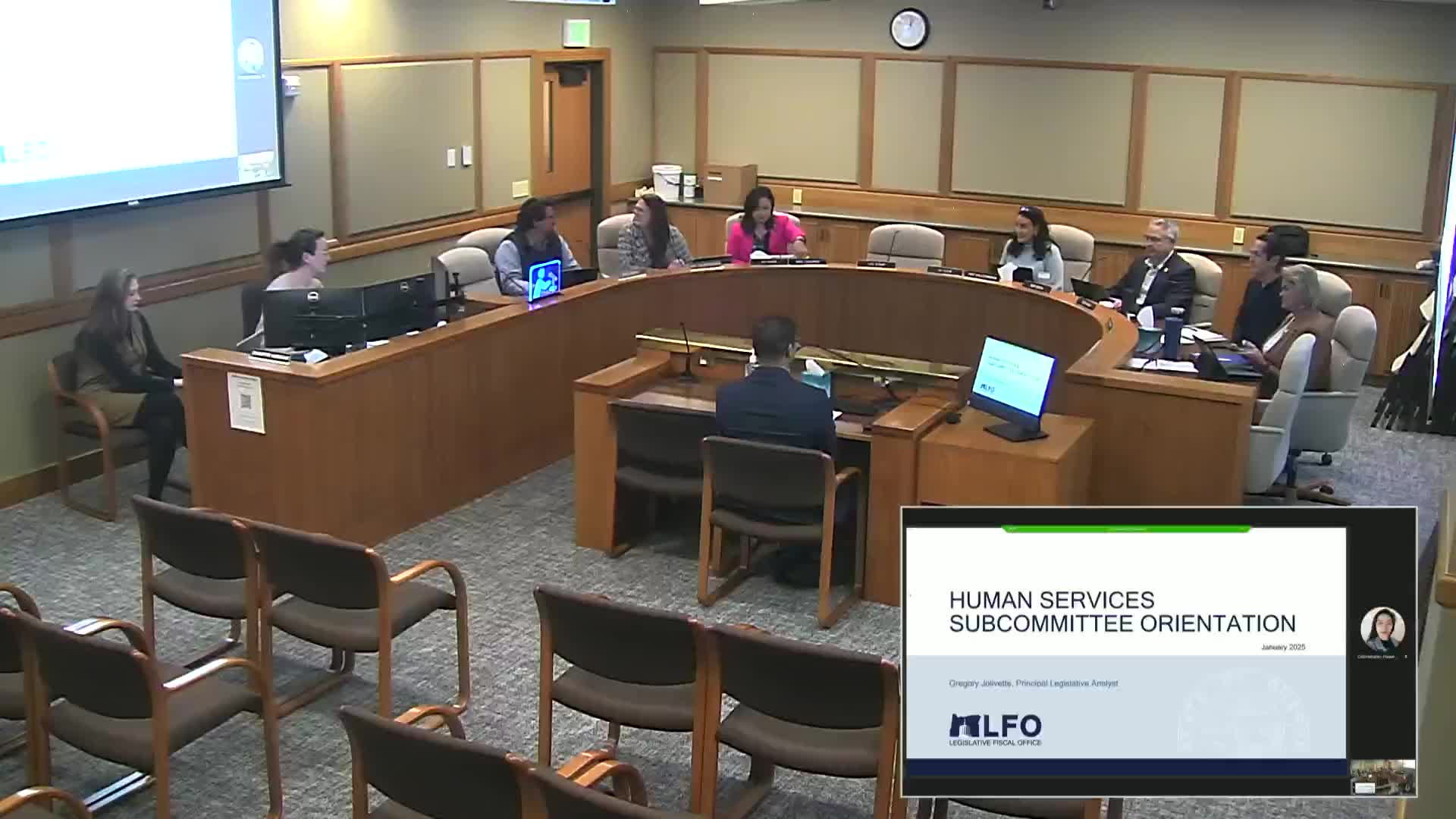
Legislative Fiscal Office briefs Human Services subcommittee on budget process, Medicaid exposure and program priorities
Summary
The Legislative Fiscal Office gave an orientation to the Joint Subcommittee on Human Services covering Oregon’s budget structure, the human services program-area size and drivers, risks tied to Medicaid funding, key performance measures and the process for agency budget reviews; no formal actions or votes were taken.
The Legislative Fiscal Office (LFO) gave an informational orientation to the Joint Subcommittee on Human Services, outlining the state budget process, fund types and issues likely to shape human services spending in the 2025 session.
LFO analyst Gregory Jolivett, who introduced himself as the subcommittee coordinator, led the presentation and described the office as a long-standing, nonpartisan budget staff that prepares fiscal impact statements and budget recommendations for the legislature. "My name is Gregory Jolivett for the record. I am your subcommittee coordinator," Jolivett said. He told members the session materials and the LFO budget review documents are posted on OLIS for members’ review ahead of agency presentations.
The memo and presentation explained the four fund types used in state budgeting — general, lottery, other and federal funds — and the biannual budget cycle. Jolivett stressed that the human services program area is large and driven by caseloads, demographics and federal policy. "Medicaid is a very significant source of funds for our program area. As I mentioned, it's about two-thirds of the budget," he said, underscoring the budget sensitivity to federal changes.
Why it matters: The orientation framed the subcommittee’s role in three phases — informational hearings, targeted follow-up on priority issues, and work sessions where the subcommittee adopts amendments to budget measures for Ways and Means. Members were briefed on how appropriation bills and accompanying budget reports work and were given a list of suggested questions to use in agency hearings to probe purpose, scope, urgency and accountability for requested investments.
Key details from the briefing: - LFO presented statewide numbers for the 2023–25 legislatively approved budget, citing roughly $127,700,000,000 in total funds and noting the human services program area accounts for a substantial share of general-fund spending; Jolivett said the subcommittee "controls 44% of that or nearly $56,000,000,000." (Figures given by the analyst.) - In the human services program area, Jolivett noted special payments account for the largest share of expenditures (roughly the mid‑80 percent range of program spending) because the programs largely pay benefits or contracts with providers. He said personal services (staffing) represents a smaller share. - The governor’s 2025–27 budget proposal figures mentioned in the briefing included a program-area total of about $62.2 billion in total funds, with $13.6 billion in general fund, and roughly 17,000 full‑time equivalent positions supported across the program area. - Jolivett flagged targeted programs likely to be discussed in the session, including stabilization of crisis units, investments for people with intellectual and developmental disabilities, and a relatively new Children's Extraordinary Needs Program. He said about 155 children are currently enrolled in that program while an estimated 1,400 children statewide may be eligible, creating potential pressure to request additional funding. - Members asked process and substance questions: Representative Nelson asked how the budget accounts for lawsuits; Jolivett replied, "The agency budget does include funds for assistance from the Department of Justice," noting agencies sometimes need adjustments depending on litigation levels. Members also asked about debt service, key performance measures (KPMs), and how the subcommittee can follow up after program expansions.
What the subcommittee will do next: LFO staff said detailed budget review documents and LFO recommendations (including KPM trends and recommended targets) are available on OLIS and will accompany agency presentations starting the following day (Oregon Health Authority was noted as posted). The subcommittee will use those materials during informational hearings (phase 1), targeted oversight (phase 2) and work sessions to adopt amendments that reflect LFO recommendations before forwarding measures to the Joint Committee on Ways and Means.
The meeting was informational only; no motions or votes were recorded and the chair closed the session early. The co‑chairs reiterated that members should review the OLIS materials before agency presentations and use the suggested questions to hold agencies accountable for performance and implementation.